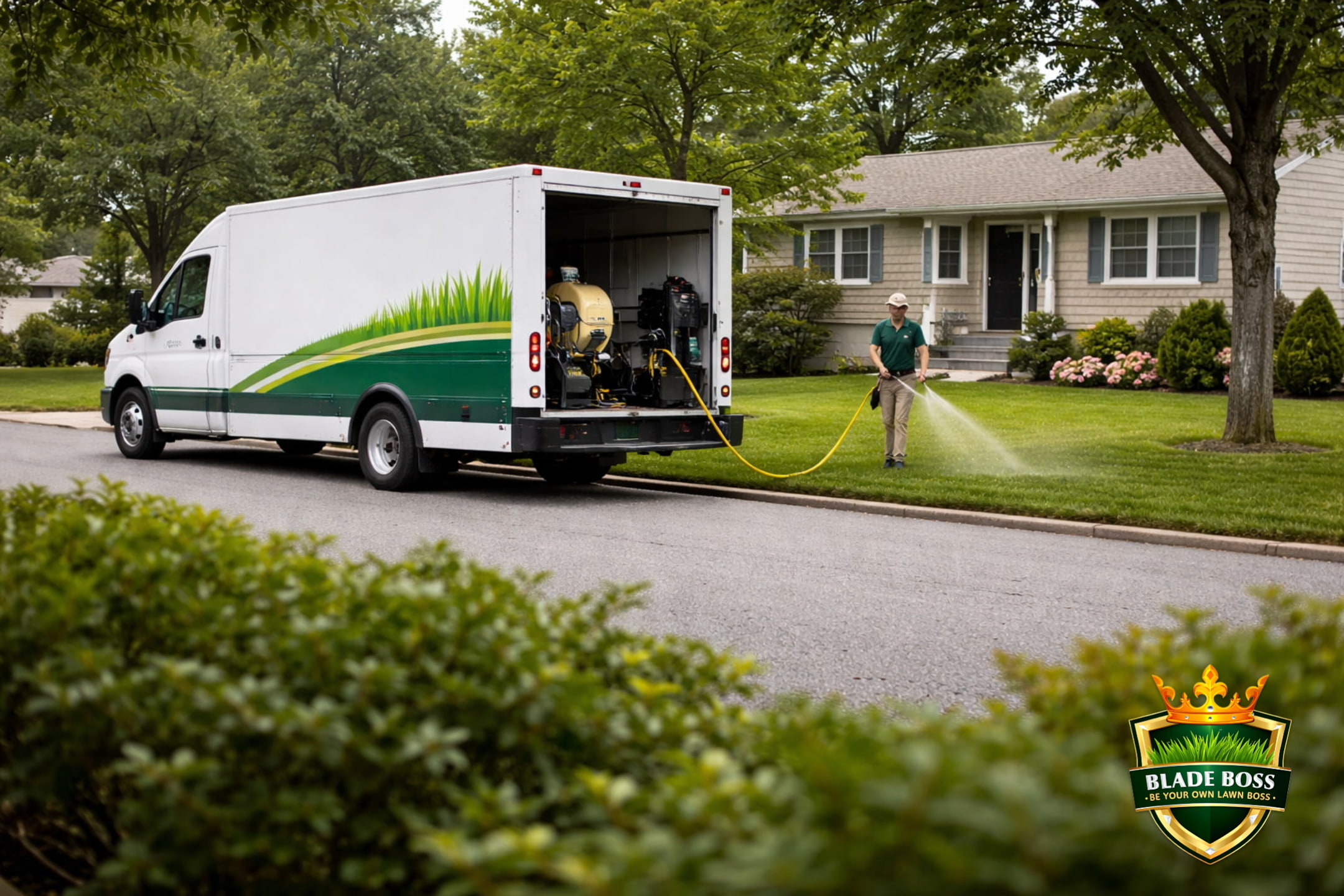
There are roughly 400 lawn care companies operating on Long Island right now, and about 390 of them do the exact same thing: show up six times a year, spray whatever's on the truck, leave an invoice on the door, and move to the next house. They don't test your soil. They don't know your pH. They don't adjust nitrogen rates for sandy soil. They treat your $600,000 Smithtown property the same way they treat every other lawn on the route. And you pay $1,200 to $3,000 a year for the privilege.
- LI service cost: Mowing only: $48 to $115 per cut. Treatment programs (fert + weed + pest): $600 to $1,500/year. Full service (everything): $2,000 to $4,000+/year.
- DIY cost: $300 to $600/year in products for a typical quarter-acre. One-time equipment (spreader, sprayer): $80 to $150.
- The real difference: Services apply the same program to every lawn. Informed DIY starts with a soil test and applies exactly what YOUR lawn needs, at rates calibrated to Long Island's sandy soil.
- When services win: When you genuinely have zero time or interest. No shame in that.
- When DIY wins: When you use data (soil test, zone-specific timing, calculated rates). That's when DIY doesn't just save money. It produces a better lawn.
What Lawn Care Services Actually Do (And Don't Do)
Let's start with what you're paying for. Most lawn care treatment programs on Long Island (TruGreen, Lawn Doctor, local outfits) follow the same basic model: 5 to 8 scheduled visits per year where a technician applies a pre-determined product to your lawn. The visit lasts 10 to 20 minutes. The technician is covering 15 to 25 lawns per day. Our Dynamic Calendar tracks these windows automatically with GDD alerts.
| What Services Typically Include | What Services Typically Don't Include |
|---|---|
| Granular fertilizer (4 to 6 rounds) | Soil test to determine what your lawn actually needs |
| Spring pre-emergent for crabgrass | Custom nitrogen rates based on your soil type |
| Broadleaf weed spray (spring + fall) | pH-specific lime application rates |
| Optional grub preventive | Micronutrient correction (Fe, Mn, Zn, B) |
| Optional aeration (annual) | Sandy soil adjustments (split apps, efficiency multipliers) |
| Invoice on your door | Any explanation of what was applied or why |
The technician doesn't know your soil pH. They don't know your nitrogen level. They don't know if your potassium is critically low or if your calcium-to-magnesium ratio is off. They apply the same 24-0-11 fertilizer to a lawn that needs phosphorus correction as they do to a lawn with excessive phosphorus (which is an environmental violation in New York). They spray the same broadleaf weed killer whether your problem is clover, dandelions, or ground ivy, when each needs a different approach. The program is designed for efficiency, not precision. Our Stripe Master members get the complete 15-step Lawn Playbook that covers exactly this.
Professional lawn care companies serve a legitimate purpose. They keep lawns looking decent for people who have no time or interest in doing it themselves. Some local LI operators are genuinely skilled. The problem isn't that services exist. The problem is that most homeowners think they're getting customized care when they're getting a standard program that ignores the single most important variable: what's actually in their soil.
The Real Cost Breakdown: Services vs. DIY on Long Island
Long Island pricing runs 20 to 40% above the national average for lawn care services. Here's what the numbers actually look like for a typical quarter-acre (roughly 5,000 to 8,000 sq ft of turf) property in Nassau or Suffolk County.
| Service Level | What You Get | Annual Cost (LI) | Per Month |
|---|---|---|---|
| Mowing only (weekly) | Cut, trim, blow. No treatments. | $1,440 to $3,450/yr | $175 to $435 |
| Treatment program (national) | 5 to 7 visits. Fert + weed + pest. | $600 to $1,500/yr | $75 to $190 |
| Treatment program (local LI) | 6 to 8 visits. Usually higher quality. | $800 to $2,000/yr | $100 to $250 |
| Full service (mow + treat) | Everything. Mow, treat, aerate, seed. | $2,500 to $4,500/yr | $310 to $560 |
| DIY (informed, with soil test) | You buy and apply based on data. | $300 to $600/yr | $25 to $50 |
| DIY (uninformed, guessing) | Random products from Home Depot. | $200 to $500/yr | $17 to $42 |
There's a sixth option nobody talks about: the homeowner who spends $400 a year at Home Depot buying whatever's on sale, applies it at the wrong time, at the wrong rate, without a soil test, and ends up with a lawn that looks worse than the neighbor who pays for TruGreen. Uninformed DIY is the worst of both worlds: you spend the money AND the time and get worse results. The difference between bad DIY and good DIY is data.
What $300 in Products Actually Buys You (DIY Budget Breakdown)
Here's what a full year of DIY lawn care actually costs in products for a 6,000 sq ft Long Island lawn with a proper fertilizer schedule. Suffolk County Local Law No. 41-2007 restricts fertilizer application from November 1 through April 1, something many national services ignore.
| Product | When | Qty Needed | Approx Cost |
|---|---|---|---|
| Soil test (MySoil kit) | January to February (plan ahead) | 1 per zone | $30 |
| Pre-emergent (prodiamine) | Early April (at GDD50 = 100) | 1 bag | $25 to $40 |
| Spring fertilizer (0.50 lb N) | April to May | 1 bag | $20 to $35 |
| Split pre-emergent (2nd app) | Late May to early June | 1 bag | $25 to $40 |
| Fall fertilizer R3 (0.75 lb N) | September | 1 bag | $20 to $35 |
| Fall fertilizer R4 (0.75 lb N) | October | 1 bag | $20 to $35 |
| Winterizer R5 (0.50 lb N) | Late October to November | 1 bag | $20 to $35 |
| Lime (if pH test says needed) | Fall or early spring | 1 to 2 bags | $10 to $25 |
| Grass seed (overseeding) | September | 5 to 10 lbs | $25 to $60 |
| Spot weed treatment | As needed | 1 bottle concentrate | $15 to $25 |
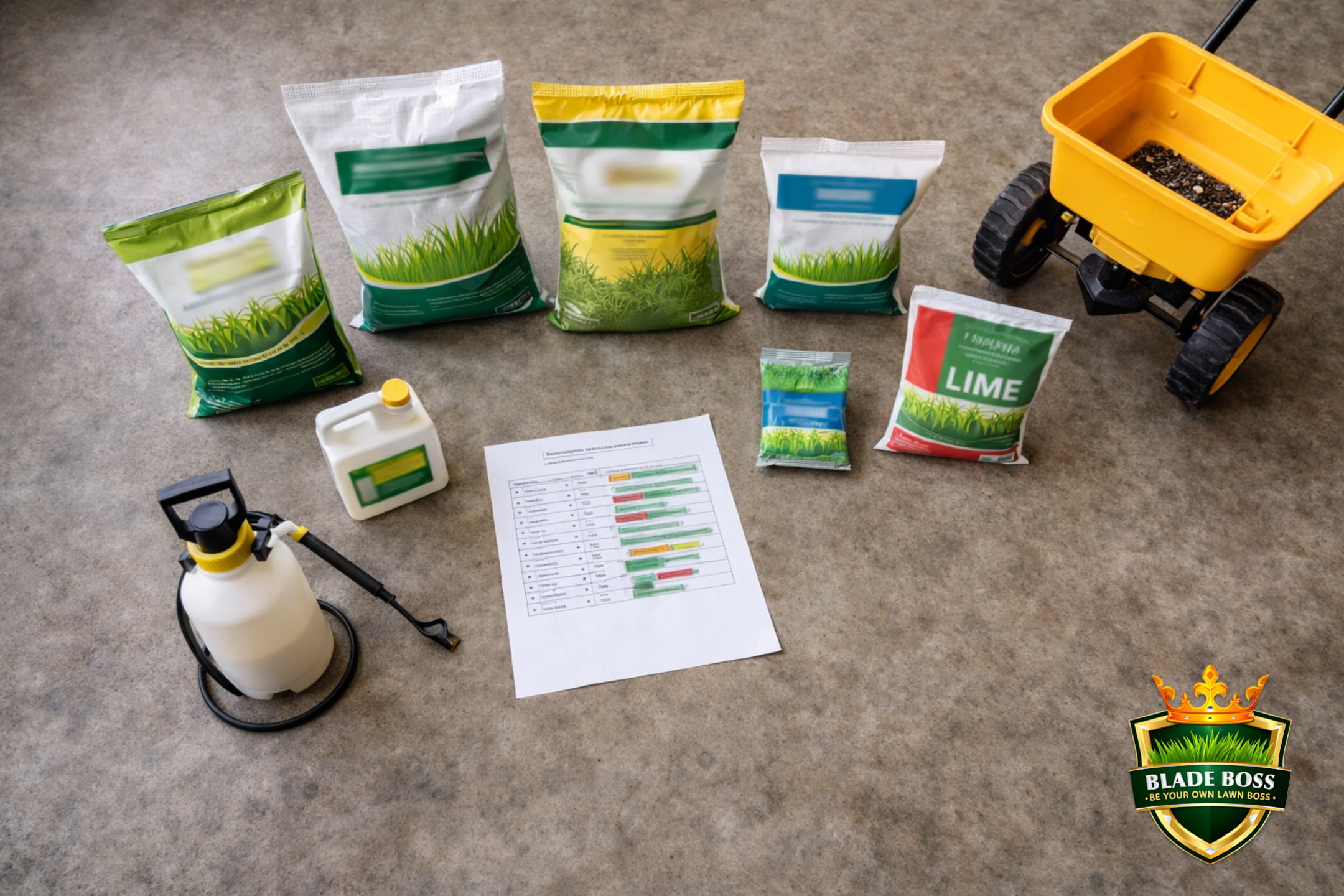
Total: $210 to $370 in products for a 6,000 sq ft lawn. For a full quarter-acre (8,000 to 10,000 sq ft of turf), budget $300 to $600. Add a $35 broadcast spreader from Home Depot (one-time purchase, lasts years) and a $25 pump sprayer for spot treatments. First-year all-in cost: roughly $270 to $430. Year two and beyond: $210 to $370 in products only. Compare that to $600 to $1,500 for a treatment program that doesn't even include a soil test.
MySoil Test Kit
Lab-grade results for pH and 13 nutrients. Mail-in test with results in about 7 days. This is the $30 investment that makes everything else work. Without it, you're guessing.
Check Price on AmazonCalculate Your Exact Product Amounts
Enter your lawn size, grass type, and soil test results. The Fertilizer Calculator gives you exact bag counts and spreader settings. No more guessing at the hardware store.
The 5 Things Services Get Right
Fairness matters. Here's where professional services genuinely earn their fee.
1. Consistency (they show up on schedule)
The biggest advantage of a service is that it happens whether you remember or not. The truck shows up every 6 weeks, the product goes down, and you don't have to think about it. For homeowners with demanding careers, young kids, or travel schedules, this consistency has real value.
2. Commercial-grade equipment
Professional applicators use ride-on spreader-sprayers that cover a lawn in minutes with even distribution. A homeowner with a $35 broadcast spreader can achieve the same results, but it takes longer and requires more care to maintain even coverage.
3. Licensed pesticide application
In New York, applying restricted-use pesticides requires a commercial applicator license. If your lawn has a severe insect or disease problem requiring restricted products, a licensed professional is the right call. Most common lawn products (fertilizer, pre-emergent, broadleaf weed killer) are NOT restricted and can be applied by homeowners.
4. They handle the timing math
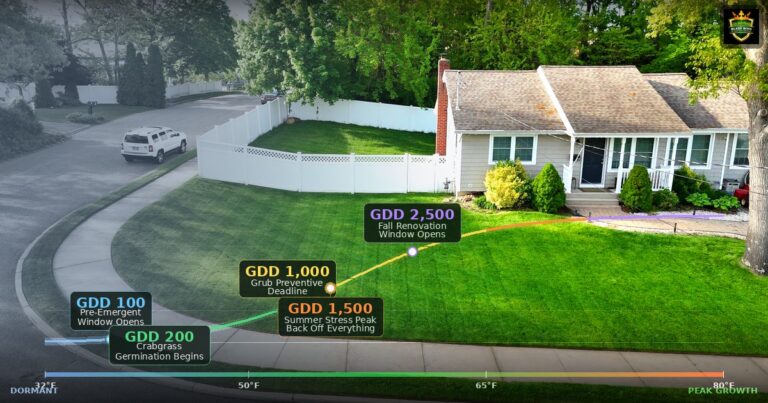
Pre-emergent needs to go down at GDD50 = 100. Fall fertilizer needs to hit before the Suffolk County blackout on November 1 (Nassau starts November 15). Grub preventive needs to be in the soil by mid-July. Services track these windows for you. Of course, so does the Blade Boss Calendar.
5. Liability and guarantees
If a service burns your lawn or misapplies a product, they carry insurance and typically offer re-treatment guarantees. If you burn your own lawn, that's on you. The flip side: services rarely admit fault and their "guarantee" usually means "we'll come spray it again" rather than actual compensation.
The 7 Things Services Get Wrong on Long Island
1. No soil test (the fatal flaw)
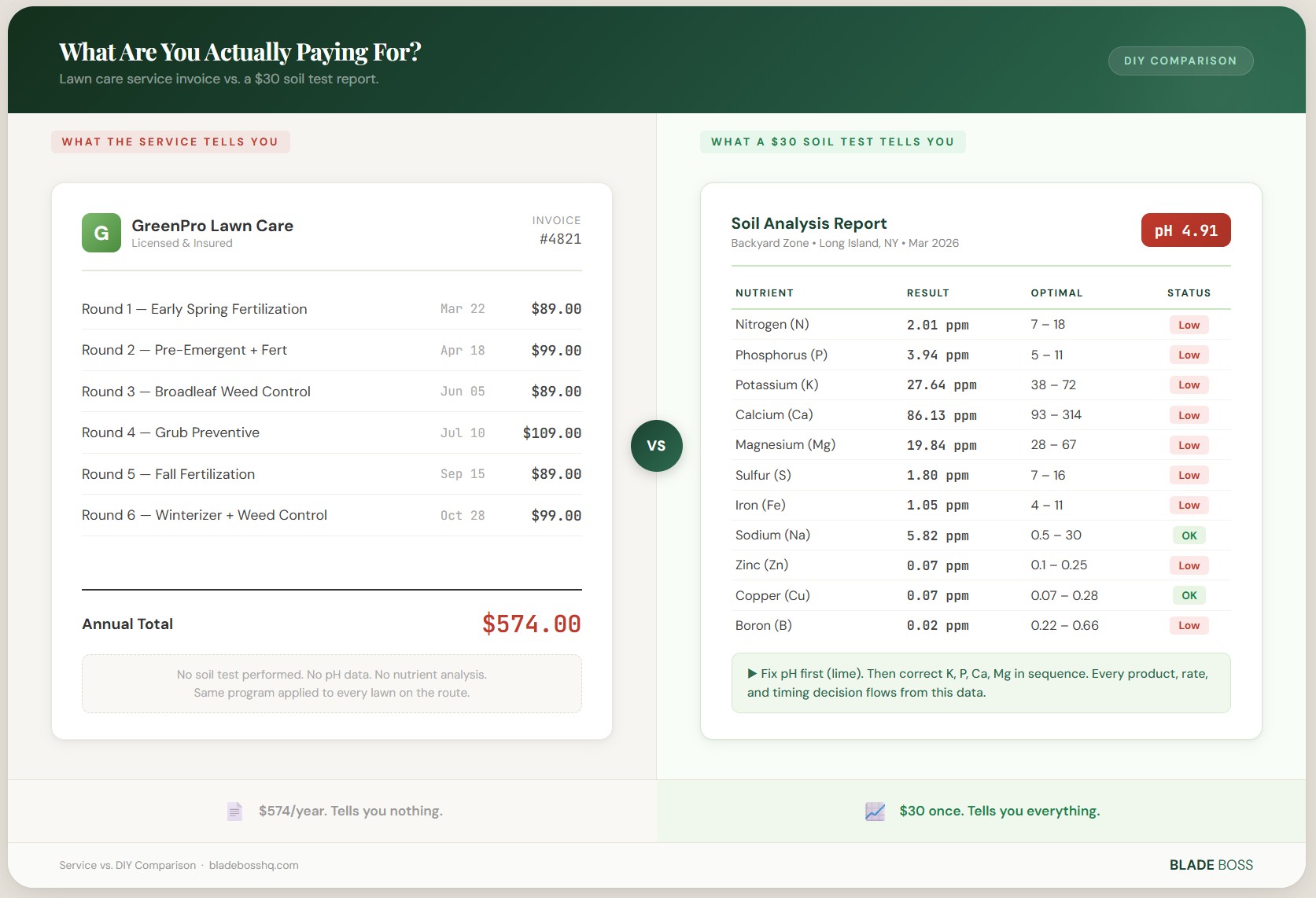
This is the big one. Almost no lawn care service starts with a soil test. They apply the same fertilizer analysis (typically 24-0-11 or similar) to every lawn regardless of what the soil actually needs. A lawn with pH 4.9 and critically low potassium gets the same bag as a lawn with pH 6.8 and optimal nutrients. The service corrects nothing because they never measured anything. Your $30 soil test gives you more actionable data than a $1,500 annual service contract.
2. Generic nitrogen rates (not calibrated to sand)
Long Island's sandy glacial outwash soils have low CEC and leach nitrogen fast. The correct approach is split applications at lower per-app rates with higher frequency. Services apply one heavy dose every 6 weeks because that's what fits their route schedule. On clay soil in Ohio, that works. On Long Island sand, half that nitrogen is in the water table before the grass can use it.
3. No pH correction (ever)
Most LI lawns sit at pH 4.5 to 5.5 natively. Optimal is 6.0 to 7.0. Without lime, every nutrient you apply is partially locked in the soil and unavailable to the grass. Services rarely test pH and almost never include lime application in their standard program. They fertilize a lawn that can't access the fertilizer.
4. One-size-fits-all timing
The technician covers 15 to 25 lawns per day on a set route. Your lawn gets treated when the route reaches your street, not when GDD accumulation or soil temperature says it's time. A week early or late on pre-emergent timing can mean the difference between stopping crabgrass and missing the window entirely.
5. The phosphorus problem
New York State law prohibits applying phosphorus to established lawns unless a soil test shows a deficiency. Many services use fertilizers containing phosphorus anyway because it's cheaper to stock one product. Without a soil test on file, they can't legally justify the application. And with 86% of submitted Long Island soil samples tested sufficient or excessive for phosphorus (Cornell Nutrient Management Spear Program, 2002 to 2006 data from submitted samples, not a randomized survey), most of it is unnecessary and ends up in the aquifer.
6. Zero education (you learn nothing)
After three years and $4,500 in payments, you know exactly as much about your lawn as you did on day one. If you cancel the service, you're starting from zero. The service model is designed for dependency, not empowerment. You never learn what your soil needs, why certain products work, or how to time applications. That knowledge has permanent value.
7. The upsell machine
Most national services use aggressive upselling. The technician "finds" a grub problem that requires an additional $150 treatment. Aeration is recommended every visit ($200 to $300 each time) regardless of whether your lawn actually needs it. Tree and shrub care gets added at $400+ per year. The initial $640 annual plan quietly becomes $1,800 by August.
Join Long Island homeowners who are taking control of their lawn care with data-driven tips, cost comparisons, and seasonal guidance.
The Time Investment (How Many Hours Does DIY Actually Take?)
This is the real objection, and it's fair. Time has value. Here's the honest breakdown for a 6,000 sq ft lawn over a full year.
| Task | Frequency | Time Per Session | Annual Total |
|---|---|---|---|
| Mowing (not included in treatment programs either) | Weekly, Apr to Nov (~30 weeks) | 45 to 90 min | ~22 to 45 hrs |
| Fertilizer application (5 rounds) | 5x per year | 20 to 30 min | 2 hours |
| Pre-emergent application (1 to 2 rounds) | 1 to 2x per year | 20 to 30 min | 0.5 to 1 hour |
| Weed spot-treatment | 3 to 4x per year | 15 to 30 min | 1 to 2 hours |
| Core aeration (rental machine) | 1x per year (fall) | 3 to 4 hours | 3 to 4 hours |
| Dethatching (if needed, not annual) | Every 2 to 3 years | 4 to 6 hours (full day) | 2 to 3 hrs/yr avg |
| Overseeding + prep | 1x per year (fall) | 1 to 2 hours | 1 to 2 hours |
| Soil test collection + review | 1x per year | 30 min | 0.5 hours |
| Sprayer/spreader calibration | 2x per year | 15 to 20 min | 0.5 hours |
| Total DIY treatment time (no mowing) | ~12 to 16 hrs/yr |
The actual hands-on time for a full DIY treatment program (not counting mowing, which you either do yourself or hire out regardless) is about 12 to 16 hours per year. That breaks down to roughly one Saturday morning per month during the growing season, with the fall renovation weekend (aeration + overseeding + dethatching if needed) being the biggest single time block. If your service costs $1,200/year, you're paying roughly $75 to $100 per hour for someone to apply generic products without a soil test.
When You Should Absolutely Hire a Professional
DIY isn't always the answer. Here are the situations where professional service is the right call.
You Genuinely Have No Time
If your schedule makes it impossible to spend 30 minutes once a month on your lawn, a service keeps things from falling apart. No shame in that.
Severe Pest or Disease Problem
Active disease outbreaks (pythium, severe grub damage) sometimes need restricted-use products that require a commercial license.
Full Lawn Renovation
If you're killing the entire lawn and starting over (sod or seed), the grading, topsoil, and establishment phase benefits from professional equipment and experience.
Tree and Shrub Care
Deep root feeding, large tree pruning, and disease diagnosis on mature trees is a different skill set from lawn care. Hire an arborist for that.
The Third Option: Data-Driven DIY
This is what Blade Boss exists for. Not blind DIY where you guess at products and timing. Not expensive services that treat every lawn the same. The third option: you do the work yourself, but with the data, tools, and timing that professionals should be using but aren't.
| Professional Service | Blind DIY | Data-Driven DIY | |
|---|---|---|---|
| Annual cost | $600 to $3,000+ | $200 to $500 | $300 to $600 + tools |
| Soil test included? | Almost never | Rarely | Always (foundation of the plan) |
| Products matched to soil? | No (same program for everyone) | No (whatever's on sale) | Yes (soil test drives every decision) |
| Timing precision | Route schedule (close enough) | Whenever you remember | GDD-tracked, zone-specific |
| Sandy soil adjustments | Rarely | Rarely | Split apps, efficiency multipliers |
| pH correction | Rarely included | Rarely done | Lime/sulfur rates from soil test |
| Knowledge gained | Zero (dependency model) | Some (trial and error) | Complete (you understand your lawn) |
| Results | Decent (above average) | Variable (hit or miss) | Best (precision + understanding) |
See What Data-Driven DIY Looks Like
Lawn Map Pro lets you draw zones on satellite imagery, enter soil test results, and get a complete correction and maintenance plan built for your specific lawn. The patent-pending Soil Correction Engine does what no lawn service on Long Island offers: a plan based on what your soil actually needs.
How to Fire Your Lawn Service (The Right Way)
If you're ready to take over, don't just cancel and wing it. Here's the transition plan.
Get a Soil Test Before You Cancel
Order a MySoil test kit and get your baseline results. You need to know your pH, nitrogen, phosphorus, potassium, and micronutrient levels before you can build a plan. This takes 1 to 2 weeks for results.
Cancel at the Right Time
The best time to transition is after the last fall treatment (November) or before the first spring treatment (March). Don't cancel mid-season and leave your lawn without coverage during peak weed or stress periods.
Build Your Plan from the Soil Test
Enter your results into the Blade Boss Soil Test Command Center. The correction engine builds a sequenced amendment plan. Then build your fertilizer schedule around the correction plan.
Stock Up on Products in Winter
Buy your season's products in January or February when prices are lowest and everything is in stock. By April, popular products sell out. The Fertilizer Calculator tells you exact quantities.
Follow the Calendar
The Blade Boss Calendar gives you month-by-month timing for every task, calibrated to Zone 7B soil temps and GDD. Set phone reminders for each action window.
What About Just Hiring for Mowing and DIYing the Rest?
This is actually the sweet spot for a lot of Long Island homeowners. Mowing is the time-consuming part (22+ hours per year). Treatments are the knowledge-intensive part (6 hours per year). You can hire a local mowing crew for weekly cuts and handle all the treatment decisions yourself based on your soil test and schedule.
A mowing-only service on LI runs $48 to $115 per cut for a typical lot, or roughly $1,440 to $3,450 per season. Add your $300 to $600 in DIY treatment products and you're at $1,700 to $3,000 for a premium lawn: professionally mowed, precisely treated, and you actually understand what's going into the soil. That's often less than a full-service package and produces better results because the treatment half is data-driven.
Hiring a crew for mowing is the smart hybrid move, but go in with eyes open:
Disease transmission. Their mower decks go from lawn to lawn without sanitizing. If your neighbor has brown patch or dollar spot, the crew can carry infected clippings to your yard on the same blades.
Mowing in peak heat. Crews mow midday in summer because it fits their route schedule. Cutting grass at 1 PM in 90°F heat stresses turf significantly more than an early morning or evening cut.
Wet grass cuts. Morning crews often mow dew-wet lawns to maximize houses per day. Wet mowing tears blades instead of cutting clean, leaving ragged edges that invite disease.
Dull blades. Commercial crews run all day. Blades should be sharpened every 8 to 10 hours of use. Most crews sharpen weekly at best, meaning your lawn is getting torn by dull steel.
Scalping and ruts. Speed is profit. Crews take turns fast, drop deck height to cut less often, and create tire ruts in soft soil. Set a mowing height requirement in writing when you hire.
The Knowledge Compounds (Why DIY Gets Better Every Year)
Whether you're fixing winter damage in March or fighting crabgrass in April, knowing WHY you're doing each step makes you faster and more effective every season.
Here's something no service will ever tell you: lawn care knowledge compounds. Year one, you're learning. You make some mistakes. Your pre-emergent timing might be a week late. You might over-apply lime because you didn't understand the soil test math. But by year two, you know your soil. By year three, you're running the program on autopilot. By year four, your lawn is the one neighbors ask about.
A service never gets better because it never adapts. The same generic program in year one is the same generic program in year five. Your lawn doesn't improve because the inputs don't change. With DIY, every annual soil test shows you what's working and what needs adjustment. Your pH moves from 4.9 to 5.8 to 6.3. Your potassium climbs from critically low to optimal. The lawn gets measurably better every season because the plan evolves with the data.
Track Your Progress Over Time
The Soil Test Command Center stores every test you take and shows trends over time. Watch your pH climb, your nutrients optimize, and your lawn improve season over season. That's something no service receipt will ever show you.
The Bottom Line
Lawn care services exist because most homeowners don't know what their soil needs. That's a knowledge gap, not a skill gap. Spreading fertilizer isn't hard. Spraying weeds isn't hard. Knowing which fertilizer, at what rate, at what time, based on what your soil test says? That's the part most people are missing. And it's exactly the part that services skip too.
A $30 soil test and a free Blade Boss account gives you more insight into your lawn than a $1,500 annual service contract. Pair that with the right grass (see our TTTF vs KBG comparison) (full species guide) for your conditions, proper mowing height, fall aeration, thatch management, smart irrigation, and a targeted weed control approach. The Zone 7B master guide ties the complete system together, and you're not just saving money. You're building a lawn that gets better every year because you understand it. For zone-specific guidance, Cornell Cooperative Extension Suffolk County is an excellent local resource. Cool-season turfgrass research from Rutgers NJAES applies directly to Long Island growing conditions.
Your neighbor's service truck will keep showing up every six weeks. And their lawn will keep looking exactly the same.
Chris C. is a Combat Search and Rescue pilot turned airline pilot and the founder of Blade Boss. After years of paying for lawn services that couldn't explain what they were applying or why, he built the platform he wished existed: data-driven tools that turn any homeowner into a more effective lawn manager than the service they're replacing.
See what Blade Boss members get and see what data-driven DIY lawn care looks like. Preview our tools, explore Lawn Map Pro, and find out what your lawn actually needs.
See Plans →Frequently Asked Questions
How much do lawn care services cost on Long Island?
Lawn care service costs on Long Island depend on the level of service. Mowing only runs $48 to $115 per cut for a typical quarter-acre lot. Lawn treatment programs (fertilization, weed control, pest control) from companies like TruGreen or Lawn Doctor cost $600 to $1,500 per year. Full-service lawn care (mowing plus treatments plus aeration plus overseeding) runs $2,000 to $4,000+ per year. Long Island pricing is approximately 20 to 40% above the national average due to high cost of living and demand.
Is TruGreen worth it on Long Island?
TruGreen provides convenience and a basic fertilization and weed control program, but their approach has limitations on Long Island. Their treatment programs are standardized nationally and do not account for Long Island's unique sandy glacial outwash soils, sole-source aquifer, or the specific county fertilizer regulations in Suffolk and Nassau. A TruGreen basic plan (fertilization + weed control) runs $640 to $1,000 per year for a typical LI lawn. Mid-tier plans adding aeration and grub control reach $1,100 to $1,500. For the same cost in products (approximately $200 to $400 per year), a homeowner with a soil test and a zone-specific plan can apply the right products at the right rates, which a national service doing hundreds of lawns per week rarely achieves.
How much does DIY lawn care cost per year on Long Island?
DIY lawn care on Long Island costs approximately $300 to $600 per year for a typical quarter-acre lot. This includes fertilizer (5 rounds at $15 to $40 per bag), pre-emergent herbicide ($30 to $60), lime or soil amendments ($20 to $50), grass seed for overseeding ($30 to $80), and a soil test ($30). One-time equipment costs (broadcast spreader, pump sprayer) add $80 to $150 but last for years. The total annual DIY cost is roughly 25 to 50% of what a professional treatment program charges.
What do lawn care services actually apply to your lawn?
Most lawn care treatment programs on Long Island include 5 to 8 visits per year consisting of granular fertilizer applications, pre-emergent herbicide in spring, post-emergent broadleaf weed control spray in spring and fall, and optional grub preventive in summer. Higher-tier plans add core aeration, overseeding, and lime application. What most services do NOT include: soil testing, custom nutrient correction based on actual soil deficiencies, pH-specific lime rates, micronutrient supplementation, or any adjustment for sandy vs clay soil. They apply the same program to every lawn on the route.
Should I hire a lawn care service or do it myself?
If you have zero interest in learning about your lawn and just want it to look acceptable with minimal effort, a professional service is the right choice. If you want the best possible results and are willing to invest a few hours per month, informed DIY with a soil test and a zone-specific plan will produce a better lawn for less money. The key word is informed. DIY without knowledge (buying random products at Home Depot without a soil test or a plan) often produces worse results than a professional service. Data-driven DIY with proper soil testing, zone-specific timing, and calculated application rates consistently outperforms professional services that treat every lawn the same.
Keep Reading
 DIY How-To
Long Island Lawn Irrigation Guide: How Much Water Does Your Lawn Actually Need?
Long Island gets 46 inches of rain a year. Your lawn still needs supplemental water. Learn exactly how...
Mar 19, 2026
19 min
 DIY How-To
GDD Explained: The Secret to Perfect Lawn Timing
Growing degree days (GDD) predict exactly when to apply pre-emergent, fertilize, and treat for pests on your lawn....
Feb 25, 2026
14 min
 DIY How-To
Lawn Dethatching Guide for the Northeast: Timing, Tools, and Why Fall Beats Spring
Most dethatching advice gets the timing wrong. Fall is the ideal window for Northeast lawns, not spring. Learn...
Mar 17, 2026
16 min
What is your lawn actually sitting on?
Pull the soil survey, hardiness zone and current growing conditions for your exact address. Eight government sources, about a minute.
No comments yet. Be the first to share your thoughts.
Create a free account to join the conversation.