USDA Zone 7B Lawn Care Guide: Everything Long Island Homeowners Need to Know
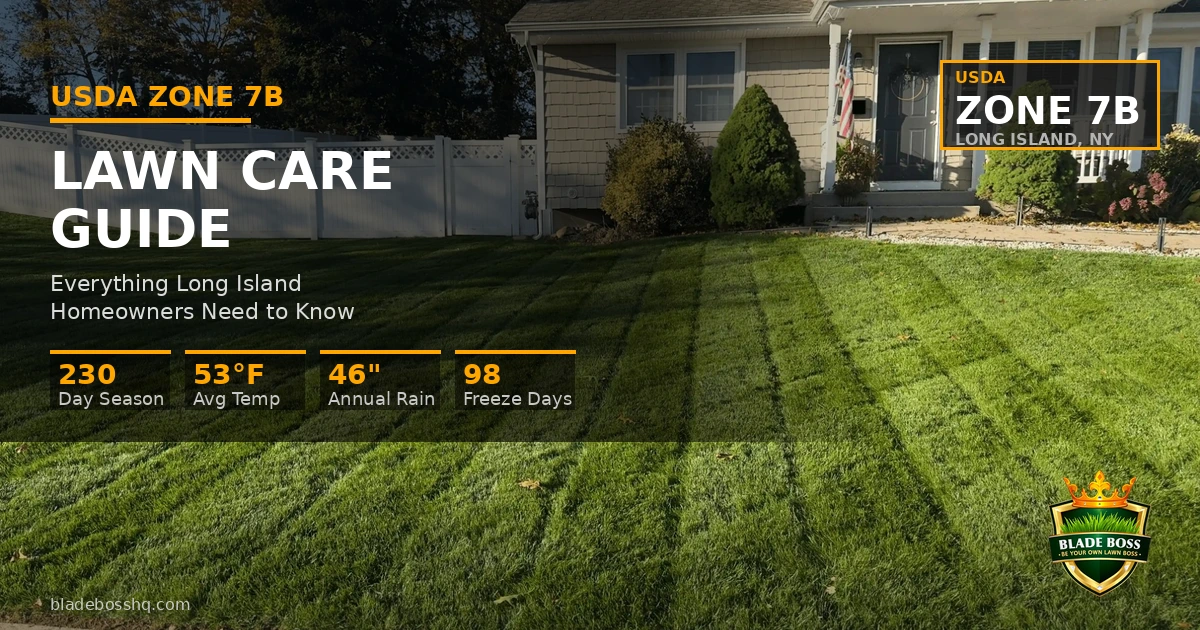
If you Google "Zone 7B lawn care," you'll get advice written for Virginia, North Carolina, and the Pacific Northwest. You'll read about Bermuda grass, transition zone strategies, and warm-season overseeding. None of it applies to Long Island. Zone 7B on Long Island is a completely different animal: sandy soil that drains like a colander, strict county fertilizer regulations, coastal humidity that breeds disease, and 98 days below freezing that kill any warm-season grass before it establishes. This guide is built specifically for that reality.
- Zone 7B (average extreme minimum 5 to 10°F) means cool-season grass only. Warm-season species will not survive Long Island winters.
- Growing season: approximately 230 days, mid-March through mid-November.
- Sandy loam soils with naturally strongly acidic pH (4.5 to 5.5 native, typically 5.9 to 6.2 in maintained lawns) demand lighter, more frequent fertilizer applications.
- Suffolk County prohibits turf fertilizer from November 1 through April 1.
- Six highest-impact tasks: pre-emergent at GDD50 of 100 (around April 6), first fertilizer after April 1, mow at 3.5 to 4 inches all season, core aerate in September, overseed by October 15, and winterizer before the November 1 blackout.
What Zone 7B Actually Means for Your Lawn
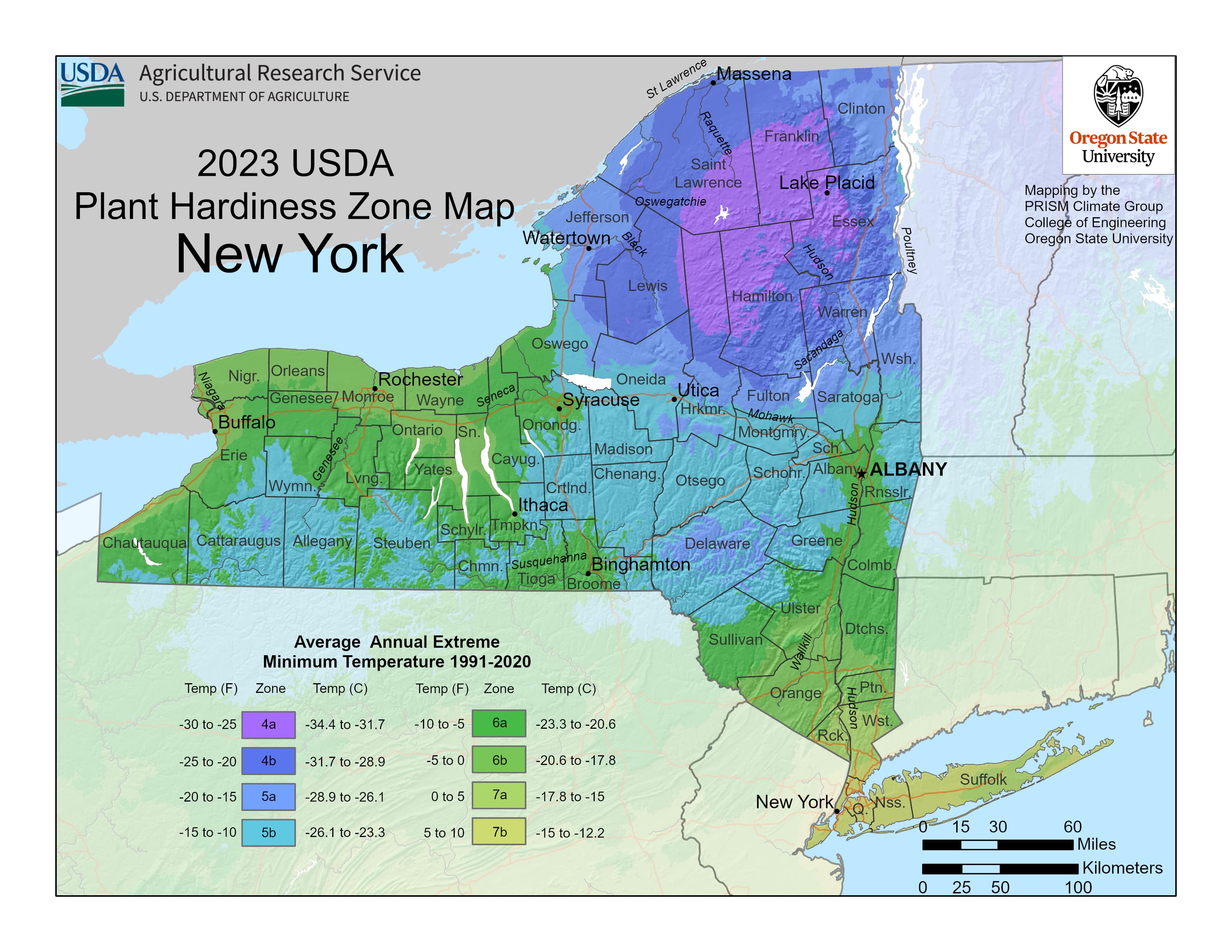
Most lawn care articles explain USDA zones as nothing more than a minimum temperature range. Zone 7B means your average annual extreme minimum is 5 to 10 degrees Fahrenheit. That's true, but it's barely 10% of what matters for lawn care. The zone classification tells you which grass species can survive winter here. Everything else, the timing, the rates, the strategies, comes from the actual climate data underneath. Our Dynamic Calendar tracks these windows automatically with GDD alerts.
Long Island's position in Zone 7B is shaped by three forces. The Atlantic Ocean and Long Island Sound moderate temperatures in both directions: winters are milder than inland 7B locations (we average zero days below 0 degrees Fahrenheit), and summers are cooler than southern 7B areas like Virginia. The glacial outwash geology gives us sandy soils that drain exceptionally fast. And our latitude (40.8 degrees N) delivers a photoperiod that perfectly supports cool-season grass biology. Put it together and you get a zone that's ideal for cool-season turf if you understand the specific constraints.
The Long Island Climate Profile
Generic zone guides give you one number: the minimum temperature. Here's what 30 years of NOAA climate data from the Islip weather station actually shows for Long Island. Our Stripe Master members get the complete 15-step Lawn Playbook that covers exactly this.
| Metric | Value | Why It Matters |
|---|---|---|
| Annual mean temp | 53.1°F | Ideal range for cool-season grass (optimum 60 to 75°F air temp) |
| Avg summer high | 80.5°F | Triggers summer stress in cool-season turf above 85°F |
| Avg winter low | 26.6°F | Cold enough to kill warm-season grass; cool-season survives easily |
| Days above 85°F | 23 | Your summer stress window. Raise mowing height for these days. |
| Days above 90°F | 8 | Peak heat stress days. No fertilizer, minimal traffic. |
| Days below 32°F | 98 | Dormancy period. 3+ months of frozen or near-frozen soil. |
| Last frost (50%) | April 9 | Spring lawn care can begin after this, but watch for late surprises |
| First frost (50%) | November 4 | Fall renovation must finish well before this date |
| Frost-free days | 209 | Your active lawn management window |
| Annual precipitation | 46.0 inches | Evenly distributed, but July and August often run dry |
| Annual snowfall | 31.8 inches | Moderate. Snow insulates dormant turf from desiccation. |
Cool-season grass on Long Island has two peak growth periods: spring (April 15 through May 31) and fall (September 1 through October 10). Between them is a roughly 2-month summer stress window (late June through late August) where growth slows dramatically or stops entirely. Your entire lawn care strategy should revolve around maximizing those two growth windows and simply surviving summer. For the complete month-by-month breakdown, see our Long Island Lawn Care Calendar.
Answer 2 quick questions and see where you stand.
Long Island Soil: Why Zone 7B Here is Different
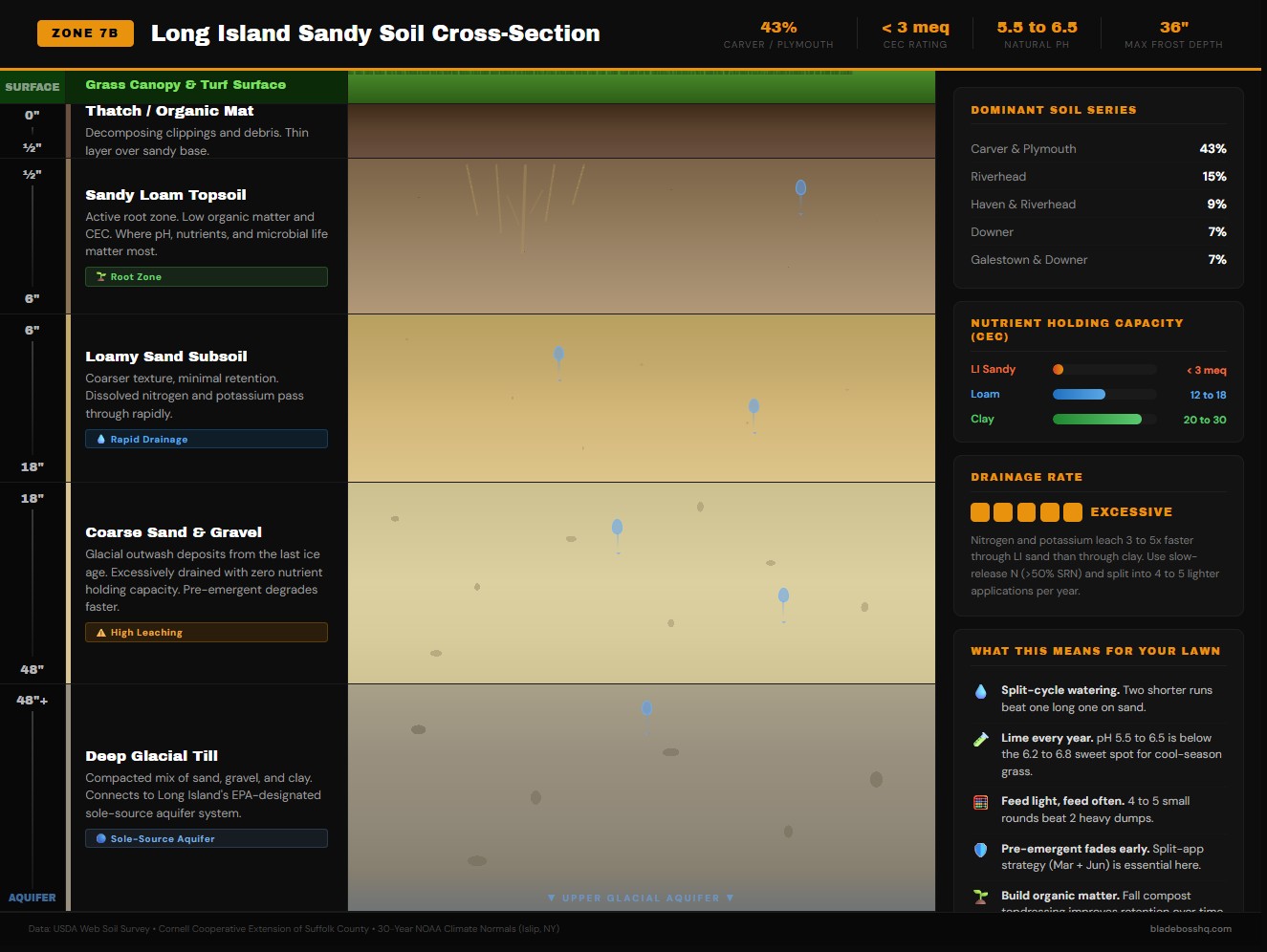
This is where most generic Zone 7B guides completely fall apart. Zone 7B in Virginia has clay-heavy Piedmont soils. Zone 7B in the Pacific Northwest has volcanic loam. Zone 7B on Long Island has glacial outwash: sandy loam to coarse sand deposited by retreating glaciers 20,000 years ago. This one difference changes nearly every recommendation.
| Soil Series | Coverage | Texture | Drainage |
|---|---|---|---|
| Carver and Plymouth | 43% | Coarse sand / loamy sand over gravel | Excessively drained |
| Riverhead | 15% | Sandy loam surface, loamy sand below | Well drained |
| Haven and Riverhead | 9% | Sandy loam with some silt | Well drained |
| Downer | 7% | Sandy loam to loamy sand | Well drained |
| Galestown and Downer | 7% | Sandy loam to sand | Well drained |
Notice a pattern? Every major soil series on Long Island is sandy and well-drained to excessively drained. This has massive implications for lawn care.
Nutrients Leach Fast
Sandy soil has low cation exchange capacity (CEC ranging from under 3 for deep sands to 12 for loams). Nitrogen and potassium wash through quickly. You need lighter, more frequent fertilizer apps instead of heavy dumps.
Naturally Acidic
Long Island soils test between pH 5.5 and 6.5, below the 6.2 to 6.8 sweet spot for cool-season grass. Most lawns need periodic liming.
Water Moves Through Fast
Sandy soil holds less water. Summer irrigation needs split-cycle watering: run each zone twice for shorter durations to improve absorption before it drains below the root zone.
Low Organic Matter
Sandy soils naturally have low organic matter content, which means less microbial activity and lower natural fertility. Topdressing with compost in fall builds this up over time.
For the full breakdown on soil pH management, including how to test, read results, and apply the right amendment at the right rate, see our Long Island Soil pH Guide.
Best Grass Types for Zone 7B on Long Island
Let's kill one myth immediately: Zone 7B does NOT mean you can grow warm-season grass on Long Island. Some national guides suggest Bermuda or Zoysia for Zone 7B. Those recommendations are written for southern Zone 7B locations like coastal Virginia and the Carolinas where winters are shorter and soils are different. On Long Island, with 98 days below freezing and average winter lows of 26.6°F, warm-season grasses either die outright or go dormant for 5+ months. You're in cool-season territory. Full stop.
| Species | LI Rating | Best For | Key Trade-Off |
|---|---|---|---|
| Tall Fescue | ★★★★★ | All-around performer, drought tolerant, low-to-moderate maintenance | Bunch-type growth, no self-repair |
| Kentucky Bluegrass | ★★★★★ (with irrigation) | Best appearance, self-repairs via rhizomes | High water demand, summer dormancy without irrigation |
| Perennial Ryegrass | ★★★★ | Quick germination (3 to 7 days), excellent in blends | Poor drought tolerance, no self-repair |
| Fine Fescue | ★★★★ | Shade areas, low maintenance, lowest nitrogen need | Poor traffic tolerance, thin blade texture |
Most Long Island lawns aren't uniform sun or shade, so a single species rarely covers everything. The most versatile approach is a Tall Fescue dominant blend (60 to 70%) with Kentucky Bluegrass (20 to 30%) and Perennial Ryegrass (10%). Shaded zones get a Fine Fescue blend instead. This gives you drought tolerance, self-repair, quick fill, and shade coverage across the whole property.
For detailed species profiles including seeding rates, mowing heights, nitrogen requirements, germination timelines, disease vulnerabilities, and NTEP trial data, read our Best Cool-Season Grass Types for Long Island guide.
The Zone 7B Seasonal Framework
Your lawn year on Long Island breaks into four distinct phases. Understanding these phases is more important than memorizing individual tasks because every decision you make should fit within the phase you're in.
Winter Planning (Dormancy)
Soil is 35 to 40°F. Grass is fully dormant. No mowing, no fertilizer, no traffic on frozen turf. This is your planning window: review soil test results, order products, service equipment, calibrate spreaders. February is the "itchy trigger finger" month. Resist the urge.
Spring Activation
Soil warms from 40 to 65°F. Green-up starts around March 15. Pre-emergent goes down when GDD50 hits 100 (around April 6). First fertilizer after Suffolk blackout lifts (April 1). First mow when grass reaches 3.5 inches (typically late April, GDD50 around 200). Peak spring growth runs April 15 through May 31, mow twice a week during this surge.
Summer Survival
Soil climbs above 70°F. Growth slows dramatically, then nearly stops by mid-July. Raise mowing height to 4+ inches. Standard schedule: no nitrogen. Advanced users with established, irrigated lawns can spoon-feed 0.25 lbs N every 3 to 4 weeks with organic products (see fertilizer schedule). Water deeply 1 to 1.5 inches per week if maintaining green, or let the lawn go dormant and water 0.5 inches every 3 weeks to keep crowns alive. Scout for grubs in August.
Fall Power Season
This is the most important period on the entire lawn care calendar. Core aerate September 1 through October 15. Overseed by October 15. Fall fertilizer in September and October. Broadleaf weed control mid-October. Winterizer before November 1 Suffolk blackout. Last mow at 2.5 to 3 inches before growth stops around November 10.
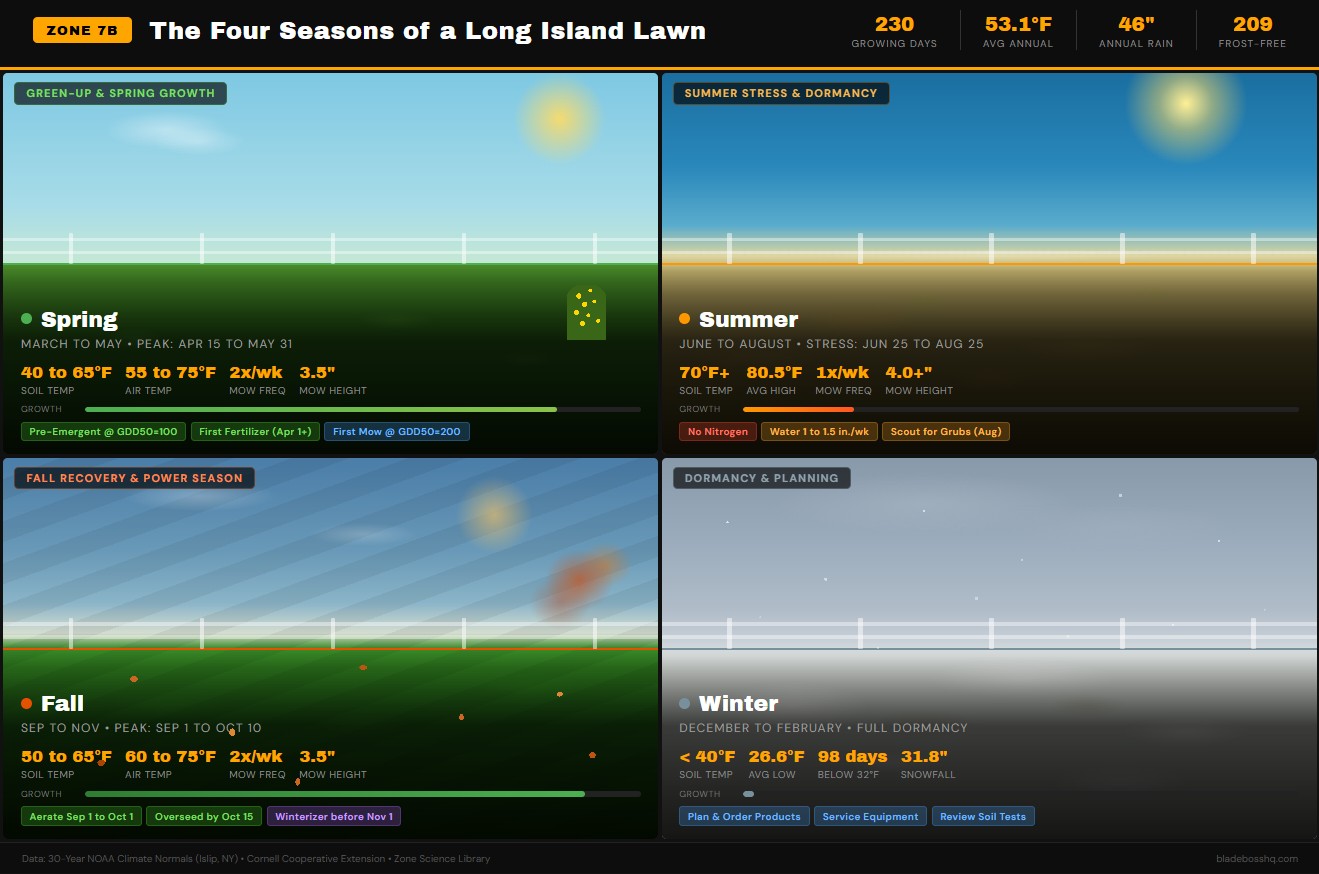
For every task, every month, every date you need, see the complete Long Island Lawn Care Calendar. For the science behind GDD-based timing, read GDD Explained: The Secret to Perfect Lawn Timing.
Track Your Zone in Real Time
The Blade Boss Weather Hub inside Lawn Map Pro™ monitors soil temperature and GDD accumulation for your ZIP code. Stop guessing when spring starts. Let the data tell you.
The Six Pillars of Zone 7B Lawn Care
Every great lawn on Long Island stands on the same six foundations. Get these right and the rest is maintenance. Get any one wrong and it undermines everything else.
Pillar 1: Soil pH Management
Your soil pH controls whether your grass can actually absorb the nutrients you feed it. Below 6.0, nitrogen availability drops. Below 5.5, phosphorus locks out almost entirely. Most Long Island soils have a native pH of 4.5 to 5.5 (strongly acidic per the Suffolk County BMP report), though most maintained residential lawns test between 5.9 and 6.2 from years of liming. Both are below the ideal 6.2 to 6.8 range for cool-season turf. This means most lawns here benefit from periodic lime applications.
Test your soil every 2 to 3 years through Cornell Cooperative Extension of Suffolk County ($5 per sample). Apply calcitic lime in fall (October or November) based on your test results and your soil's buffer capacity. Sandy soils respond faster to amendments but also lose them faster, so lighter annual applications beat heavy corrections. Full details in our Long Island Soil pH Guide.
Pillar 2: Fertilization
On Long Island, fertilizer timing is governed by both turf biology and county law. Suffolk County Local Law 41-2007 prohibits turf fertilizer application from November 1 through April 1. Nassau County restricts it from November 15 through April 1. New York State's law runs December 1 through April 1. You follow whichever is strictest for your location.
No Suffolk County or Nassau County law specifies a per-application nitrogen rate limit or an annual nitrogen total for homeowners. The enforceable rules are the blackout dates, the phosphorus ban, and the buffer zone. The Suffolk County Healthy Lawns Program focuses on education and reducing overall fertilizer use. The NEIWPCC voluntary guidelines recommend no more than 0.7 lbs N per application and 2.0 lbs N per year for areas over sole-source aquifers like Long Island, but these are best practice recommendations, not enforceable law. Cornell Cooperative Extension recommends 2 to 3 lbs of nitrogen per year for most Long Island lawns, with applications of 0.5 to 1.0 lb N per 1,000 square feet. Use slow-release nitrogen sources (at least 60% slow-release on sandy soils) to reduce leaching through Long Island's glacial outwash soils. Long Island's glacial outwash sand (Carver, Plymouth, Riverhead series) is the single biggest factor that separates our lawns from generic Zone 7B advice. Our complete sandy soil guide breaks down exactly how to adjust.
New York State law prohibits phosphorus in turf fertilizer unless a soil test shows a deficiency. Always use 0-0-X or X-0-X fertilizer formulas on established lawns unless your soil test specifically calls for phosphorus. Starter fertilizer with phosphorus is only permitted for new seedings.
For exact rates, a 5-round fertilizer schedule with spreader settings, and the math behind nitrogen calculations, see How Much Fertilizer Does Your Lawn Actually Need?. For the science-based 4-round approach with the 2/3 + 1/3 split application technique for Long Island's annual nitrogen requirements by grass type, see our Best Fertilizer Schedule for Long Island.
Pillar 3: Mowing
Mowing is the most frequent thing you do to your lawn and the most commonly done wrong. The one-third rule is non-negotiable: never remove more than one-third of the grass blade in a single cut. On Long Island, that means maintaining 3.5 to 4 inches during spring and fall growth periods, and raising to 4+ inches during summer stress. Taller grass shades the soil, reduces water evaporation, and naturally suppresses weed germination.
Your first mow of spring should happen when grass reaches 3.5 to 4 inches and GDD50 hits approximately 200, typically late April on Long Island. Your last mow drops the height to 2.5 to 3 inches to prevent snow mold matting over winter, usually late October to early November. For the full timing guide with zone-by-zone schedules, read When to Start Mowing in Spring: Northeast Timing Guide.
Get Your Exact Mowing Schedule
MowMaster Pro™ calculates your mowing frequency, height adjustments, and seasonal transitions based on your grass type and Zone 7B growth stages. No more guessing when to raise or lower the deck.
Pillar 4: Pre-Emergent Timing
Pre-emergent herbicide is your primary defense against crabgrass, goosegrass, and annual weeds. The trigger is not a calendar date. It's growing degree days: apply your spring barrier when GDD50 reaches 100, which on Long Island averages around April 6 but can vary 2 to 3 weeks in either direction depending on the year.
One application is not enough on sandy soil. Our soil leaches herbicide faster than clay or loam, shortening the effective barrier window. A split application strategy (first app at GDD50 of 100, second app 6 to 8 weeks later) provides season-long protection. If you've had Poa annua issues, you also need a fall pre-emergent in late August plus a late-winter bridge app in February or March.
For the complete timing calendar, split-app strategy, and product comparisons, read When to Apply Pre-Emergent on Long Island.
Pillar 5: Weed Control
Pre-emergent handles seeds before they sprout. But weeds that break through, or established perennials like clover, dandelion, and plantain, need post-emergent treatment. The best windows for broadleaf control on Long Island are mid-October (weeds are actively moving sugars to roots, carrying herbicide with them) and late April through May (active spring growth).
Crabgrass that escapes your pre-emergent barrier needs a targeted post-emergent like quinclorac (Drive XLR8) applied before the crabgrass reaches the 4-tiller stage. After that, it becomes extremely difficult to kill. For the complete crabgrass battle plan including identification, GDD-based prevention, post-emergent rescue, and a 3-year eradication strategy, see Crabgrass Prevention on Long Island: The Complete Battle Plan.
Pillar 6: Irrigation for Sandy Soil
Long Island gets 46 inches of precipitation annually, which sounds like plenty. The problem is distribution: July and August, when your lawn needs water most, often run dry. Our sandy soils compound this because they hold less moisture per inch of depth than clay or loam.
The rule of thumb is 1 to 1.5 inches per week including rainfall during the active growing season. But on sandy soil, how you apply that water matters as much as the total amount. Deep, infrequent watering (0.5 to 0.75 inches per session, two to three times per week) beats daily light sprinkling. Split-cycle irrigation, running each zone for two shorter sessions 30 minutes apart, allows sandy soil to absorb water before it drains below the root zone.
Suffolk County restricts lawn watering between 10 AM and 4 PM daily. Odd-numbered addresses water on odd calendar days. Even-numbered addresses water on even days. Early morning (4 to 8 AM) is ideal anyway because it reduces evaporation and disease pressure.
If you choose to let your lawn go dormant during summer heat, provide 0.5 inches of water every 3 weeks to keep the crowns alive. The grass will turn brown but will recover when temperatures cool in September.
Zone 7B Disease Threats on Long Island
Long Island's coastal humidity creates a disease pressure profile that inland Zone 7B locations don't face. Our summer combination of 80°F days, 65+ degree nights, and heavy dew creates ideal conditions for fungal pathogens. Here are the diseases that matter most for Long Island lawns.
| Disease | Active Window | Trigger Conditions | Affected Grasses |
|---|---|---|---|
| Brown Patch | June to September | Night temps above 65°F plus humidity, soil temps 80 to 90°F | Tall Fescue (primary), all cool-season |
| Dollar Spot | May to October | Air temps 70 to 80°F, nitrogen-deficient turf | Kentucky Bluegrass, Fine Fescue |
| Red Thread | March to October | Air temps 60 to 75°F, low nitrogen, wet conditions | Perennial Ryegrass, Fine Fescue |
| Summer Patch | June to October (symptoms) | Infection at soil temps 55 to 65°F in spring | Kentucky Bluegrass (primary) |
| Leaf Spot / Melting Out | March to June | Air temps 50 to 65°F, wet spring conditions | All cool-season grasses |
| Gray Leaf Spot | July to August | Air temps 82 to 90°F, humid, warm nights | Perennial Ryegrass (primary) |
| Rust | August to October | Air temps 64 to 71°F, slow-growing stressed turf | Kentucky Bluegrass, Perennial Ryegrass |
Most lawn diseases on Long Island can be prevented without chemicals. Proper nitrogen fertility prevents dollar spot and red thread. Mowing at the correct height improves air circulation. Watering in early morning (not evening) reduces leaf wetness duration. Avoiding excess nitrogen in summer prevents brown patch. Get the basics right and you'll rarely need a fungicide.
Zone 7B Pest and Grub Management
The number one grub species on Long Island is the Oriental beetle, not the Japanese beetle that most national guides focus on. European chafer grubs are also present. Adult beetles lay eggs in July, larvae feed on grass roots from August through October and again from April through May, and the damage shows as brown patches that pull up like carpet.
Preventive grub treatment goes down in late June or early July before eggs hatch. On Long Island, the recommended product is imidacloprid (BioAdvanced Season-Long or Merit 0.5G) since chlorantraniliprole (GrubEx) is NYSDEC-restricted in Nassau and Suffolk Counties. Water in with 0.5 inches immediately after application. Curative treatment with trichlorfon (Dylox) works on active grubs in August through September but only reaches larvae near the surface. By October, grubs move deeper and become harder to reach.
Join Long Island homeowners who get data-driven lawn care tips every week. Seasonal reminders, timing alerts, and the stuff your lawn service won't tell you.
Long Island is in the epicenter of Lyme disease. Deer ticks are active from April through October. This doesn't change your lawn care strategy, but it changes your safety protocol. Wear treated clothing when working in your yard, check yourself after every session, and keep your lawn mowed to reduce tick habitat at the edges.
Calculate Exact Product Rates for Your Lawn
NitroCalc Pro™ calculates your nitrogen rate per application based on your grass type, zone size, and product analysis. SeedGenius Pro™ handles seed math for overseeding and renovation. No more guessing from bag labels.
Long Island Regulations You Need to Know
Long Island sits on a sole-source aquifer that supplies drinking water to over 3 million people. Because of this, Suffolk and Nassau counties have some of the strictest lawn care fertilizer regulations in the country. These blackout dates and the phosphorus ban are enforceable law. Violate them and you face fines.
| Rule | Suffolk County | Nassau County | New York State |
|---|---|---|---|
| Fertilizer blackout (LAW) | Nov 1 to Apr 1 ($1,000 fine) | Nov 15 to Apr 1 | Dec 1 to Apr 1 |
| Phosphorus ban (LAW) | Banned unless soil test shows need | Banned unless soil test shows need | Banned unless soil test shows need |
| Buffer zone (LAW) | 20 ft from water bodies | 20 ft from water bodies | 20 ft from water bodies |
| N per application (NEIWPCC voluntary guideline) | 0.7 lbs/1,000 sq ft | 0.7 lbs/1,000 sq ft | Not specified |
| Annual N (NEIWPCC voluntary guideline) | 2.0 lbs/1,000 sq ft | 2.0 lbs/1,000 sq ft | Not specified |
| Water-soluble N per app (NEIWPCC voluntary guideline) | 0.5 lbs/1,000 sq ft | 0.5 lbs/1,000 sq ft | Not specified |
| Cornell CCE recommendation | 2 to 3 lbs N/year | 2 to 3 lbs N/year | Varies by grass type |
| Governing law | Local Law 41-2007 | Local Law 11-2009 | NYS Nutrient Runoff Law (ECL 17-2103) |
Standalone pre-emergent herbicides like prodiamine and dithiopyr contain zero nitrogen, phosphorus, or potassium. They are classified as pesticides, not fertilizer. The Suffolk and Nassau county blackout periods do not apply to them. You CAN apply pre-emergent during the blackout months. Just make sure you're not using a weed-and-feed combo product, because those contain fertilizer and ARE restricted.
The 10 Most Common Zone 7B Mistakes on Long Island
1. Following warm-season advice for a cool-season zone
Zone 7B covers Virginia, the Carolinas, the Pacific Northwest, and Long Island. The advice for each is completely different. If a guide mentions Bermuda grass, warm-season overseeding, or mowing below 2 inches, it was not written for you.
2. Applying fertilizer during the county blackout
Suffolk County: no turf fertilizer November 1 through April 1. Nassau County: November 15 through April 1. This is law, not a suggestion. Mark these dates on your calendar and respect them.
3. Fertilizing in July and August heat
Nitrogen during summer stress forces top growth when roots can't support it. It's like redlining an engine with no oil. The plant burns through carbohydrate reserves and becomes more vulnerable to disease and drought damage.
4. Using calendar dates instead of soil temperature and GDD
"Apply pre-emergent in March" is wrong in cold years and dangerously early in warm years. Use GDD50 reaching 100 as your trigger instead. Soil temperature at 4-inch depth approaching 50°F is your secondary confirmation. Our GDD guide explains exactly how this works.
5. Mowing too short in summer
Scalping your lawn to 2 inches in July is an invitation for crabgrass, heat stress, and shallow roots. Maintain 4+ inches during summer. The extra blade height shades soil, reduces evaporation, and outcompetes weed seeds.
6. Overseeding too late in fall
New grass seedlings need 6 to 8 weeks of growing conditions before the first hard freeze (around November 4 on Long Island). That means overseeding must be complete by October 15 at the latest. September 1 to 15 is ideal.
7. Ignoring soil pH
You can buy the best seed, the best fertilizer, and the best weed control on the market. If your soil pH is below 6.0, your grass can't absorb most of those nutrients. Test first, amend second, then build your program.
8. Skipping the fall power season
Fall is when your lawn builds its foundation for next year. September aeration plus overseeding is the single highest-ROI task on the entire calendar. Homeowners who skip fall renovation and try to fix everything in spring are always playing catch-up.
9. Watering daily with light sprinkles
On sandy soil, light daily watering creates a shallow root zone and wastes water to evaporation. Water deeply (0.5 to 0.75 inches per session) two to three times per week instead. Use rain gauges or tuna cans to measure actual output.
10. Treating the entire lawn the same
Your front yard in full sun needs different grass, different mowing height, and different water than the shaded side yard. Zone your lawn by sun exposure and soil conditions, then treat each zone according to its needs.
The Zone 7B Quick-Reference Data Sheet
Bookmark this. Screenshot it. Print it and tape it inside your garage door. These are the numbers that drive every decision for your Long Island lawn.
| Category | Key Data Point | Source |
|---|---|---|
| Pre-emergent trigger | GDD50 = 100 (avg April 6, plus or minus 2 to 3 weeks) | NOAA / Cornell |
| Crabgrass germination | Soil temp 55°F at 2 to 4 inch depth for 3+ days | Rutgers / Penn State |
| First mow trigger | GDD50 = 200, grass height 3.5 to 4 inches | NOAA / Extension |
| Spring fertilizer | After April 1 (Suffolk), soil temp above 55°F | Suffolk Local Law 41-2007 |
| Summer mowing height | 4+ inches minimum | Cornell / Rutgers |
| Aeration window | September 1 to October 1 | Cornell CCE |
| Overseeding deadline | October 15 (latest), September 1 to 15 ideal | Cornell CCE |
| Fall fertilizer | September to October, 0.75 lbs N per 1,000 sq ft per app (50%+ slow-release) | Extension best practices |
| Winterizer | Late October to early November, before Nov 1 Suffolk blackout | Suffolk Local Law 41-2007 |
| Last mow | October 25 to November 10, drop to 2.5 to 3 inches | Extension best practices |
| Soil pH target | 6.2 to 6.8 | Cornell Soil Lab |
| Annual N budget | 2 to 3 lbs N per 1,000 sq ft (Cornell CCE); NEIWPCC voluntary guideline recommends 2.0 max | Cornell CCE / NEIWPCC voluntary guideline |
| Growing season | Mid-March to mid-November (approximately 230 days) | NOAA 30-year normals |
| Peak growth windows | April 15 to May 31 and September 1 to October 10 | Zone Science data |
| Summer stress window | June 25 to August 25 | NOAA soil temp records |
Your Zone 7B Action Plan
If you're starting from scratch or resetting your lawn care approach, here's the sequence that gets results.
Test Your Soil
Send a sample to Cornell Cooperative Extension. Know your pH and nutrient levels before you buy a single product. This costs $5 and saves you hundreds in misapplied amendments.
Fix Your pH First
If your pH is below 6.0, apply calcitic lime in fall based on your test results. Wait 2 to 3 months and retest. Nutrients you apply to acidic soil are wasted because your grass can't absorb them. Details in our Soil pH Guide.
Choose the Right Grass
Match species to your conditions. Full sun with irrigation: Kentucky Bluegrass dominant blend. Full sun without irrigation: Tall Fescue dominant. Shade: Fine Fescue. Mixed conditions: Tall Fescue/KBG blend. Details in our Grass Types Guide.
Build Your Seasonal Schedule
Don't rely on bag labels or generic advice. Follow a zone-specific lawn care calendar that's timed to Long Island's actual soil temperatures, frost dates, and growing degree days.
Get Your Timing Instruments
Buy a soil thermometer ($10) and learn how to track growing degree days. These two things replace guesswork with data. Pre-emergent, fertilizer, mowing, overseeding: every major decision has a GDD or soil temp trigger.
Commit to the Fall Power Season
September is the most impactful month on the Long Island lawn care calendar. Aerate, overseed, and fertilize in September. Treat broadleaf weeds in October. This one month delivers more results than the rest of the year combined.
Go Deeper: The Complete Blade Boss Guide Library
This guide gives you the framework. The articles below give you the execution details for each pillar of Zone 7B lawn care on Long Island.
Month-by-Month Calendar
Every task, every date, timed to Zone 7B soil temps and GDD. Read the Calendar
Grass Types Guide
Species profiles, seeding rates, and head-to-head performance comparisons. Choose Your Grass
GDD Explained
The science behind precision timing for every lawn care task. Learn GDD
Soil pH Guide
Test, read results, and fix your lawn's foundation. Fix Your pH
Fertilizer Calculator
Exact rates, spreader settings, and a 5-round schedule. Calculate Your Rate
Pre-Emergent Timing
GDD-based windows, split-app strategy, and fall barrier planning. Time Your Apps
Crabgrass Battle Plan
ID, prevention, post-emergent rescue, and 3-year eradication. Fight Crabgrass
Spring Mowing Guide
First mow timing, seasonal heights, and the one-third rule. Mow Right
This guide is your home base. Explore the details with our aeration timing guide, the grub control guide for pest management, and the spring recovery playbook. The TTTF vs KBG comparison helps with grass selection, and our clover control guide handles the most common broadleaf invader on Long Island. Cool-season turfgrass research from Rutgers NJAES applies directly to Long Island growing conditions. Penn State Extension offers additional cool-season grass management resources for the Northeast.
The complete month-by-month calendar for Zone 7B. Every task, every timing window, every product on one printable page.
Blade Boss was built by a Long Island homeowner for Long Island homeowners. Every tool, every calculation, and every recommendation is calibrated for Zone 7B sandy soil and Northeast growing conditions. See our membership plans or start exploring for free.
See Plans →Chris C. is a Combat Search and Rescue pilot turned airline pilot and the founder of Blade Boss. He built the Zone Science data library from 30-year NOAA climate normals, Cornell Cooperative Extension research, and three years of hands-on soil monitoring on his own Long Island lawn. Every number in this guide comes from real data, not marketing copy. Read the full story. Wondering whether to tackle it yourself? Read our honest comparison of DIY vs professional lawn care services on Long Island.
Frequently Asked Questions
What does USDA Zone 7B mean for lawn care on Long Island?
USDA Zone 7B means Long Island's average annual extreme minimum temperature is 5 to 10 degrees Fahrenheit, which determines that cool-season grass species (Tall Fescue, Kentucky Bluegrass, Perennial Ryegrass, Fine Fescue) are the only viable options for year-round lawns. Warm-season grasses like Bermuda cannot survive Long Island winters. The zone classification combined with Long Island's sandy glacial soils, 230-day growing season, 98 days below 32 degrees Fahrenheit, and strict Suffolk County fertilizer regulations (no turf fertilizer November 1 through April 1) creates a unique lawn care environment that generic Zone 7B guides written for Virginia or the Pacific Northwest do not address.
What type of grass grows best in Zone 7B on Long Island?
Long Island sits firmly in cool-season grass territory. The top performers for Zone 7B are Tall Fescue (best all-around for drought tolerance and low maintenance), Kentucky Bluegrass (best appearance but requires irrigation), Perennial Ryegrass (fastest germination, ideal in blends), and Fine Fescue (best shade tolerance). Most Long Island lawns perform best with a Tall Fescue and Kentucky Bluegrass blend that balances drought tolerance with self-repair capability.
When should I fertilize my lawn in Zone 7B on Long Island?
On Long Island, fertilizer timing is governed by both biology and law. Suffolk County prohibits turf fertilizer from November 1 through April 1. Nassau County prohibits it from November 15 through April 1. New York State prohibits it from December 1 through April 1. Your first application should go down in mid to late April after the blackout lifts and soil temperature reaches 55 degrees Fahrenheit. The most important application is the fall fertilizer in September and October when grass is actively building root reserves.
How often should I water my lawn on Long Island in Zone 7B?
Long Island's sandy soils drain fast, so watering strategy matters more here than in clay soil regions. Established lawns need 1 to 1.5 inches of water per week including rainfall during the growing season. Water deeply and infrequently, applying 0.5 to 0.75 inches per session twice a week rather than light daily watering. Sandy soils benefit from split-cycle irrigation, running each zone twice for shorter durations to reduce runoff and improve absorption. Suffolk County Water Authority restricts watering between 10 AM and 4 PM daily.
What are the biggest lawn care challenges in Zone 7B on Long Island?
Long Island's Zone 7B presents five unique challenges not covered in generic lawn guides. First, sandy soils (Carver, Plymouth, and Riverhead series) drain fast and leach nutrients quickly, requiring more frequent but lighter fertilizer applications. Second, naturally acidic soil (pH 5.5 to 6.5) needs periodic liming. Third, strict fertilizer regulations in Suffolk and Nassau counties limit timing and rates. Fourth, summer heat stress pushes cool-season grass into semi-dormancy for roughly 2 months (late June through August). Fifth, the coastal influence extends the growing season but also increases humidity-driven disease pressure from brown patch and dollar spot.
Is Zone 7B considered a transition zone for grass?
Zone 7B sits at the warm edge of the cool-season grass territory. Some national guides incorrectly classify it as a transition zone where warm-season grasses like Bermuda are viable. On Long Island, this is wrong. The coastal Northeast climate with cold winters (average 98 days below 32 degrees Fahrenheit) and reliable snowfall makes warm-season grasses like Bermuda and Zoysia poor choices. Long Island is cool-season grass territory. Tall Fescue, Kentucky Bluegrass, Perennial Ryegrass, and Fine Fescue are the only viable species for year-round lawns here.
Keep Reading
 Lawn Science
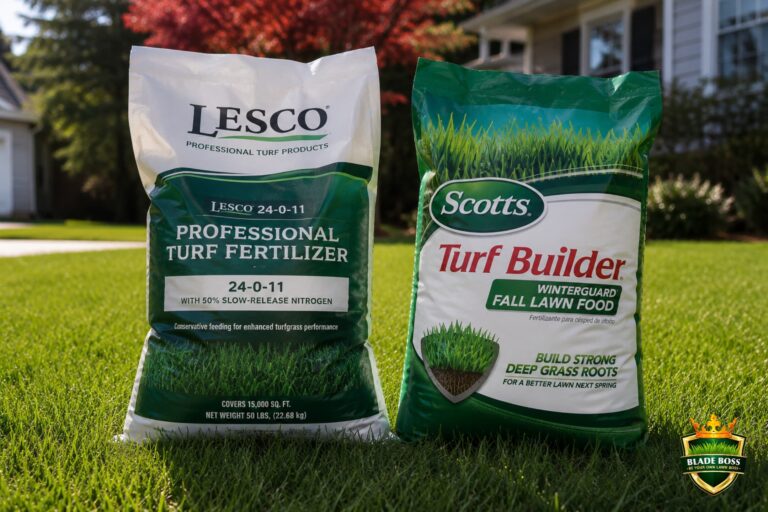
Lesco vs Scotts Fertilizer: Which Is Better for Northeast Lawns?
Scotts is everywhere. Lesco is what the pros use. Here's the real difference: granule size, nitrogen quality, cost...
May 11, 2026
11 min
 DIY How-To
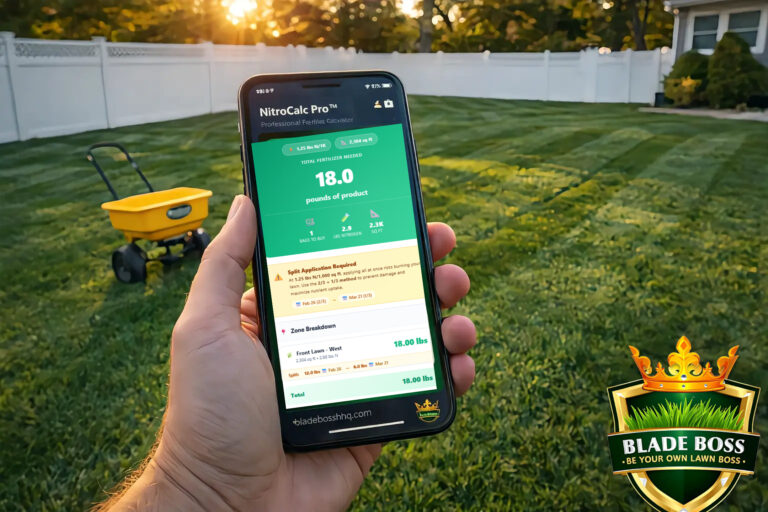
How Much Fertilizer Does Your Lawn Actually Need? (Calculator Inside)
Stop guessing with bag rates. Learn the 4-step nitrogen math, see the Zone 7B fertilizer schedule backed by...
Feb 28, 2026
20 min
 Lawn Science
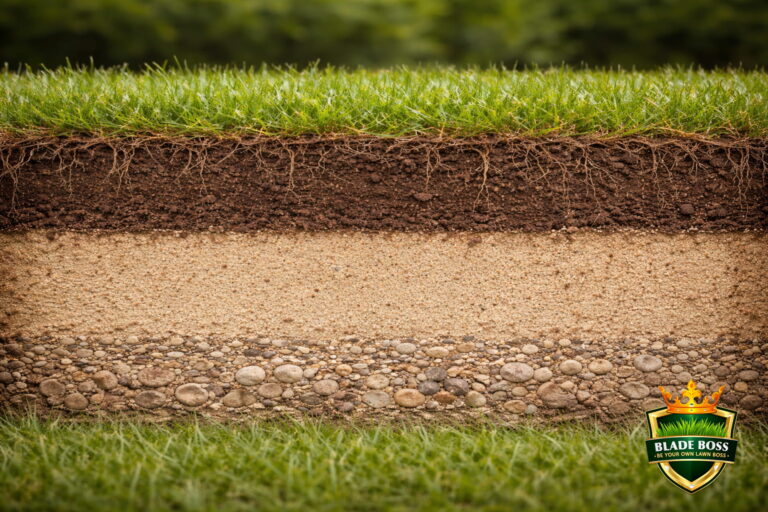
Lawn Care in Sandy Soil: Long Island’s Unique Challenge
Long Island sits on glacial outwash sand that drains fast, holds almost nothing, and breaks every rule in...
Mar 26, 2026
13 min
What is your lawn actually sitting on?
Pull the soil survey, hardiness zone and current growing conditions for your exact address. Eight government sources, about a minute.
No comments yet. Be the first to share your thoughts.
Create a free account to join the conversation.