Best Fertilizer Schedule for Long Island Lawns: Zone 7B Month-by-Month Guide

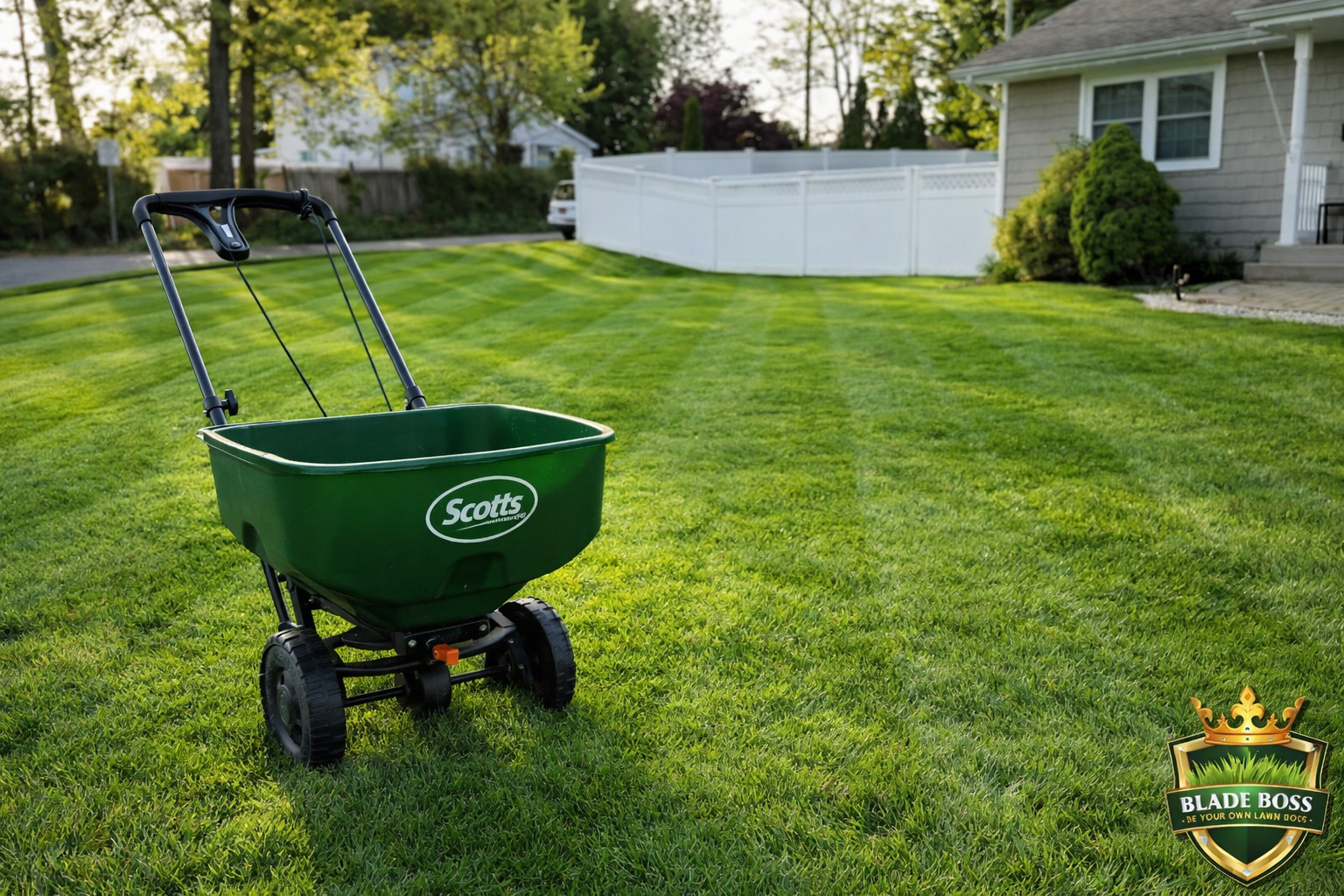
Most fertilizer bags tell you to apply four times a year, evenly spaced, at whatever rate the manufacturer decided would sell the most product. That advice was written for a lawn in Ohio. It wasn't written for Long Island, where sandy outwash soils have low nutrient-holding capacity that increases leaching risk, where county law prohibits application for six months of the year, and where 50 to 75 percent of annual nitrogen should be applied between August and November (Cornell CCE, 2012).
- Moderate schedule (most homeowners): 5 rounds, 2.75 lbs N per year. Light spring (0.50 lbs), optional bridge (0.25 lbs), no summer feeding, three fall rounds (0.75, 0.75, 0.50 lbs). 73% of nitrogen in fall.
- Advanced schedule (Lawn Legend, established + irrigated): 5 rounds plus 3 summer spoon-feeds, 3.25 lbs N per year. Adds 0.75 lbs of light organic nitrogen through summer (0.25 lbs every 3 to 4 weeks). Reduces fall kickoff to 0.50 because summer feeds maintained lawn health.
- Fall is still king. Even the Advanced schedule puts 54% of nitrogen in fall. September and October are when cool-season grass builds the roots and reserves that carry it through winter.
- Critical rules: 60%+ slow-release nitrogen on all applications. Organic or SRN only for summer feeds. No quick-release nitrogen past May on Long Island's sandy soil.
Why Long Island Needs Its Own Fertilizer Schedule
Generic fertilizer schedules fail on Long Island for three reasons, and every one of them connects to the ground beneath your feet. Our Dynamic Calendar tracks these windows automatically with GDD alerts. Lawn Map Pro puts all this data on your satellite map with zone-by-zone tracking.
First, the soil. The dominant soil series on Long Island (Carver, Plymouth, Riverhead, Haven, and Downer) are all sandy to excessively well-drained. The cation exchange capacity (CEC) of Long Island's sandy loam is below 3 meq/100g, compared to 15 to 30 for clay soils. CEC measures how well soil holds nutrients. A CEC below 3 means nitrogen and potassium wash through the root zone before your grass can absorb them. This is why you need more frequent applications at moderate rates and why the 2/3 + 1/3 split technique works so well here. For the full breakdown on Long Island soil composition, read our Long Island Soil pH Guide. Sandy soil changes everything about fertilizer strategy. Our Long Island sandy soil guide explains why split applications and slow-release N are non-negotiable here. Our Stripe Master members get the complete 15-step Lawn Playbook that covers exactly this.
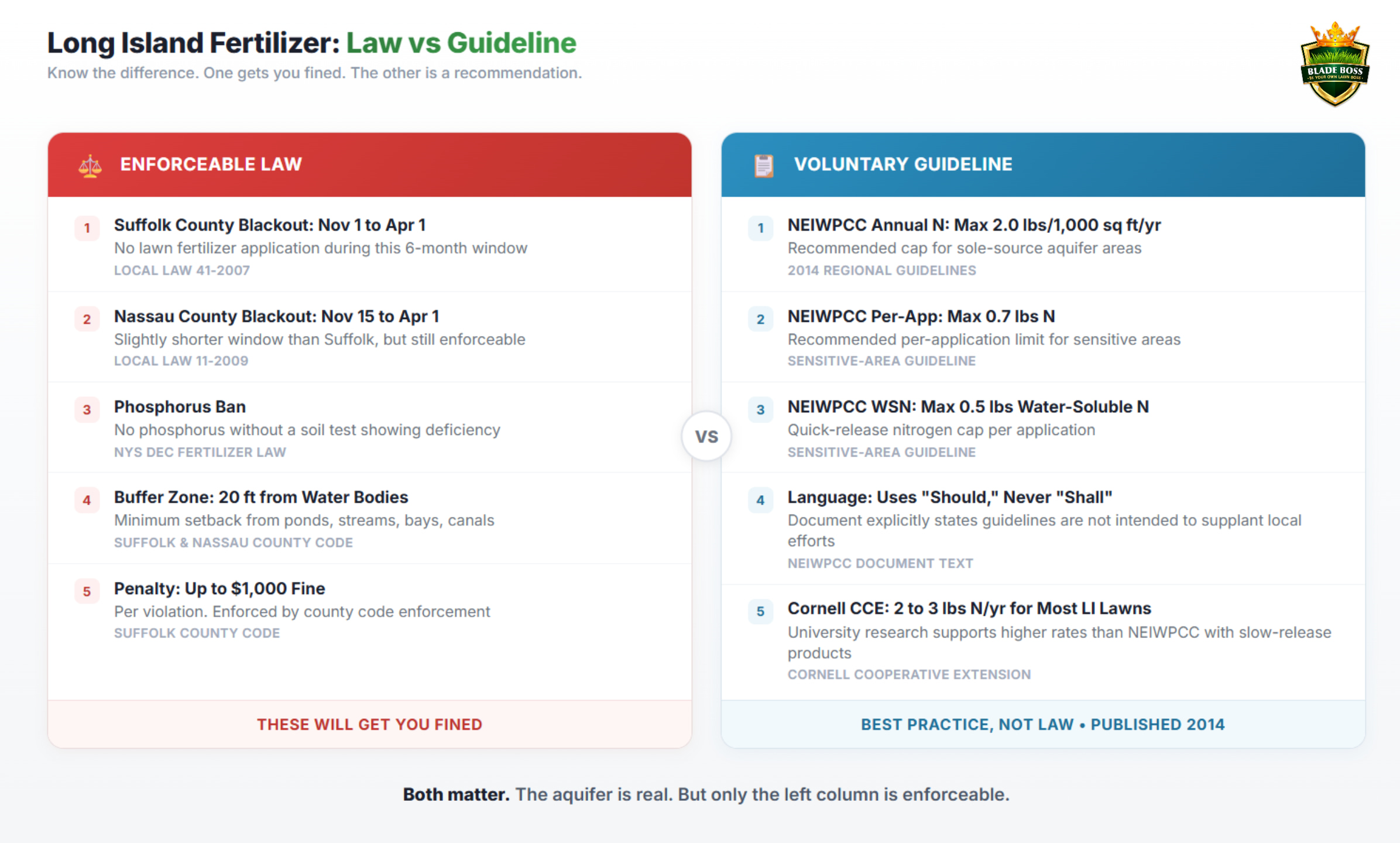
Second, the blackout dates. Suffolk County Local Law 41-2007 prohibits lawn fertilization from November 1 through April 1. Nassau County's Local Law 11-2009 runs November 15 through April 1. New York State bans phosphorus in lawn fertilizer unless a soil test confirms a deficiency. These are enforceable laws with real fines. The blackout compresses your entire fertilizer program into a 7-month window.
Third, the growing season. USDA Zone 7B on Long Island gives you roughly 230 growing days (mid-March to mid-November) but your cool-season grass only has two windows of peak growth: spring (April 15 to May 31) and fall (September 1 to October 10). Summer is a stress survival period when nitrogen does more harm than good. Your fertilizer schedule needs to match those biology windows, not a calendar printed on the back of a bag.
What the Law Actually Says (And What It Doesn't)
There's a lot of confusion about fertilizer regulations on Long Island. Some of it is law. Some of it is voluntary guidelines that get presented as law. Here's the clean breakdown so you know exactly what's enforceable and what's a recommendation.
| Rule | Suffolk County | Nassau County | New York State |
|---|---|---|---|
| Fertilizer blackout period | Nov 1 to Apr 1 (Law 41-2007) | Nov 15 to Apr 1 (Law 11-2009) | Dec 1 to Apr 1 |
| Phosphorus ban | No P unless soil test shows need | No P unless soil test shows need | No P unless soil test shows need |
| Buffer zone near water | 20 ft from water bodies | 20 ft from water bodies | Per county |
| Penalty for violation | $1,000 fine | Fine per violation (amount not specified in Local Law 11-2009) | Varies |
| Annual nitrogen rate limit | None specified in statute | None specified in statute | None specified in statute |
| Per-application nitrogen limit | None specified in statute | None specified in statute | None specified in statute |
The blackout dates, phosphorus ban, and buffer zones are law. There is no enforceable annual nitrogen cap or per-application nitrogen limit in Suffolk County, Nassau County, or New York State statute. The rate limits you may have seen elsewhere (2.0 lbs N/year, 0.6 to 0.7 lbs per application) come from NEIWPCC voluntary guidelines, not legislation.
One rule that gets overlooked: the 20-foot fertilizer buffer zone. Both Suffolk and Nassau counties prohibit applying fertilizer within 20 feet of any body of water, including bays, ponds, canals, streams, and wetlands. If your Long Island property backs up to a canal or sits near a retention pond, this applies to you. It's the same level of enforceability as the blackout dates and the phosphorus ban. When in doubt, measure from the water's edge. Twenty feet is roughly six long paces.
- Who: The New England Interstate Water Pollution Control Commission (NEIWPCC) published voluntary regional guidelines in 2014.
- What: No more than 2.0 lbs of nitrogen per 1,000 sq ft per year in environmentally sensitive areas. Per-application recommendations are 0.6 to 0.7 lbs N depending on number of annual applications.
- Where: All of Long Island qualifies as a sensitive area because it sits over a sole-source aquifer providing drinking water for over 3 million people.
- Voluntary, not law: These use the word "should," not "shall." There is no enforcement mechanism, fine, or penalty for exceeding them.
- Why they matter anyway: Excess nitrogen from fertilizer is a documented contributor to Long Island groundwater contamination. The schedule in this guide uses slow-release nitrogen and split applications to deliver what your grass needs while minimizing leaching risk.
- The bottom line: This is the responsible middle ground between starving your lawn and ignoring the environmental reality.
How Much Nitrogen Does Your Lawn Actually Need?
This is the question the bag can't answer. Your annual nitrogen requirement depends on your grass species, your maintenance goals, and your lawn's current condition. Here's what the turfgrass science says:
| Grass Type | Low Maintenance | Moderate | High Maintenance | Source |
|---|---|---|---|---|
| Kentucky Bluegrass | 2.0 lbs/yr | 2.5 to 3.0 lbs/yr | 3.0 to 4.0 lbs/yr | Rutgers FS633 |
| Tall Fescue (TTTF) | 2.0 lbs/yr | 2.5 lbs/yr | 3.0 to 3.5 lbs/yr | Rutgers FS633 |
| Perennial Ryegrass | 2.0 lbs/yr | 2.5 to 3.0 lbs/yr | 3.0 to 4.0 lbs/yr | Rutgers FS633 |
| Fine Fescue | 1.0 lbs/yr | 1.5 lbs/yr | 2.0 lbs/yr | Rutgers FS633 |
| Mixed/Blend | 2.0 lbs/yr | 2.5 to 2.75 lbs/yr | 3.0 to 3.25 lbs/yr | Match to dominant species |
For most Long Island homeowners running a KBG or mixed lawn, the moderate column (2.5 to 2.75 lbs/year) is the sweet spot. That's enough nitrogen to build density, recover from summer stress, and maintain year-round color without pushing into sports-turf territory. Cornell Cooperative Extension of Nassau County recommends 2 to 3 lbs of nitrogen per year for most Long Island home lawns, and this schedule lands right in the middle of that range.
A lawn that's thin, patchy, or recovering from renovation needs the upper end of these ranges (or even a temporary bump into the high column for one season) to build density. A thick, established lawn that just needs to stay where it is can run at the low end. And a shaded lawn needs less nitrogen than a full-sun lawn of the same species because growth rate is lower. Adjust your target based on what you're looking at, not just what you're growing.
Get the complete 5-round fertilizer schedule as a printable PDF. Exact dates, rates, and products for Long Island.
Why Slow-Release Nitrogen Matters on Sandy Soil
Water-soluble nitrogen (quick-release) dissolves immediately on contact with moisture. On clay soil, that's fine because the soil holds it. On Long Island's sandy soils with CEC values often in the single digits, quick-release nitrogen washes through the root zone in days. It's gone before your grass gets the full benefit, and it ends up in the groundwater. Most lawn care services on Long Island use a one-size-fits-all 6-round program. Our honest comparison of DIY vs. professional services shows what you actually get for that money.
Slow-release nitrogen (SRN/WIN) breaks down gradually over 6 to 12 weeks, feeding your grass steadily instead of all at once. On sandy soil, this is how you get real value from each application. Look for these terms on the bag: "water-insoluble nitrogen" (WIN), "slowly available nitrogen," "polymer-coated urea," "sulfur-coated urea," or "methylene urea." You want 50% or higher slow-release. At 60%+ slow-release, you can confidently apply 0.75 to 1.0 lbs N per application because the nitrogen is metered out over weeks, not days. The grass absorbs more, the aquifer absorbs less. This is the responsible way to feed a lawn on Long Island at rates that actually produce results. Before you start any fertilizer program, you need a soil test. And when those results come back, our guide to reading soil test reports tells you exactly what each number means and what to do about it.
The 2/3 + 1/3 Split Application Technique
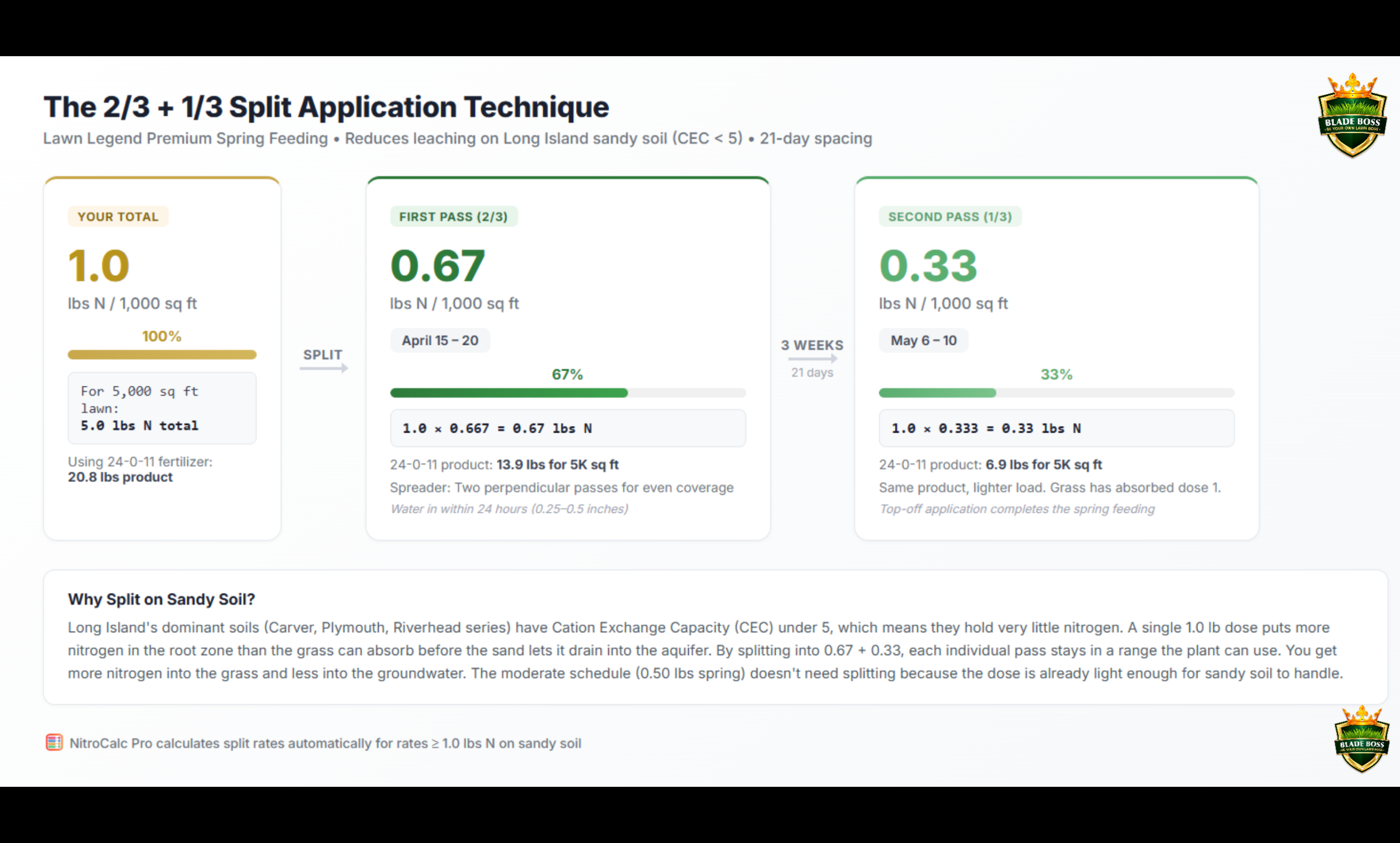
This is the technique that changes everything for spring feeding on Long Island. Instead of one heavy application that risks burn and leaching, you split it into two passes three weeks apart. The moderate schedule below uses a simple 0.50 lb spring dose that doesn't need splitting. But if you're running a premium KBG program (Lawn Legend tier) and pushing spring to 1.0 lbs N or higher, the split is how you deliver it safely on sandy soil.
Here's the math. Say you're targeting 1.25 lbs N per 1,000 sq ft for your spring feeding on a 5,000 sq ft KBG lawn using a 24-0-11 fertilizer:
Calculate Total Nitrogen Needed
(Square Footage / 1,000) x Target N Rate = Total N
(5,000 / 1,000) x 1.25 = 6.25 lbs of nitrogen needed.
Convert to Product Pounds
Total N / (N% on bag / 100) = Pounds of Product
6.25 / 0.24 = 26.0 lbs of 24-0-11 product total.
Calculate the 2/3 First Pass
26.0 x 0.667 = 17.3 lbs of product for the first application. This delivers approximately 0.83 lbs N per 1,000 sq ft. Load your spreader with 17.3 lbs and make two perpendicular passes for even coverage.
Wait 3 Weeks
Give the grass 21 days to absorb and metabolize the first dose. You'll see visible green-up within 7 to 10 days. By week 3, the grass has used the nitrogen and is ready for more.
Apply the 1/3 Follow-Up
26.0 x 0.333 = 8.7 lbs of product for the second application. This delivers approximately 0.42 lbs N per 1,000 sq ft. A lighter pass that tops off the spring feeding without overloading.
A single application of 1.0 lbs N would put more nitrogen in the root zone than the grass can absorb in one shot, especially on sandy soil with low CEC. The excess leaches through. By splitting into 0.83 + 0.42, each individual pass stays in a range the grass can actually use before the sand lets it drain away. You get more nitrogen into the plant and less into the aquifer. NitroCalc Pro calculates this split automatically for rates of 1.0 lbs N or higher.
Let NitroCalc Pro Do the Split Math
Enter your lawn's square footage, select your rate, and pick your product. For rates at 1.0 lbs N or higher, NitroCalc Pro automatically calculates the 2/3 + 1/3 split with exact product amounts for each pass and a scheduled date for the follow-up application.
The Long Island Fertilizer Schedule: 5 Rounds, 2.75 lbs N
This is the schedule for KBG and mixed lawns at moderate maintenance. It delivers 2.75 lbs of nitrogen per year across 5 rounds (2.50 if you skip the optional spring bridge). Every round is timed to soil temperature data from 30-year NOAA climate normals for Islip, NY, calibrated against Cornell Cooperative Extension of Suffolk County soil monitoring data. For Fine Fescue, use the 3-Round Essential schedule below. For Lawn Legend members running a premium KBG program, use the 2/3 + 1/3 split technique on Round 1 to push the spring total to 1.0 lbs N (see above).
Round 1: Spring Wake-Up (April 15 to April 25)
A light spring feeding to break dormancy and fuel green-up. The Suffolk County blackout lifts April 1, but don't rush. Wait until soil temperature at 4-inch depth has crossed 55 degrees Fahrenheit for at least 3 consecutive days. On Long Island, 30-year NOAA normals put average April soil temperature at 52.6°F, which means the 55°F threshold is typically reached around April 15 to 21. Use our GDD tracking guide to nail the exact date for your yard.
Apply 0.50 lbs N per 1,000 sq ft using a slow-release dominant product (at least 60% SRN on sandy soil). Water in within 24 hours with 0.25 to 0.5 inches. This is a deliberately light dose because spring's job is wake-up, not growth surge. Heavy spring nitrogen pushes excessive top growth at the expense of root development, exactly the wrong move heading into summer stress. Cornell's guidance for "better" lawns is just 1 to 2 applications per year, with September always first priority.
Lawn Legend upgrade: If you're running a high-maintenance KBG monoculture, you can push Round 1 to 1.0 lbs N total using the 2/3 + 1/3 split technique described above (0.67 lbs first pass, 0.33 lbs three weeks later). This adds 0.50 lbs to your annual total.
If you're using a pre-emergent with fertilizer (weed and feed combo), the pre-emergent should go down at GDD50=100, which is roughly April 6 to 10 on Long Island. But the fertilizer blackout doesn't lift until April 1. If spring runs early and GDD50 hits 100 before April 1, apply a standalone pre-emergent first, then start your split-application fertilizer program after April 15 when soil is warm enough.
Round 2: Spring Bridge (May 20 to May 30) OPTIONAL
A light bridge feeding for lawns that need extra help coming out of winter. If your fall program was strong and the lawn looks dense and green by late May, skip this round entirely. If you do apply, use slow-release or organic nitrogen only (Milorganite, corn gluten meal, or polymer-coated urea). Keep it light at 0.25 lbs N. This is the last feeding before the summer stress period. Do NOT apply quick-release nitrogen past May because it promotes foliar disease and excessive top growth heading into heat.
Advanced: Summer Maintenance Feeding (Conditional)
Summer spoon-feeding is an advanced technique for lawns that are already thick, deep-rooted, and under active irrigation. If your lawn is thin, newly seeded, drought-stressed, or you don't water consistently, skip this entire section and go straight to Round 3 in late August. Pushing nitrogen on a struggling lawn in summer heat is the fastest way to kill it.
Here's what most extension guides won't tell you: the standard advice to cut all nitrogen from June through August is designed for the average homeowner who doesn't irrigate and can't monitor soil conditions. For Lawn Legend members running established turf with proper irrigation, light summer feeding keeps the lawn green and healthy through the stress period instead of letting it go semi-dormant and then scrambling to recover in fall.
Join Long Island homeowners who get data-driven lawn care tips and seasonal fertilizer reminders every week.
The technique is called spoon-feeding and it's exactly what it sounds like: tiny, frequent doses of nitrogen that the grass can actually use without being pushed into stress. The zone-master data in our tools supports this with a specific exception protocol: no more than 0.25 lbs N per 1,000 sq ft, slow-release or organic sources only, and only when the turf is actively growing under irrigation.
| Application | Timing | Rate | Product | Conditions |
|---|---|---|---|---|
| Summer A | June 5 to 10 | 0.25 lbs N | Zero-P organic (corn gluten, feather meal) or polymer-coated urea. Milorganite only if soil test shows P deficiency. | Only if soil temp still below 72°F at your location. Skip if already heat-stressed. |
| Summer B | July 5 to 10 | 0.25 lbs N | Same (organic preferred) | SKIP if consecutive days above 90°F or brown patch is active |
| Summer C | August 1 to 5 | 0.25 lbs N | Same | Transition feed before fall kickoff at Aug 25 |
Notice the spacing: June 5 to July 5 is roughly 30 days, July 5 to August 1 is roughly 27 days, and August 1 to August 25 (Round 3) is about 24 days. That's consistent 3 to 4 week intervals all the way from late spring through fall. Your lawn never goes more than a month without food.
Products like Milorganite (6-4-0) are popular for summer spoon-feeding because they're self-regulating: soil bacteria must break down the nitrogen before it becomes available, and when soil gets hot and dry, microbial activity slows, so nitrogen release slows automatically. Important: Milorganite contains 4% phosphorus. New York State law prohibits phosphorus on established lawns unless a soil test shows a deficiency. If your soil test shows adequate P levels (most Long Island soils do), use a zero-phosphorus organic alternative instead: corn gluten meal (9-0-0), feather meal (12-0-0), or blood meal (12-0-0). These deliver slow-release nitrogen without the phosphorus issue. On Long Island's sandy soil with low CEC, any organic source at 0.25 lbs N per application is effectively leach-proof. These NPK values are from OMRI-listed product labels (Down To Earth, Espoma, Nature's Creation) and are standard across the organic fertilizer industry.
If you run the full Advanced schedule with all three summer feeds, you can reduce Round 3 (Fall Kickoff) from 0.75 to 0.50 lbs N because your lawn didn't go semi-dormant over summer. The whole purpose of a heavy fall kickoff is post-summer recovery, but if there's less damage to recover from, less nitrogen is needed. This keeps your total in a responsible range while maintaining green color all season.
Round 3: Fall Kickoff (August 25 to September 5)
This is where the serious feeding begins. Fall is the power season for cool-season grass. Soil temperature in late August averages around 72°F on Long Island, dropping from the summer peak of 76.3°F in July. Air temperatures are cooling into the 70s and 80s. Your grass is snapping out of summer stress and entering the fastest growth phase of the year. Starting in late August (rather than waiting until September) gives the grass a head start on fall recovery.
Advanced track adjustment: If you ran the summer spoon-feed program above, your lawn enters fall already healthy. Drop Round 3 to 0.50 lbs N instead of 0.75. Less recovery needed means less nitrogen required.
If you're aerating and overseeding, do it in this window. The nitrogen feeds both existing turf and new seedlings. Use a product with potassium (the K in NPK) to support root development heading into winter. A 24-0-11 or similar zero-phosphorus formulation with 60%+ slow-release is ideal.
Round 4: Peak Fall Feeding (September 25 to October 5)
The single most important fertilizer application of the year. October soil temperature averages 59.8°F, which is the sweet spot for cool-season root growth. The grass is actively building carbohydrate reserves and root density that will carry it through winter and fuel early spring green-up. Every turfgrass extension from Rutgers to Cornell says the same thing: fall feeding matters more than spring feeding.
Keep slow-release at 60% or higher on this round. You want steady feeding through October, not a quick flush. If you're dealing with broadleaf weeds, this is also the best time to apply post-emergent herbicide since the weeds are actively pulling chemicals into their root systems before winter.
Track Your Soil Temperature and GDD
The Blade Boss dashboard tracks soil temperature, GDD accumulation, and county blackout dates for your exact location. Know exactly when each round should go down instead of guessing.
Round 5: Winterizer (October 15 to October 25)
The final feeding of the year. Grass is still green and photosynthesizing, but top growth has slowed significantly. Roots are in maximum storage mode, banking carbohydrates for winter survival and spring energy. This application must be completed before November 1 in Suffolk County (November 15 in Nassau). That's law, not guideline.
The GDD50 data from NOAA puts the winterizer window at GDD50 = 3050 to 3097, which translates to approximately October 16 to November 1. Aim for mid to late October to give yourself a buffer before the blackout.
The winterizer is the application most homeowners either skip or time wrong. Apply it too early (before mid-October) and the grass is still using nitrogen for top growth instead of root storage. Wait past the blackout date and you're breaking the law. Mark October 15 to 25 on your calendar right now.
Full Year Schedule Summary
| Round | Timing | Moderate Rate | Advanced Rate | Product |
|---|---|---|---|---|
| 1 | April 15 to 25 | 0.50 lbs N | 0.50 lbs N (or 1.0 with split) | 24-0-11 (60%+ SRN) |
| 2 (optional) | May 20 to 30 | 0.25 lbs N | 0.25 lbs N | SRN or organic |
| Summer A | June 5 to 10 | None | 0.25 lbs N | Milorganite or organic |
| Summer B | July 5 to 10 | None | 0.25 lbs N (skip if heat wave) | Organic only |
| Summer C | Aug 1 to 5 | None | 0.25 lbs N | Organic or SRN |
| 3 | Aug 25 to Sep 5 | 0.75 lbs N | 0.50 lbs N (reduced) | 24-0-11 (60%+ SRN) |
| 4 | Sep 25 to Oct 5 | 0.75 lbs N | 0.75 lbs N | 32-0-4 (60%+ SRN) |
| 5 | Oct 15 to 25 | 0.50 lbs N | 0.50 lbs N | 24-0-11 (60%+ SRN) |
| TOTAL | Full season | 2.75 lbs N/yr | 3.25 lbs N/yr | Varies by round |
The Moderate track delivers 2.75 lbs N per year (2.50 without the optional bridge), with 73% in fall. The Advanced track adds 0.75 lbs of summer spoon-feeding and reduces the fall kickoff by 0.25, for a total of 3.25 lbs per year. Both stay within Rutgers FS633 moderate-to-high maintenance ranges. Lawn Legend members running the 2/3 + 1/3 split on Round 1 add another 0.50 lbs for 3.75 total on the Advanced track.
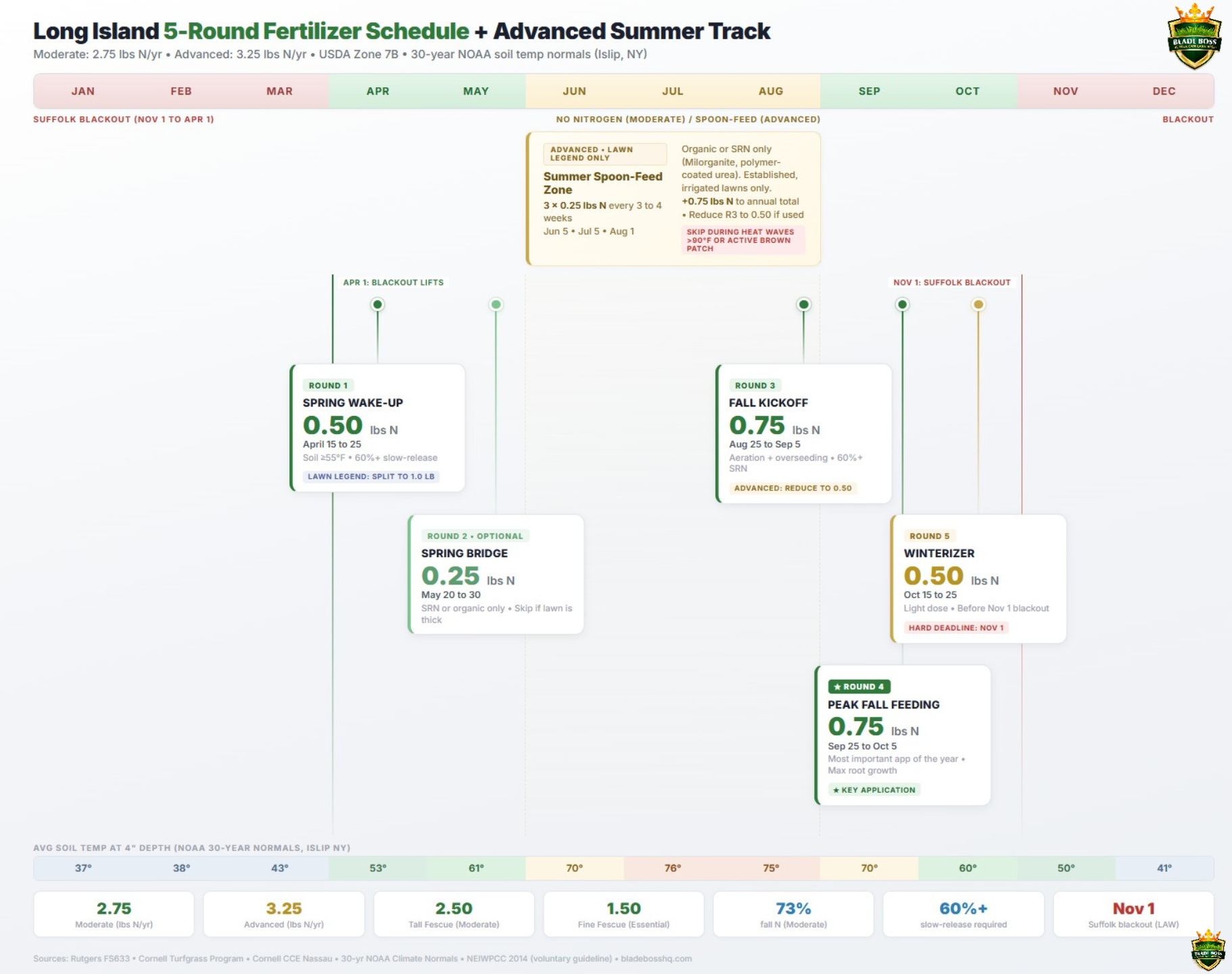
The Full Year at a Glance
Blackout Period: Plan and Prepare
Order soil test from Cornell CCE. Results take 2 to 3 weeks. Buy fertilizer early while selection is full. Review last year's notes.
Blackout Period: Monitor Soil Temps
Soil averages 43.3°F in March. Still too cold for fertilizer. Focus on pre-emergent planning and first mow timing.
Round 1: Spring Wake-Up (0.50 lbs N)
Light dose, 60%+ slow-release. Soil has crossed 55°F. Feed the green-up without pushing excessive top growth. Lawn Legend option: run at 1.0 lbs N using 2/3 + 1/3 split.
Round 2: Spring Bridge (0.25 lbs N) OPTIONAL
Light organic or slow-release feeding. Skip if lawn looks thick and green. Last feeding before summer dormancy. No quick-release N past May.
Summer: No Nitrogen (Moderate) / Spoon-Feed (Advanced)
Moderate track: Zero nitrogen. Mow high, water deep, let the lawn coast. Advanced track (Lawn Legend): Spoon-feed 0.25 lbs N every 3 to 4 weeks with organic or slow-release products. Skip during heat waves above 90°F. Adds 0.75 lbs N to annual total.
Round 3: Fall Kickoff (0.75 lbs N)
The serious feeding starts. Pair with aeration and overseeding if planned. 60%+ slow-release.
Round 4: Peak Fall Feeding (0.75 lbs N)
The single most important fertilizer application of the year. Maximum root growth and carbohydrate storage. 60%+ slow-release.
Round 5: Winterizer (0.50 lbs N)
Final feeding before the November 1 Suffolk County blackout. Light dose because late-season uptake is slowing. Roots bank energy for winter survival and spring green-up.
Blackout Period: Season Complete
Suffolk County blackout begins November 1. Nassau begins November 15. Zero fertilizer. Clean up leaves, make final mow at 2.5 to 3 inches.
Adjusted Schedules by Grass Type
Not every lawn runs the full 3.0 program. Here's how to adjust based on what you're growing:
| Grass Type | Track | Spring | Summer | Fall (R3+R4+R5) | Annual Total |
|---|---|---|---|---|---|
| Kentucky Bluegrass | Moderate | 0.50 + 0.25 bridge | None | 0.75 + 0.75 + 0.50 | 2.75 lbs/yr |
| Kentucky Bluegrass | Advanced | 0.50 + 0.25 bridge | 3 x 0.25 | 0.50 + 0.75 + 0.50 | 3.25 lbs/yr |
| Tall Fescue (TTTF) | Moderate | 0.50 (skip bridge) | None | 0.75 + 0.75 + 0.50 | 2.50 lbs/yr |
| Tall Fescue (TTTF) | Advanced | 0.50 + 0.25 bridge | 2 x 0.25 (skip Jul) | 0.50 + 0.75 + 0.50 | 3.00 lbs/yr |
| Fine Fescue | Essential | Skip | None | 0.50 + 0.50 + 0.50 | 1.50 lbs/yr |
| Mixed/Blend | Moderate | 0.50 + 0.25 bridge | None | 0.75 + 0.75 + 0.50 | 2.75 lbs/yr |
| Mixed/Blend | Advanced | 0.50 + 0.25 bridge | 2 to 3 x 0.25 | 0.50 + 0.75 + 0.50 | 3.00 to 3.25 lbs/yr |
The 3-Round Essential Schedule (Fine Fescue and Low-Maintenance Lawns)
If you have a Fine Fescue lawn, a shaded property, or you just want to keep things simple on an established lawn that looks good already:
| Round | Timing | Rate | Product | Purpose |
|---|---|---|---|---|
| 1 | April 15 to 30 | 0.5 lbs N | 24-0-11 (50%+ SRN) | Spring wake-up (single application) |
| 2 | September 1 to 15 | 0.5 lbs N | 24-0-11 (60%+ SRN) | Fall kickoff with aeration |
| 3 | October 15 to 25 | 0.5 lbs N | 24-0-11 (50%+ SRN) | Winterizer before blackout |
Monthly Soil Temperature Reference
Soil temperature is the real trigger for every application on this schedule, not calendar dates. Calendar dates are averages. Your actual soil temperature at 4-inch depth determines when the grass is ready. Here are the 30-year averages for Zone 7B on Long Island, derived from NOAA climate normals calibrated against Cornell CCE Suffolk County soil monitoring data:
| Month | Avg Soil Temp (°F) | Fertilizer Action | Why |
|---|---|---|---|
| January | 37.3°F | None (blackout) | Soil frozen/near frozen. Full dormancy. |
| February | 37.9°F | None (blackout) | Still too cold. Plan and order products. |
| March | 43.3°F | None (blackout) | Soil warming but below 55°F threshold. |
| April | 52.6°F | Round 1A (mid to late April) | Crosses 55°F around April 15 to 21. |
| May | 61.2°F | Round 2: Spring Bridge (late May) or Lawn Legend split follow-up (early May) | Three weeks after 1A. Active spring growth. |
| June | 70.2°F | None (summer stress begins) | Too warm for nitrogen. Iron only. |
| July | 76.3°F | None (peak heat stress) | Semi-dormancy. Do not fertilize. |
| August | 75.4°F | None (stress continues) | Wait for temps to drop below 70°F. |
| September | 69.9°F | Rounds 3 and 4 | Prime fall growth window. |
| October | 59.8°F | Rounds 4 and 5 (peak fall + winterizer) | Root storage at maximum capacity. |
| November | 50.2°F | None (blackout Nov 1 Suffolk) | Grass slowing. Roots still active. |
| December | 42.6°F | None (dormancy) | Approaching 40°F dormancy threshold. |
We'll text you 5 days before each application window opens. Five rounds, five texts, perfect timing.
No spam. One seasonal alert per application window. Unsubscribe anytime.
What to Buy: Product Selection for Long Island
High nitrogen, zero phosphorus, moderate potassium. New York State law bans phosphorus for established lawns unless a soil test shows a deficiency. Most Long Island soils already test adequate to high for phosphorus, which is why New York State law bans phosphorus on established lawns unless a soil test shows a deficiency. So you're looking for products where the middle number (P) is zero: 24-0-11, 32-0-4, 29-0-5, 22-0-4, and similar formulations.
Good for Long Island
24-0-11 with 50%+ slow-release. 32-0-4 polymer-coated urea. 29-0-5 with sulfur-coated urea. Any high-N, zero-P product with WIN at 50% or above.
Use with Caution
10-10-10 (contains phosphorus, only if soil test shows P deficiency). Any product under 40% slow-release (too much quick-release for sandy soil).
Avoid on Long Island
Anything with phosphorus unless soil test proves need. Products with 100% quick-release nitrogen. Cheap fertilizer with no slow-release listed on the label.
The 8 Biggest Fertilizer Mistakes on Long Island
1. Feeding heavy in spring instead of fall
Heavy spring nitrogen forces lush top growth that depletes root carbohydrate reserves heading into summer stress. Your grass looks great in May and crashes in July. The 2/3 + 1/3 split technique gives you a strong spring push while keeping the heaviest feeding (65% of annual N) in the fall rounds where it builds the density and root reserves that matter most. Advanced exception (Lawn Legend tier): Established, irrigated lawns with thick root systems can handle light spoon-feeding at 0.25 lbs N per 1,000 sq ft every 3 to 4 weeks using organic or slow-release products. See the Advanced Summer Feeding section above for full details.
2. Applying nitrogen in summer
When soil temperature exceeds 70°F, cool-season grass slows or stops growth. Nitrogen forces the plant to push top growth it cannot sustain, increasing vulnerability to brown patch, dollar spot, and summer patch. From mid-June through August, the answer is no nitrogen. If you want green color, use chelated iron or milorganite.
3. Using cheap, 100% quick-release fertilizer
Dollar-store fertilizer with no slow-release nitrogen is the worst possible choice for Long Island. The nitrogen hits the root zone all at once, the grass can't absorb it fast enough, and the rest washes through sandy soil into the aquifer within days. You get a brief green flush followed by nothing. Spend the extra money on products with 50%+ slow-release.
4. Applying phosphorus without a soil test
It's illegal under New York State law to apply phosphorus to an established lawn without a soil test showing a deficiency. It's also unnecessary on most of Suffolk County soils that already test high for phosphorus. Excess phosphorus doesn't help your grass. It feeds algae in waterways.
5. Following bag rates without doing your own math
Bag rates are designed for the manufacturer's idea of an "average" lawn. Long Island's sandy loam is not average. Bag rates often overshoot what a single pass should deliver, wasting product and money. Always calculate your own rate based on your lawn size and your target N per 1,000 square feet. NitroCalc Pro does this in seconds.
6. Missing the winterizer window
The winterizer (Round 5) is the application most homeowners skip because the season "feels" over in October. It's not. Your grass is still photosynthesizing and roots are actively storing carbohydrates. This last feeding fuels spring green-up and early-season density. Apply October 15 to 25, before the November 1 Suffolk blackout.
7. Not adjusting for soil pH
Fertilizer is only as effective as your soil pH allows. Long Island soils naturally run 5.5 to 6.5 pH, but the optimal range for cool-season grass nutrient uptake is 6.2 to 6.8. Below 6.0, your grass can only access about 50% of the nitrogen you apply. The other half is locked in the soil or washed away. Test your pH first. Lime if needed. Then fertilize. Read our full soil pH guide for more details.
8. Fertilizing during or before heavy rain
A light rain after application is fine. It waters the granules in. But fertilizing before a heavy storm (1+ inches expected) on sandy soil is flushing money and nitrogen directly into the aquifer. Check the forecast. If heavy rain is coming within 24 hours, wait.
Quick-Reference Data Sheet
| Item | Data | Source |
|---|---|---|
| KBG Moderate annual N | 2.75 lbs/1,000 sq ft | Rutgers FS633 / Cornell CCE |
| KBG Advanced annual N | 3.25 lbs/1,000 sq ft | Rutgers FS633 high-maintenance tier |
| TTTF annual N (moderate) | 2.50 lbs/1,000 sq ft | Rutgers FS633 |
| Fine Fescue annual N | 1.0 to 2.0 lbs/1,000 sq ft | Rutgers FS633 |
| Cornell CCE LI recommendation | 2 to 3 lbs N/year | CCE Nassau County |
| Max per application | 1.0 lb N (never exceed) | Cornell Turfgrass Program |
| Summer spoon-feed max | 0.25 lbs N per app, SRN/organic | Zone-master exception protocol |
| Slow-release minimum (sandy soil) | 60% SRN | Cornell Turfgrass Program |
| Suffolk blackout (LAW) | Nov 1 to Apr 1 ($1,000 fine) | Local Law 41-2007 |
| Nassau blackout (LAW) | Nov 15 to Apr 1 | Local Law 11-2009 |
| Phosphorus (LAW) | Zero P unless soil test shows need | NYS Nutrient Runoff Law |
| NEIWPCC guideline (voluntary) | 2.0 lbs N/yr, 0.7/app for sensitive areas | NEIWPCC 2014 |
| Split method (premium spring) | 2/3 first pass, 1/3 at 3 weeks | NitroCalc Pro |
| 20-ft buffer zone (LAW) | No fertilizer within 20 ft of water | Suffolk & Nassau County law |
| Summer skip conditions | Heat wave >90°F, brown patch active, no irrigation | Blade Boss / Extension synthesis |
Go Deeper: Related Guides
Fertilizer Calculator
Calculate exact product amounts with NitroCalc Pro. Enter your lawn size and get spreader settings.
Soil pH Guide
Test and fix your soil pH before you fertilize. Low pH locks out nitrogen.
Full Lawn Care Calendar
Month-by-month schedule covering every task, not just fertilizer.
GDD Explained
Understand growing degree days and why they beat calendar dates for timing.
Pre-Emergent Schedule
Pre-emergent timing and how it interacts with your fertilizer rounds.
Best Grass Types for LI
Which grass to grow and its nitrogen requirements.
Mowing Guide
When and how to mow for the healthiest turf between feedings.
Zone 7B Complete Guide
Everything about Zone 7B on Long Island in one place.
Crabgrass Battle Plan
Prevent crabgrass with the right pre-emergent and fertilizer combo strategy.
The Blade Boss Story
How a pilot built a data-driven lawn care platform on Long Island.
Your fertilizer program works best as part of a complete system. Pair it with our aeration timing guide in September, address any grub damage before fall seeding, and use the spring recovery playbook if winter left bare spots. For grass-specific advice, the tall fescue vs KBG comparison and clover control guide tie directly into your nitrogen strategy. Penn State Extension offers additional cool-season grass management resources for the Northeast. See also: fall lawn care checklist. See also: Lesco vs Scotts comparison.
See what Blade Boss members get and get instant access to preview NitroCalc Pro, Lawn Map Pro, and the full suite of zone-specific tools. Your lawn is sitting on sand over an aquifer. Guessing isn't good enough.
See Plans →Chris C. is a Combat Search and Rescue pilot turned airline pilot and the founder of Blade Boss. He built the Zone Science data library from 30-year NOAA climate normals, Cornell Cooperative Extension research, and three years of hands-on soil monitoring on his own Long Island lawn. Every number in this guide comes from real data, not marketing copy. Read the full story.
Frequently Asked Questions
How many times should I fertilize my lawn on Long Island per year?
Most Long Island lawns benefit from 5 fertilizer rounds per year on the Moderate schedule: one light spring wake-up (0.50 lbs N), an optional spring bridge (0.25 lbs N), and three fall rounds (0.75, 0.75, and 0.50 lbs N). Advanced users with established, irrigated lawns can add 3 summer spoon-feeds of 0.25 lbs N each (organic or slow-release only) for a total of 8 applications per year. The Advanced track reduces the fall kickoff from 0.75 to 0.50 because summer maintenance feeding reduces post-summer recovery needs.
How much nitrogen does a Long Island lawn need per year?
Cornell Cooperative Extension recommends 2 to 3 lbs of nitrogen per 1,000 square feet per year for most Long Island lawns. The Moderate schedule delivers 2.75 lbs (within that range). The Advanced schedule for established, irrigated lawns delivers 3.25 lbs (within Rutgers FS633 moderate-to-high maintenance range of 2.5 to 3.5 lbs). Fine Fescue lawns need only 1.50 lbs. All rates assume 60%+ slow-release nitrogen products on Long Island's sandy soil.
What is the 2/3 + 1/3 split application method for fertilizer?
The 2/3 + 1/3 split divides a single fertilizer application into two passes three weeks apart. The first pass applies two-thirds of the total nitrogen (67%). Three weeks later, the second pass applies the remaining one-third (33%). On Long Island's sandy soil (CEC under 5), this reduces leaching risk because each individual dose stays in a range the grass can absorb before the sand lets it drain. NitroCalc Pro calculates the split automatically. This technique is recommended for Lawn Legend premium programs pushing spring rates to 1.0 lbs N or higher.
When is the fertilizer blackout on Long Island?
Suffolk County law prohibits all lawn fertilizer application from November 1 through April 1, with a $1,000 fine for violations (Local Law 41-2007). Nassau County's blackout runs November 15 through April 1. New York State's statewide blackout is December 1 through April 1. Always follow the strictest applicable date. There are no enforceable per-application rate limits or annual nitrogen caps in any Long Island law. The NEIWPCC guidelines recommending 2.0 lbs N per year are voluntary best practices, not enforceable regulations.
Should I fertilize my Long Island lawn in summer?
No. Do not apply nitrogen fertilizer to Long Island lawns from mid-June through mid-August. Cool-season grasses enter heat-induced semi-dormancy when soil temperatures exceed 70 degrees Fahrenheit, which typically occurs by late June in Zone 7B. Nitrogen forces top growth the grass cannot support, increasing disease risk from brown patch and dollar spot. If your lawn looks pale in summer, use iron-only products like chelated iron or milorganite for color without growth stimulation. The one exception is for established, irrigated lawns on the Advanced track, where light organic spoon-feeding at 0.25 lbs N every 3 to 4 weeks is permitted. See the Advanced Summer Feeding section for conditions.
What is the best fertilizer NPK ratio for Long Island lawns?
The best NPK ratio for established Long Island lawns is high-nitrogen, zero-phosphorus, moderate-potassium. Products like 24-0-11, 32-0-4, or 29-0-5 work well. New York State law bans phosphorus in lawn fertilizer unless a soil test shows a deficiency, and most Long Island soils already test adequate to high for phosphorus. Look for products with at least 50% slow-release nitrogen to reduce leaching through Long Island's sandy soil.
Can I fertilize my cool-season lawn in summer on Long Island?
Yes, but only under specific conditions. For established, irrigated lawns with thick root systems, light summer spoon-feeding of 0.25 lbs of nitrogen per 1,000 square feet every 3 to 4 weeks using organic or slow-release products (like Milorganite) keeps the lawn green without pushing dangerous growth. Skip applications during heat waves above 90 degrees Fahrenheit or if brown patch fungus is active. This technique is for advanced users only. If your lawn is thin, newly seeded, or you don't irrigate, do not apply any nitrogen between June and late August.
Keep Reading
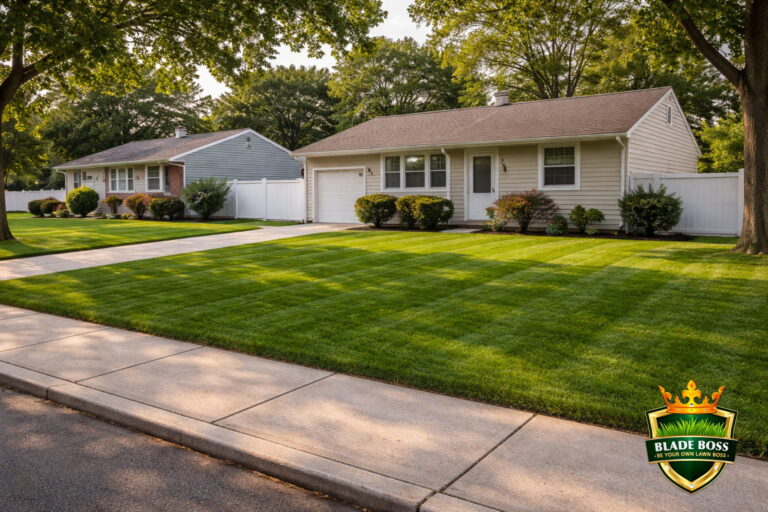 Lawn Science
Nassau County Lawn Care: Neighborhood-Specific Tips
Nassau County is 20 miles of post-war suburbs sitting on 4 distinct soil zones. Your lawn in Levittown...
Apr 1, 2026
13 min
 DIY How-To
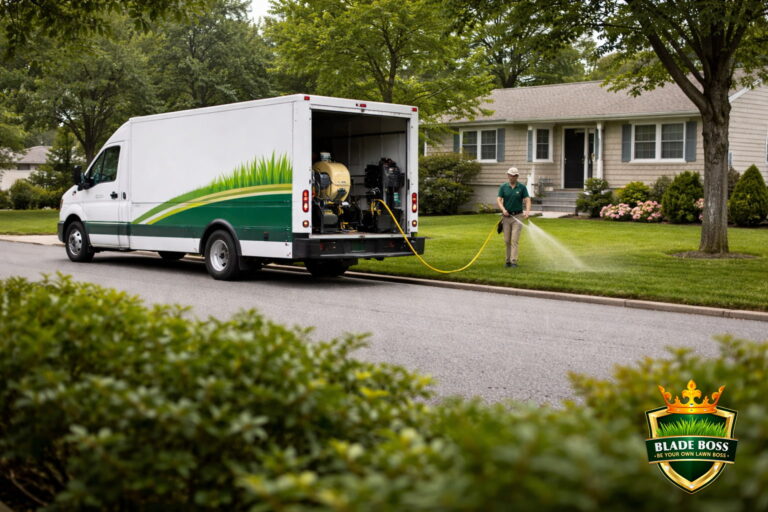
The Truth About Lawn Care Services on Long Island (DIY Comparison)
Long Island lawn services cost $1,200 to $3,000 a year and most treat your lawn identically to every...
Mar 25, 2026
15 min
 Lawn Science
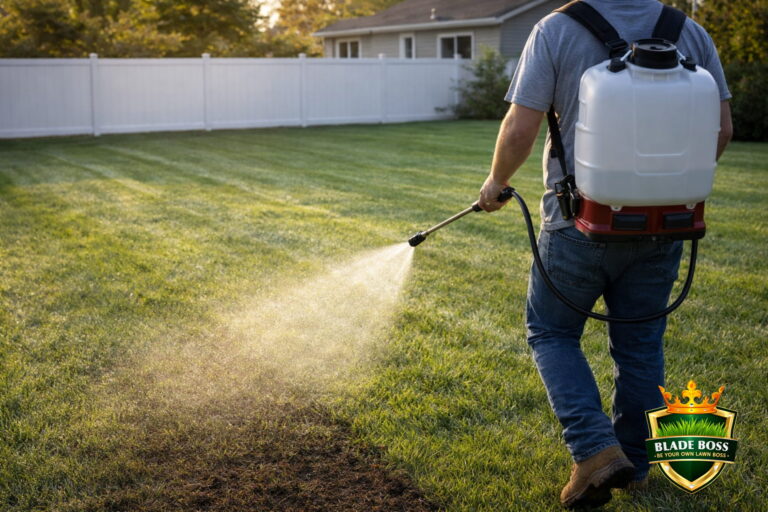
Long Island Fungicide Guide: FRAC Groups, Rotation Schedule, and What to Buy
The complete beginner's guide to lawn fungicide on Long Island. Learn FRAC groups, build a 4-product rotation schedule...
Mar 27, 2026
17 min
What is your lawn actually sitting on?
Pull the soil survey, hardiness zone and current growing conditions for your exact address. Eight government sources, about a minute.
No comments yet. Be the first to share your thoughts.
Create a free account to join the conversation.