Summer beat up your lawn. Brown patches, thin spots, bare areas where the dog runs, that section near the driveway that never filled in. You have been staring at it since July and waiting for the right time to fix it. That time starts August 15. Fall overseeding is the single most impactful thing you can do to transform your lawn, and the window on Long Island is specific, short, and unforgiving. Miss it by two weeks and your seed sits in cold soil that stalls germination. Nail it and every seed has 6 to 8 weeks of perfect growing conditions to establish before winter.
- Window: August 15 through September 30 (hard cutoff October 5). Soil temps 50 to 65 degrees, air temps 60 to 75 degrees.
- Prep: Mow short (2 to 2.5 inches), core aerate, dethatch if thatch exceeds 0.5 inches.
- Seed rates: Tall fescue 6 to 8 lbs/1K for full overseed, KBG 2 to 3 lbs/1K. More is not better.
- Fertilizer: Starter fertilizer (high phosphorus like 18-24-12) at seeding. No standard pre-emergent. Tenacity only if needed.
- Water: 2 to 3 light waterings per day for 14 to 21 days. Moist, not saturated. Transition to deep watering after first mow.
- Use SeedGenius Pro to calculate exact seed amounts, starter fertilizer, and watering schedules per zone.
The Overseeding Window on Long Island
Cool-season grass seed germinates best when soil temperature is 50 to 65 degrees at 4-inch depth and air temperature is 60 to 75 degrees. On Long Island, this window opens around August 15 and closes by the end of September, with October 5 as the absolute latest safe date.
Why August 15 and not September 1? Because KBG takes 14 to 21 days to germinate, and the new seedlings need 4 to 6 weeks of growing weather after germination to build enough root depth to survive the first freeze. Plant KBG on September 15 and it germinates by October 7, leaving only 4 to 5 weeks before the first typical frost (mid-November on Long Island). That is tight. Plant it August 20 and it germinates by September 10, giving it a full 8 to 9 weeks of growth. That is comfortable.
| Grass Type | Germination Time | Ideal Seed Date (LI) | Why |
|---|---|---|---|
| Kentucky Bluegrass | 14 to 21 days | Aug 15 to Sep 1 | Slowest germination, needs most establishment time |
| Tall Fescue | 7 to 14 days | Aug 15 to Sep 15 | Moderate germination, aggressive root growth |
| Perennial Ryegrass | 5 to 10 days | Aug 15 to Sep 30 | Fastest germination, quickest fill-in |
| KBG/TTTF/PRG Blend | 7 to 21 days | Aug 15 to Sep 15 | PRG germinates first, KBG fills long-term |
Spring overseeding (April to May) is possible but significantly riskier than fall. You face crabgrass competition the moment soil hits 55 degrees, standard pre-emergents cannot be used with new seed (they will kill it), and summer heat arrives 10 to 12 weeks later before seedlings are fully established. If you must overseed in spring, use Tenacity (mesotrione) at seeding for crabgrass suppression without blocking grass germination. But fall is always the better window.
Which Grass Seed to Use on Long Island
Long Island is USDA Zone 7B with mostly sandy soil (CEC 3 to 12 depending on location). The best grass types for our conditions are tall fescue (TTTF) for drought tolerance and deep roots, Kentucky bluegrass (KBG) for self-repair and density, and perennial ryegrass (PRG) for quick fill-in. Most successful Long Island lawns use a blend of all three. Our grass types guide covers the science behind each species.
Jonathan Green Black Beauty Ultra Grass Seed
Tall fescue dominant blend with PRG and KBG. Dark green color, deep roots, excellent drought and disease tolerance. Specifically formulated for the Northeast. The most recommended seed on Long Island lawn forums.
Check PriceSeed Rates by Purpose
| Purpose | KBG | Tall Fescue | PRG | Blend |
|---|---|---|---|---|
| Patch repair (thin spots) | 1 to 2 | 4 to 6 | 4 to 6 | 4 to 6 |
| Full overseed (thicken up) | 2 to 3 | 6 to 8 | 6 to 8 | 6 to 8 |
| Full renovation (start over) | 2 to 3 | 8 to 10 | 8 to 10 | 8 to 10 |
Overseeding at 2x the recommended rate does not give you 2x the results. It gives you overcrowded seedlings competing for light, water, and nutrients. They grow tall and spindly trying to outcompete each other instead of developing strong roots. Stick to the rates above, or let SeedGenius Pro calculate the exact rate for your lawn's condition and your project type (maintenance overseed vs heavy renovation). Trust the math.
The Step-by-Step Overseeding Process
Get a Soil Test (2 to 3 Weeks Before Seeding)
Before you buy anything, test your soil. A MySoil kit or a $5 test from Cornell Cooperative Extension tells you your pH, nutrient levels, and whether you need lime or other amendments before seeding. Ideal pH for germination is 6.0 to 7.0. If your pH is below 5.8, apply lime 2 to 3 weeks before seeding so it has time to begin adjusting. Our pH guide covers exact rates.
Mow Short (The Day Before or Day Of)
Drop your mowing height to 2 to 2.5 inches (lower than your normal 3 to 4 inches). This does two things: it opens up the canopy so seed can reach the soil surface, and it reduces competition from existing grass while seedlings establish. Bag the clippings so they do not smother the new seed.
Core Aerate
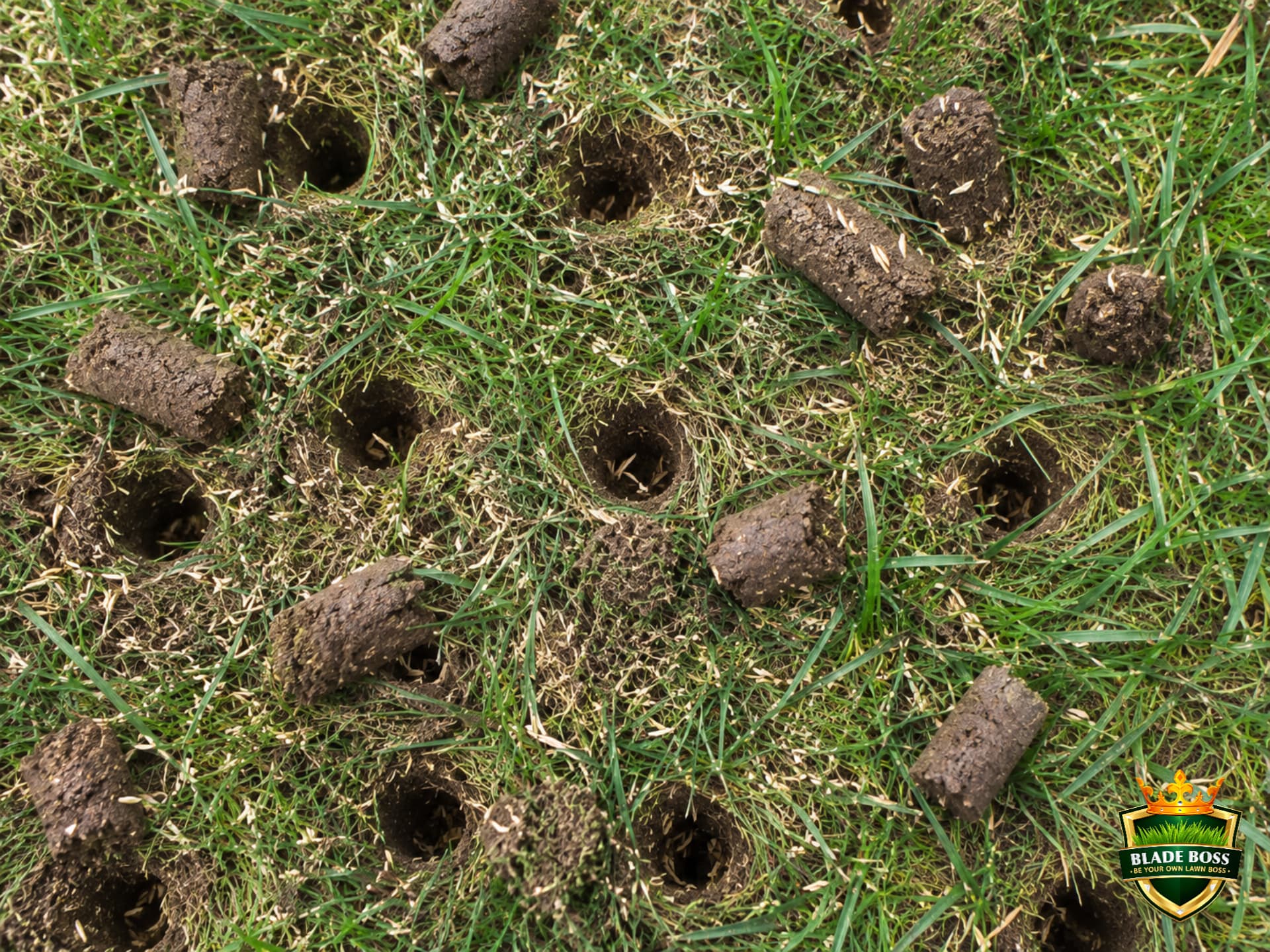
Run a core aerator across the entire lawn. Make two passes in perpendicular directions for maximum coverage. The 2 to 3 inch plugs create pockets of loose soil where seed settles, holds moisture, and makes direct contact with earth. On Long Island's sandy soils, aeration also breaks up the surface crust that forms over summer. Leave the cores on the surface. They break down in 1 to 2 weeks and topdress naturally. Our aeration guide covers rental tips and technique.
Dethatch If Needed
If your thatch layer exceeds 0.5 inches, run a power dethatcher (available at most rental centers) before seeding. Thatch acts as a barrier between seed and soil. Seed sitting on top of thatch will not germinate because roots cannot reach the earth. Our dethatching guide covers how to measure and when to dethatch.
Spread the Seed
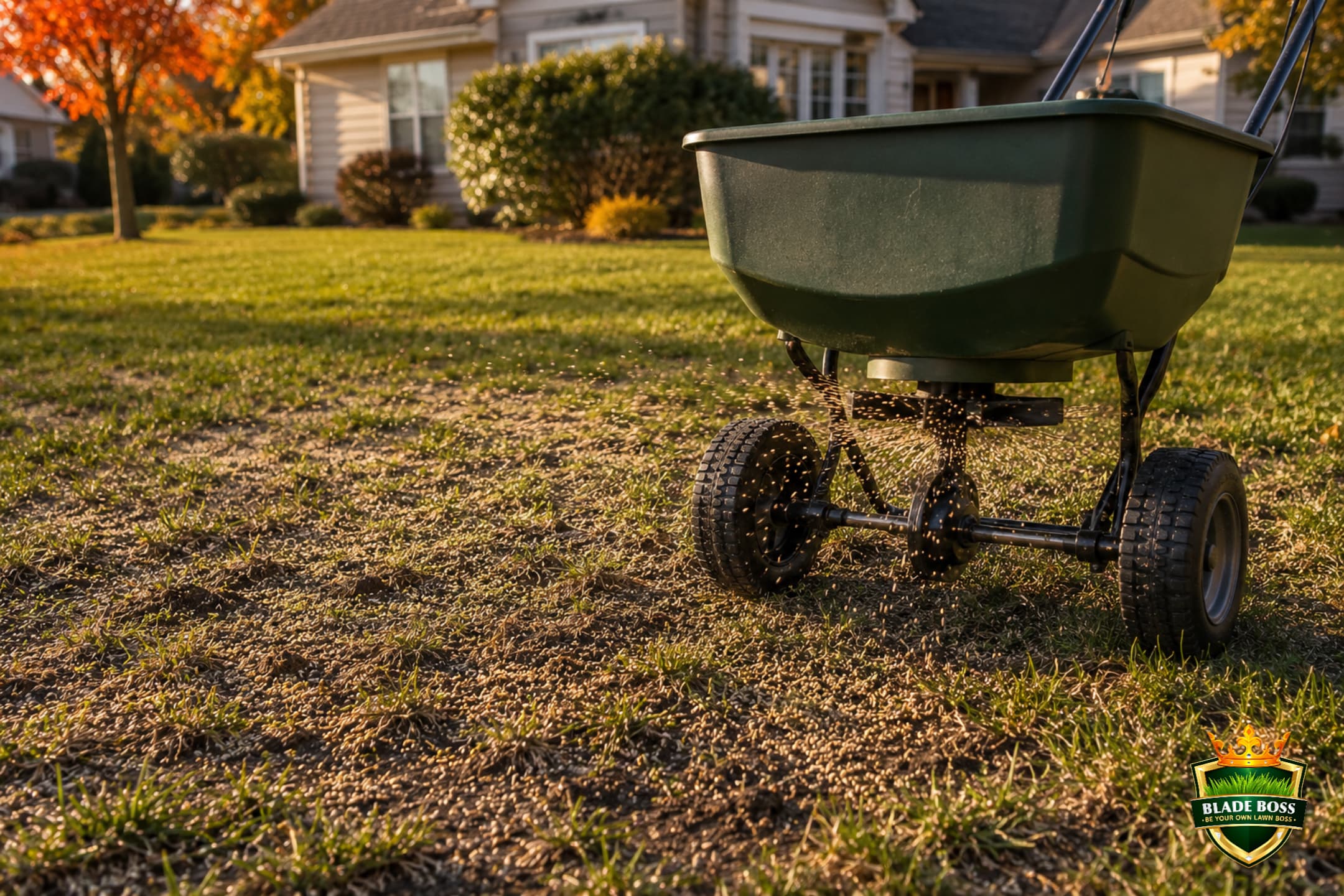
Use a broadcast spreader for large areas and hand-spread for edges and tight spots. For the most uniform coverage, apply half the seed walking north to south and the other half walking east to west (the Purdue cross-pattern method). This ensures even distribution and prevents striping. Calibrate your spreader for the specific seed product. Different seeds have different granule sizes. The SeedGenius Pro calculator gives you exact seed amounts per zone and the spreader setting for your specific seed product.
Apply Starter Fertilizer
Immediately after seeding, apply a high-phosphorus starter fertilizer. Phosphorus drives root development, which is the #1 priority for new seedlings. Use a product like Lesco 18-24-12 or Scotts Starter 24-25-4. Apply at the bag-recommended rate. Do NOT use a regular lawn fertilizer (high nitrogen, low phosphorus) at seeding. The seedlings need roots, not leaves.
Apply Tenacity If Weed Pressure Is a Concern
If you have had crabgrass or annual weed issues, apply Tenacity (mesotrione) at the time of seeding. It provides 4 to 6 weeks of pre-emergent suppression without blocking grass seed germination. This is the ONLY pre-emergent safe to use at seeding. All others (prodiamine, dithiopyr, pendimethalin) will kill your new grass along with the weeds.
Cover the Seed (Optional but Helpful)
For bare or thin areas, a light covering of peat moss or straw mulch helps retain moisture during germination. Do not bury the seed. A thin 1/4-inch layer is enough to hold moisture and protect from birds. On slopes, use an erosion control blanket or tackified straw to prevent seed from washing away in rain.
Water: The Make-or-Break Step
This is where most overseeding projects fail. New seed needs consistent moisture in the top 1 to 2 inches of soil for the entire germination period (14 to 21 days for KBG, 7 to 14 for TTTF, 5 to 10 for PRG). Water 2 to 3 times per day for 5 to 10 minutes per zone. The soil surface should be moist but not puddling. Once seedlings emerge and reach 1 inch, reduce to once daily. After the first mow, transition to normal deep, infrequent watering. SeedGenius Pro builds the full germination-to-establishment watering timeline automatically for each zone.
Lesco Starter Fertilizer (18-24-12)
High phosphorus (24%) for root development. The starter fertilizer professionals use on new seed. Apply immediately after spreading seed at the label rate.
Check PriceEZ-Straw Seeding Mulch with Tackifier
Processed straw mulch with a built-in tackifier that holds seed and mulch in place. Retains moisture during germination. Breaks down naturally. Perfect for bare spots and slopes.
Check PriceRun Your Zones Through SeedGenius Pro
Select your grass type from the NTEP-backed seed database, pick your zones from Lawn Map Pro, and SeedGenius Pro calculates exact seed pounds, starter fertilizer amounts, spreader settings, and builds a germination-to-first-mow watering timeline for each zone. Results save directly to your Lawn Command Center.
The Watering Schedule (This Is Where People Fail)
More overseeding projects fail from bad watering than from bad seed, bad soil, or bad timing. The seed needs consistent moisture to germinate. Not flooding. Not drought. Consistent, light moisture in the top 1 to 2 inches. SeedGenius Pro generates a custom watering schedule based on your grass type and germination timeline, and you can save the aftercare checklist directly to your Lawn Command Center.
Germination Phase
Water 2 to 3 times per day, 5 to 10 minutes per zone. Keep the top 1 to 2 inches moist. Never let the surface dry out completely. Set your controller or use a timer. Early morning (6 AM), midday (12 PM), and late afternoon (4 PM) cycles work well.
Seedling Emergence
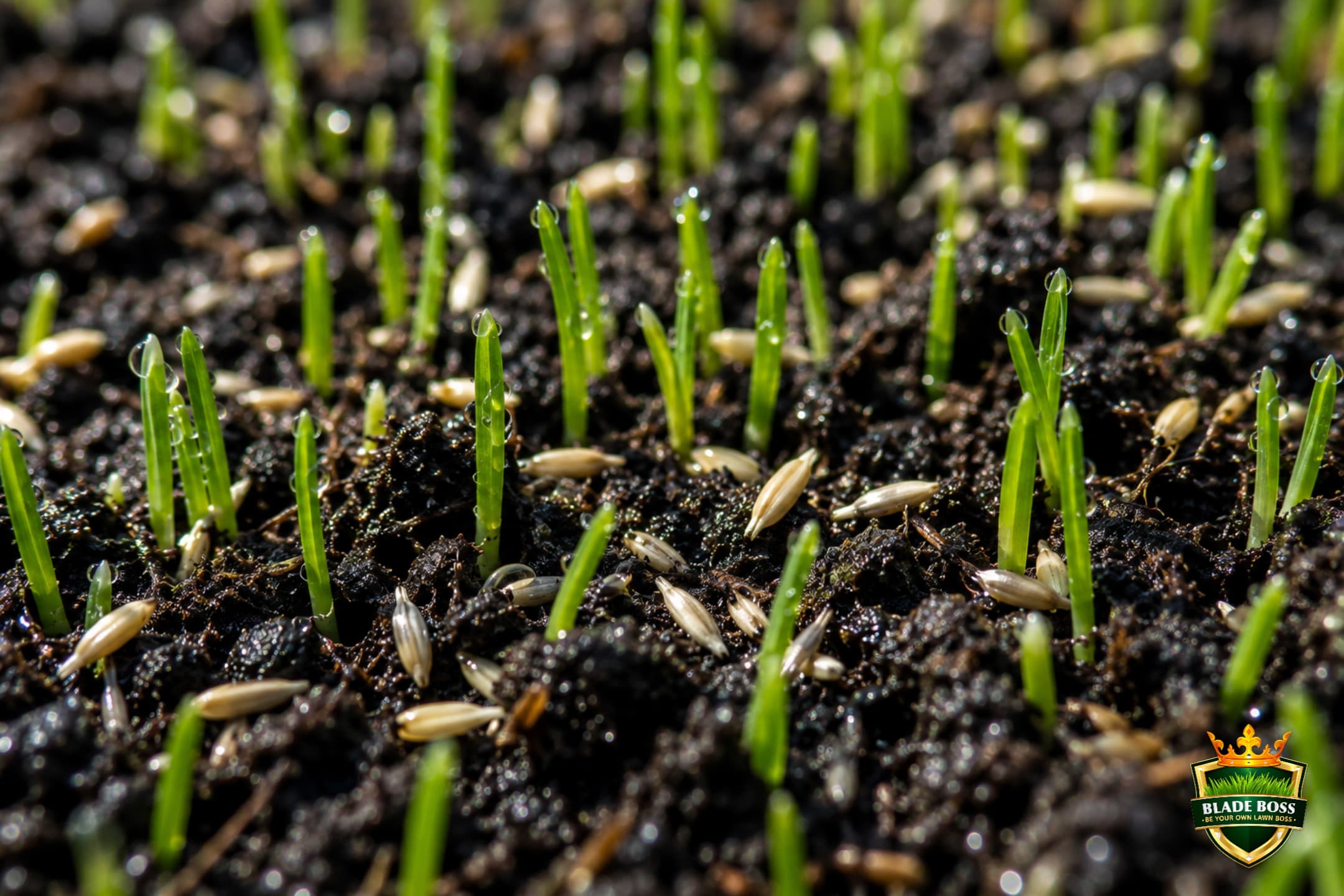
You will see tiny green shoots appearing. Reduce to once daily watering, slightly longer per cycle (10 to 15 minutes). Start letting the surface dry between waterings to encourage roots to grow down.
Establishment Phase
Seedlings are 1 to 2 inches tall. Water every other day, deeper per cycle (15 to 20 minutes). Root systems are developing. Begin transitioning to normal watering depth.
First Mow and Normal Care
When seedlings reach 3.5 to 4 inches, mow at 3 inches (remove only the top third). Use a sharp blade. Walk carefully on new turf. Transition to normal deep watering (0.5 inches every 2 to 3 days). Apply fall fertilizer (0.75 lbs N per 1,000) at the next scheduled round.
A seed that has started the germination process and then dries out is dead. It will not restart. One missed afternoon watering cycle on a hot September day can kill an entire seeding. This is not an exaggeration. If you cannot commit to 2 to 3 waterings per day for 2 weeks, either install a timer on your hose, set your irrigation controller to multiple start times, or wait until you can commit. Half-effort overseeding wastes your seed, your fertilizer, and your time.
One text when soil temps hit the ideal range for seeding on Long Island. No spam, just the window.
No spam. One seasonal alert per application window. Unsubscribe anytime.
The Pre-Emergent Conflict (And How to Handle It)
If you applied a spring pre-emergent (prodiamine or dithiopyr), the barrier may still be active in August depending on when you applied and at what rate. A full-rate prodiamine application in April can persist for up to 16 weeks, which means it could still be suppressing germination in mid-August.
The fix: core aeration. Running a core aerator physically breaks through the pre-emergent barrier by pulling plugs of soil from below the treated layer. This is another reason to always aerate before overseeding. It is not just about seed-to-soil contact. It is about clearing the chemical barrier so your new seed can actually germinate.
If you used a split-application strategy at half rate (as we recommend in the pre-emergent guide), the barrier degrades faster and is less likely to interfere with fall seeding. This is one of the underrated benefits of the split-app approach: it leaves the door open for fall overseeding without completely eliminating spring crabgrass protection.
Fall Overseeding on Sandy Soil (The LI Special)
Long Island's sandy soils (CEC 3 to 8) create two specific challenges for overseeding that clay-soil homeowners do not face:
- Water drains fast. The top 2 inches can go from moist to dry in 4 to 6 hours on a warm September day. This means your germination watering schedule needs to be more frequent (3x/day instead of 2x) and you cannot skip cycles. A moisture meter at the surface tells you when to water instead of guessing.
- Starter fertilizer leaches fast. That high-phosphorus starter you applied at seeding will flush below the seedling root zone within 2 to 3 heavy rain events. Consider a second light application of starter fertilizer 3 weeks after seeding if you get significant rain during the germination period.
- Peat moss helps significantly. A thin (1/4 inch) topdressing of sphagnum peat moss over seeded areas retains moisture dramatically better than bare sand. It also adds organic matter that improves the soil long-term. This is especially important on the South Shore (CEC 2 to 5).
- Seed-to-soil contact is easier. The one advantage of sand: it does not crust over like clay. Seed settles into sandy soil naturally, especially after aeration. You do not need a power seeder (slit seeder) on sandy soil the way you would on compacted clay.
The Overseeding Aftercare Checklist
- Water 2 to 3 times per day for 14 to 21 days. This is non-negotiable.
- Stay off the lawn. No foot traffic, no pets, no kids playing on it for at least 4 weeks.
- Do NOT apply weed killer for at least 4 to 6 weeks after seedlings emerge. Young grass cannot metabolize herbicide.
- First mow at 3 inches when seedlings reach 3.5 to 4 inches. Use a sharp blade. Walk, do not ride, on new turf.
- Apply fall fertilizer (0.75 lbs N per 1,000) at your next scheduled round after the first mow. Use the fertilizer schedule to time it.
- Apply fall pre-emergent for Poa annua in late September to mid-October (6+ weeks after seeding, and ONLY after seedlings have been mowed at least twice). Use prodiamine at the fall rate. If seedlings are not yet established, skip it this year.
- Continue mowing at 3 inches through fall. Gradually raise to normal height (3.5 to 4 inches) by late October.
- Apply winterizer (0.50 lbs N per 1,000) in late October to early November before the ground freezes.
The complete 5-round fertilizer program for Long Island lawns including the fall power round and winterizer timing. Print it and plan your entire season.
See what Blade Boss members get. SeedGenius Pro calculates exact seed rates from an NTEP-backed cultivar database, builds watering timelines, and saves your overseeding plan directly to the Lawn Command Center.
See Plans →Chris is a Combat Search and Rescue pilot turned airline pilot who built Blade Boss to bring military-grade precision to backyard lawn care. He overseeded his Ronkonkoma lawn in September 2024 with Jonathan Green Black Beauty Ultra over aerated sandy soil and watched it go from embarrassing to exceptional in 6 weeks. That experience built the protocols in this guide.
Related Reads
The grass types guide helps you pick the right seed for your conditions. The aeration guide covers rental tips and technique for the core aeration step. The pre-emergent comparison explains why Tenacity is the only option at seeding. And the fertilizer schedule shows exactly when the fall power round and winterizer fit into the aftercare timeline. And the fall lawn care checklist ties it all together.
Frequently Asked Questions
When is the best time to overseed on Long Island?
The optimal overseeding window on Long Island (USDA Zone 7B) runs from August 15 through September 30, with a hard cutoff of October 5. Soil temperatures during this window are 50 to 65 degrees at 4-inch depth, which is ideal for cool-season grass germination. Air temperatures are 60 to 75 degrees, which supports strong seedling growth without heat stress. Seeds planted after October 5 may not establish enough root depth to survive the first winter freeze.
How much grass seed do I need per 1,000 square feet for overseeding?
Seed rates for overseeding depend on your grass type and the severity of thinning. For patching thin spots: KBG 1 to 2 lbs per 1,000 sq ft, tall fescue 4 to 6 lbs, perennial ryegrass 4 to 6 lbs. For full overseeding: KBG 2 to 3 lbs, tall fescue 6 to 8 lbs, perennial ryegrass 6 to 8 lbs. For a full renovation (starting over): KBG 2 to 3 lbs, tall fescue 8 to 10 lbs, perennial ryegrass 8 to 10 lbs. More seed is not better. Overcrowding creates weak, spindly seedlings that compete with each other.
Should I aerate before overseeding?
Yes. Core aeration before overseeding is the single most effective way to improve seed-to-soil contact, which is the number one factor in germination success. The aeration cores create pockets in the soil where seeds settle, stay moist, and have direct contact with the earth. On Long Island's compacted sandy soils, aeration also breaks up the top crust and allows water to penetrate more evenly during the critical germination watering period.
Can you use pre-emergent and overseed at the same time?
Standard pre-emergents (prodiamine, dithiopyr, pendimethalin) will prevent your grass seed from germinating just like they prevent crabgrass. You cannot use them at seeding time. The one exception is Tenacity (mesotrione), which provides pre-emergent crabgrass suppression for 4 to 6 weeks without blocking grass seed germination. Apply Tenacity at the time of seeding if weed pressure is a concern.
How often should you water after overseeding?
During germination (first 14 to 21 days), keep the top 1 to 2 inches of soil consistently moist but not waterlogged. This typically means 2 to 3 light waterings per day (5 to 10 minutes per zone) depending on sun exposure and wind. After seedlings emerge and reach 1 inch tall, reduce to once daily. After the first mow (when seedlings reach 3.5 to 4 inches), transition to normal deep, infrequent watering (0.5 inches every 2 to 3 days). The goal is to gradually wean seedlings off constant moisture and train roots to grow deep.

Keep Reading
 DIY How-To
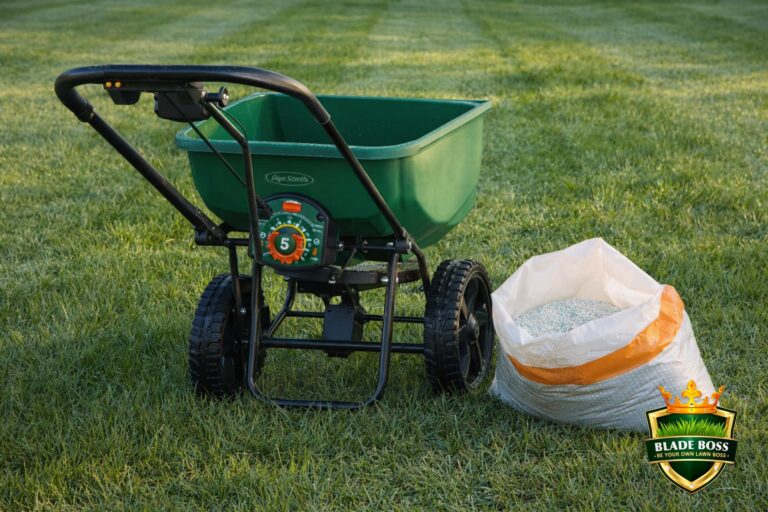
Best Spreader Settings for Scotts, Lesco, and Echo Spreaders
Bag settings are starting points, not guarantees. Here are verified label settings for 9 common products, the SiteOne...
Apr 2, 2026
13 min
 DIY How-To
GDD Explained: The Secret to Perfect Lawn Timing
Growing degree days (GDD) predict exactly when to apply pre-emergent, fertilize, and treat for pests on your lawn....
Feb 25, 2026
14 min
 DIY How-To
Long Island Lawn Irrigation Guide: How Much Water Does Your Lawn Actually Need?
Long Island gets 46 inches of rain a year. Your lawn still needs supplemental water. Learn exactly how...
Mar 19, 2026
19 min
What is your lawn actually sitting on?
Pull the soil survey, hardiness zone and current growing conditions for your exact address. Eight government sources, about a minute.
No comments yet. Be the first to share your thoughts.
Create a free account to join the conversation.