Every spring, millions of homeowners grab a bag of fertilizer, read the back, set their spreader to whatever number it says, and walk laps around the yard. They have no idea how much nitrogen they just applied.
And that's the problem. The bag doesn't know your grass type. It doesn't know your soil pH. It doesn't know you're on Long Island, sitting over a sole-source aquifer with some of the strictest fertilizer laws in the country. It doesn't know that 86% of Suffolk County soil samples submitted to labs tested high for phosphorus (Cornell Nutrient Management Spear Program, 2002 to 2006 data based on submitted samples, not a randomized survey), so that "complete" fertilizer you just spread is dumping nutrients your lawn can't use straight into the groundwater.
The answer to "how much fertilizer does my lawn need" is: it depends. It depends on your soil test, your grass type, the time of year, and the math behind the numbers on the bag. This guide teaches you that math, explains why it matters, and gives you a free calculator that does it for you.
How much fertilizer your lawn needs depends on your soil test results and grass type.
Annual nitrogen by grass type: Kentucky Bluegrass: 2 to 4 lbs N/1,000 sq ft. Tall Fescue: 2.0 to 3.5 lbs. Fine Fescue: 1 to 2 lbs.
Long Island law: Suffolk County blackout November 1 through April 1. Nassau: November 15. No phosphorus without soil test. NEIWPCC voluntary guideline: Recommends max 2.0 lbs N/year for sensitive aquifer areas. Cornell CCE recommends 2 to 3 lbs for most LI lawns.
The formula: (Square Footage / 1,000) x Desired N Rate = Total N Needed. Then: Total N Needed / (Bag N% / 100) = Pounds of Product.
A soil test from Cornell Cooperative Extension tells you exactly which nutrients your soil is missing, so you buy the right product instead of the cheapest bag.
Why "Follow the Bag Rate" Is Bad Advice
Here's what most people do every spring. They grab a bag of fertilizer, flip it over, find the spreader setting chart, set the dial, and start walking. The bag says something like "covers 5,000 sq ft" and that's all the information they use. Done.
Here's the problem. That bag has no idea what grass type you have. It doesn't know your soil pH, your potassium levels, or whether your soil even needs phosphorus. It doesn't know that you're on Long Island, where Suffolk County bans fertilizer from November 1 through April 1 and where 86% of soils already test high for phosphorus. The bag was designed to sell in every state to every lawn, and your lawn isn't every lawn.
The result? You might be putting down too much nitrogen (burning the grass and wasting money), too little nitrogen (wondering why your neighbor's lawn looks better), or the completely wrong NPK ratio for your soil conditions. Later in this guide, we'll do the actual math on a bag of Scotts Turf Builder and show you exactly how much nitrogen it's really applying. The answer might surprise you.
Professional turf managers and serious DIYers never look at the bag rate. They look at one number: the nitrogen percentage. Then they calculate the exact rate of pounds of nitrogen per 1,000 square feet they want to apply. That's the shift. Once you understand this, you'll never follow a bag rate again. This is exactly the kind of precision that separates DIY from generic service programs. Our DIY vs. lawn care services comparison shows why data-driven homeowners often get better results.
Stop thinking in "bags per lawn." Start thinking in "pounds of nitrogen per 1,000 square feet." That single change turns you from a consumer following package instructions into someone who actually controls what goes onto their lawn.
Step Zero: The Soil Test (Non-Negotiable)
Before you calculate a single rate, you need a soil test. This isn't optional. Our complete soil pH guide covers this in depth, but here's the short version: a soil test tells you exactly what your soil has and what it's missing. Without it, you're guessing, and guessing with fertilizer on Long Island is expensive and irresponsible.
Here's why this matters for fertilizer selection. New York State law bans phosphorus in lawn fertilizers for established lawns unless a soil test shows a deficiency. And according to Cornell's Nutrient Management Spear Program, 86% of Suffolk County soil submissions already test high for phosphorus. That means the vast majority of Long Island homeowners should be using zero-phosphorus fertilizers. If you're buying a "complete" NPK product without a soil test, you're likely paying for phosphorus your lawn doesn't need and dumping it into the aquifer.
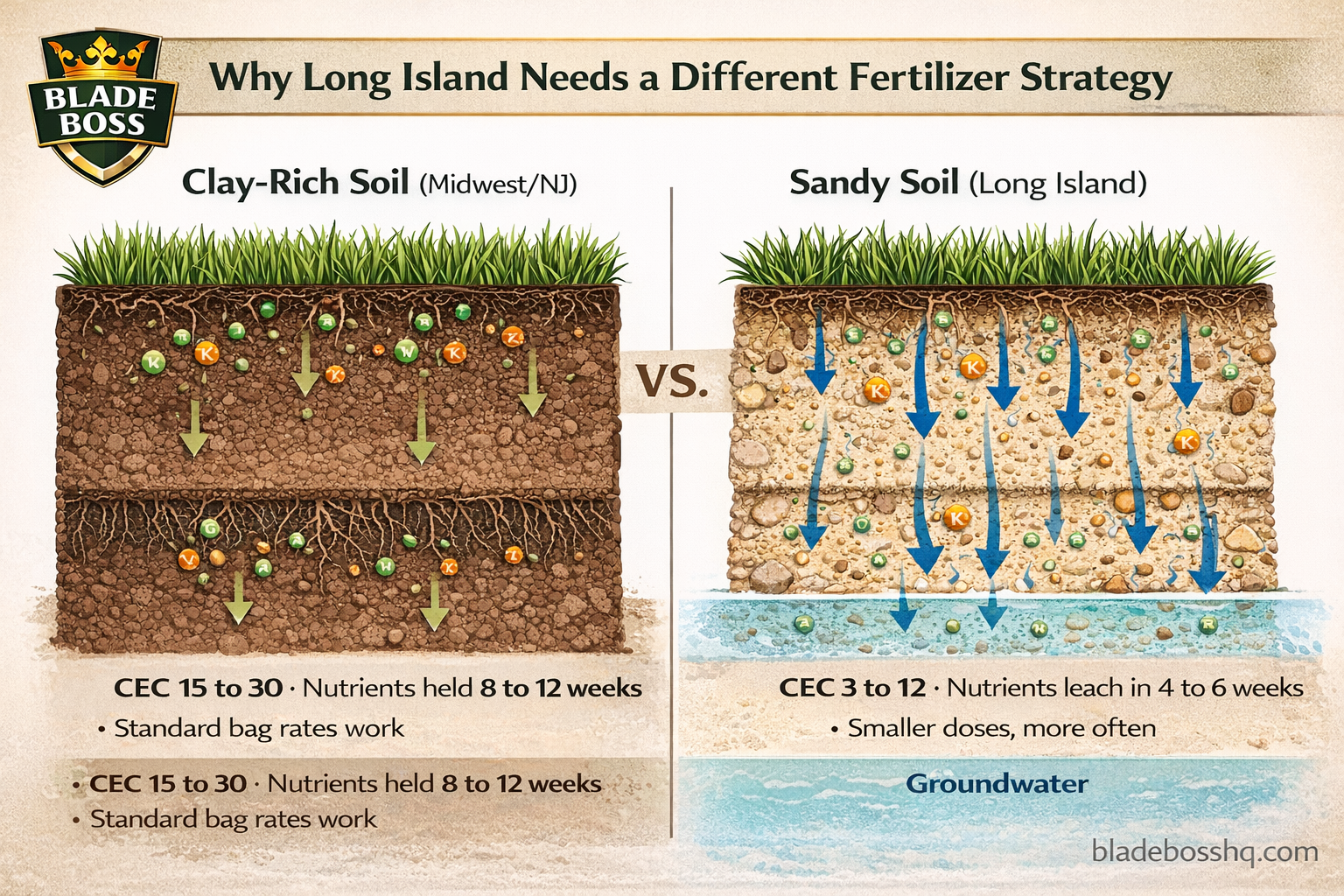
Long Island's sandy soils have a low cation exchange capacity (a defining Zone 7B characteristic) (CEC), which means they don't hold onto nutrients well. Nitrogen and potassium leach through sandy soil much faster than through clay-rich soils upstate or in New Jersey. This has two implications: first, you need to apply nitrogen more frequently at lower rates rather than dumping a big dose twice a year. Second, potassium (the K in NPK) should be supplemented annually because it washes through sand quickly. A soil test tells you the exact levels. On Long Island's sandy outwash soils, those rates need adjustment. Our sandy soil lawn care guide explains why you should cap quick-release N at 0.50 lbs per app on sand.
Sandy Long Island soils commonly run low in nitrogen, potassium, calcium, and magnesium because these nutrients leach through sand quickly. They commonly run high in phosphorus and sodium. At very low pH (below 5.5), iron and manganese can actually become too available and reach toxic levels, while at high pH (above 7.0), iron chlorosis becomes a risk. This is why "grab a bag of 10-10-10" is terrible advice here. Your soil almost certainly doesn't need equal parts of everything.
Order a soil test from Cornell Cooperative Extension Suffolk County for about $20. Results come back in 2 to 3 weeks with specific nutrient levels, pH reading, and amendment recommendations. If you want faster results with a more user-friendly process, the MySoil Test Kit ships to a professional lab and delivers results to your phone in about a week. Either way, import those results directly into our Soil Test Module for automated correction plans.
Import Your Soil Test Results
The Blade Boss Soil Test Module inside Lawn Map Pro™ interprets your lab results, identifies deficiencies, and generates zone-by-zone correction plans automatically. No more guessing what the numbers mean.
How Much Nitrogen Does Your Grass Type Need?
Once your soil test tells you what's missing, the next question is how much nitrogen to apply. This varies by grass type because different species metabolize nitrogen at different rates. Our complete grass type guide covers species selection in detail. Here's the nitrogen summary for the four grass types grown on Long Island.
| Grass Type | Low Maintenance | Moderate Maintenance | High Maintenance |
|---|---|---|---|
| Kentucky Bluegrass | 2.0 lbs N/1,000 sq ft | 3.0 lbs N/1,000 sq ft | 4.0 lbs N/1,000 sq ft |
| Turf-Type Tall Fescue | 2.0 lbs N/1,000 sq ft | 2.5 lbs N/1,000 sq ft | 3.0 to 3.5 lbs N/1,000 sq ft |
| Perennial Ryegrass | 2.0 lbs N/1,000 sq ft | 2.5 lbs N/1,000 sq ft | 3.0 lbs N/1,000 sq ft |
| Fine Fescue | 1.0 lbs N/1,000 sq ft | 1.5 lbs N/1,000 sq ft | 2.0 lbs N/1,000 sq ft |
Now here's the tension on Long Island. Your grass type might want 3 to 4 lbs N per year (high-maintenance KBG), but NEIWPCC sensitive-area guidelines recommend no more than 2.0 lbs of nitrogen per 1,000 square feet annually for areas over sole-source aquifer. That's a legal and environmental constraint you need to respect.
The way to bridge the gap is slow-release nitrogen. Turfgrass research supports higher application rates when more than 50% of the nitrogen is slow-release (water-insoluble nitrogen, or WIN). Slow-release products meter out nitrogen gradually over 8 to 12 weeks, reducing leaching risk. Rutgers NJAES research shows that slow-release dominant programs on sandy soils can safely deliver 2.5 to 3.5 lbs N per year with minimal groundwater impact, provided you follow the application schedule.
The 4-Step Fertilizer Math (NitroCalc Explained)
This is the math that every professional turf manager uses. Once you learn it, you'll never look at a bag rate the same way. It's four steps, and it's simple enough to do on your phone.
Calculate Nitrogen Needed
Formula: (Square Footage / 1,000) x Desired N Rate = Total N Needed (lbs)
You need to know your lawn's square footage. Lawn Map Pro gives you this to the square foot if you draw your zones. Let's say your lawn is 5,000 sq ft and you want to apply 0.75 lbs N per 1,000 sq ft.
5,000 / 1,000 = 5.0 units
5.0 x 0.75 = 3.75 lbs of nitrogen needed
Calculate Product Needed
Formula: N Needed / (N% / 100) = Pounds of Product
Look at the fertilizer bag. The first number in the NPK ratio is the nitrogen percentage. If your bag says 24-0-11, the nitrogen percentage is 24%.
3.75 / (24 / 100) = 3.75 / 0.24 = 15.6 lbs of product needed
Calculate Bags Needed
Formula: Product Needed / Bag Weight = Bags
If your bag weighs 50 lbs:
15.6 / 50 = 0.31 bags
One bag covers more than three applications at this rate. That's money saved.
Calculate Coverage Per Bag
Formula: (Bag Weight x N%) / Rate x 1,000 = Square Feet Per Bag
(50 x 0.24) / 0.75 x 1,000 = 12 / 0.75 x 1,000 = 16,000 sq ft per bag
Now you know exactly how far one bag goes at your chosen rate. No more "one bag per 5,000 sq ft" guessing.
Join Long Island homeowners who get fertilizer timing alerts, rate calculators, and data-driven lawn care tips every week.
The same 50 lb bag of 24-0-11 covers 16,000 sq ft at 0.75 lbs N per 1,000 or only 12,000 sq ft at 1.0 lbs N. If you follow bag rates designed for a different lawn in a different state with different soil, you could be over-applying by 30% or under-applying by 50%. The math puts you in control.
Now circle back to that bag of Scotts Turf Builder 32-0-4 we mentioned earlier. The 12.5 lb bag says it covers 5,000 sq ft. Run the math: 12.5 lbs of product x 0.32 (nitrogen percentage) = 4.0 lbs of actual nitrogen across 5,000 sq ft. That's 0.8 lbs N per 1,000 square feet in a single application. Is that the right rate for your lawn in April? In September? The bag doesn't know. But now you do.
Skip the Math. Use NitroCalc Pro.
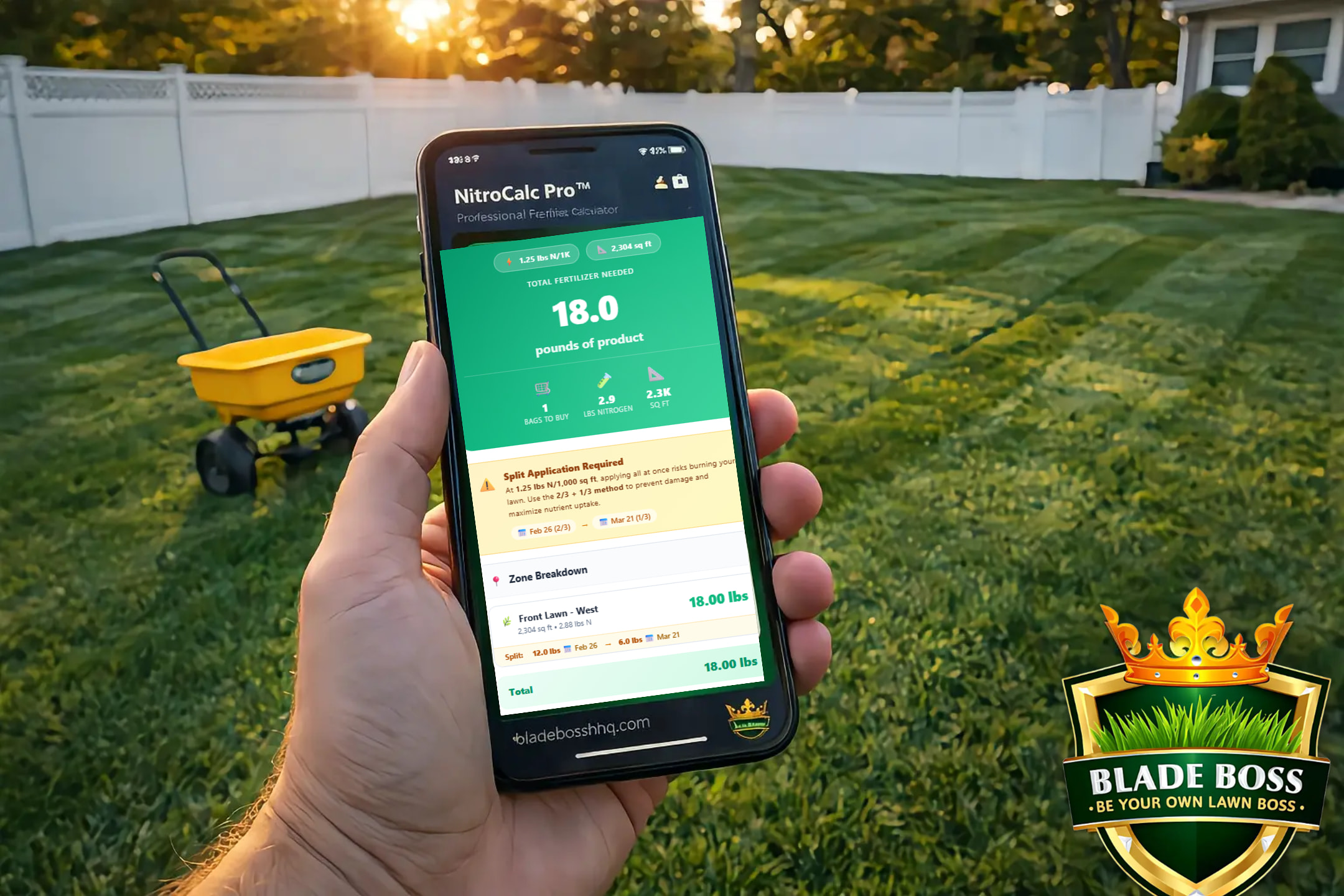
NitroCalc Pro™ does all four steps instantly. Select your lawn zones, pick a nitrogen rate, choose your product, and get exact pounds of fertilizer needed, bags required, coverage per bag, and cost per 1,000 sq ft. It even auto-splits applications over 1.25 lbs N.
Reading the Bag: NPK Decoded
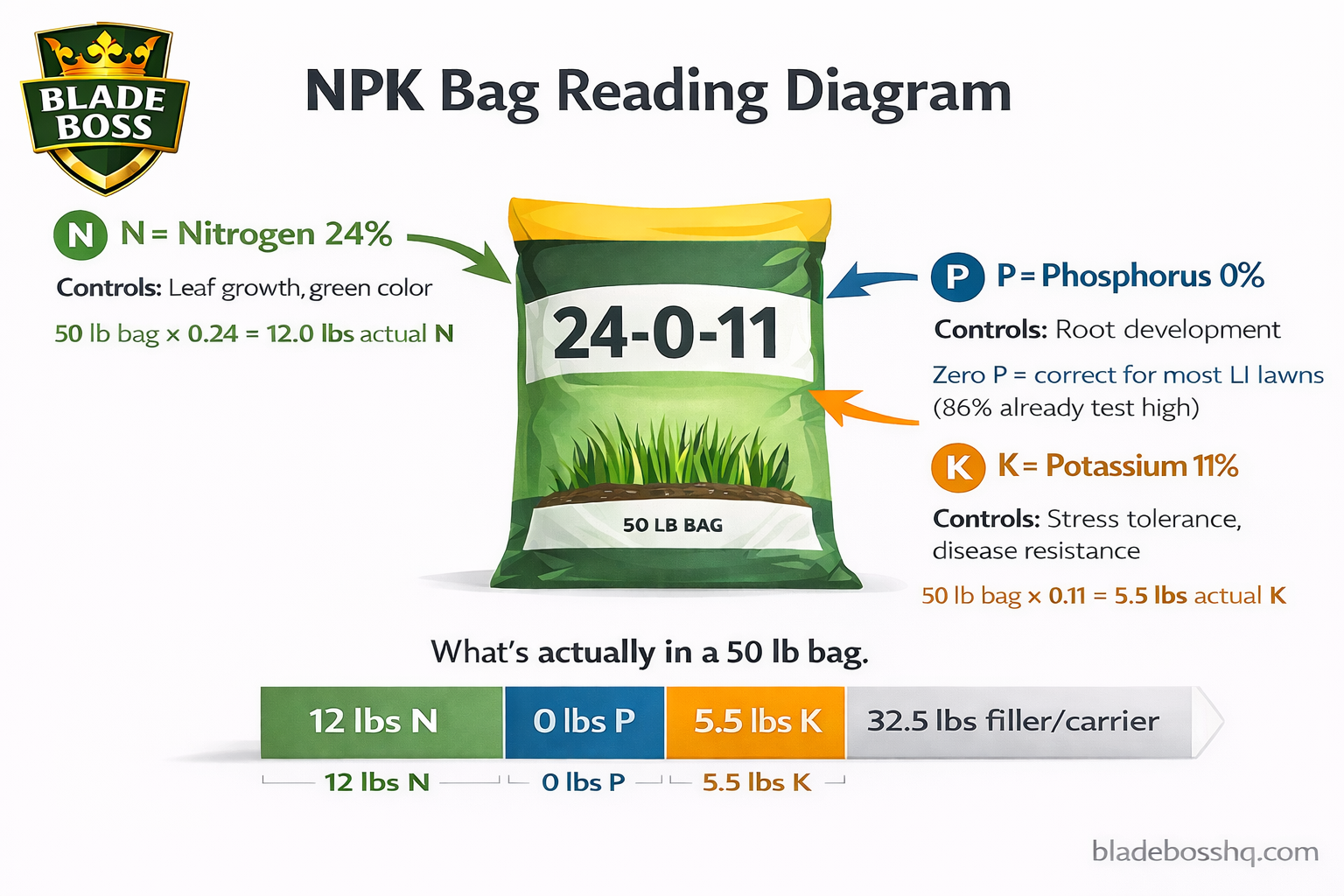
Every fertilizer bag has three numbers separated by dashes. That's the NPK ratio: nitrogen (N), phosphorus (P), and potassium (K). These numbers represent the percentage by weight of each nutrient. A 50 lb bag of 24-0-11 contains 12 lbs of nitrogen (50 x 0.24), 0 lbs of phosphorus, and 5.5 lbs of potassium (50 x 0.11).
Here's the part most people miss: the remaining 32.5 lbs in that bag is filler. Inert carrier material that helps distribute the nutrients evenly. You're not buying 50 lbs of fertilizer. You're buying 17.5 lbs of nutrients and 32.5 lbs of carrier. That's normal and necessary for even application, but it's why calculating by nitrogen percentage is so important. A bag of 6-4-0 (like Milorganite) has vastly less nitrogen per pound than a bag of 32-0-4 (like Scotts Turf Builder). You'd need five times the product weight to deliver the same nitrogen.
And remember: on Long Island, that middle number (phosphorus) should almost always be zero unless your soil test specifically shows a phosphorus deficiency. New York State law bans it for established lawns, and most LI soils already have too much.
Decode Any Fertilizer Bag with NPK Calculator Pro
NPK Calculator Pro™ inside Lawn Map Pro™ breaks down any fertilizer's NPK ratio instantly. Enter the three numbers from any bag and get a full analysis: what category it falls into, what it's best used for, what it's NOT ideal for, optimal timing, and pro tips. Compare two products side by side to find the best value.
The Split Application Technique (2/3 + 1/3)
Here's what works for me on my own lawn in Ronkonkoma. For my first spring application, I apply at 1.25 lbs of nitrogen per 1,000 square feet using the split technique (more on that below). That's above the 1.0 lb "max safe" threshold you'll see in most extension guides, but it works because I use predominantly slow-release nitrogen products and I split the application into two passes.
After that initial spring push, I switch to smaller maintenance feedings of 0.25 to 0.50 lbs N per 1,000 sq ft every 3 to 4 weeks through the growing season. That consistent, light feeding is what keeps my lawn green all summer while my neighbors' lawns go brown in July. The other piece of the puzzle is irrigation: my watering schedule is dialed in to deliver exactly what the grass needs, so the nitrogen I apply actually gets used instead of sitting on dry soil.
If your lawn has weak roots, thin coverage, or you're still building density, do NOT follow this aggressive schedule. A struggling lawn can barely keep itself alive in summer heat. Pushing growth with frequent nitrogen applications on a weak root system is like running sprints on a sprained ankle. Build your foundation first with proper overseeding, soil amendments, and a standard 3 to 5 round fertilizer schedule. Once you have thick, deep-rooted turf and proper irrigation, then you can move to maintenance feeding.
The split application technique is simple. Instead of putting down 1.25 lbs N all at once (which risks nitrogen burn and runoff), you split it into two passes: two-thirds now, one-third in 2 to 3 weeks. The grass processes the first dose, and by the time the second dose arrives, it's ready for more. NitroCalc Pro automatically calculates the split when you select a rate of 1.25 or higher.
Let's walk through the split math for that first spring application. Say you have a 5,000 sq ft lawn and you're applying at 1.25 lbs N per 1,000 sq ft using a 24% nitrogen product.
- Total nitrogen needed: (5,000 / 1,000) x 1.25 = 6.25 lbs N
- Total product needed: 6.25 / 0.24 = 26.04 lbs of product
- First application (67%): 26.04 x 0.667 = 17.4 lbs of product (spread now, water in immediately)
- Second application (33%): 26.04 x 0.333 = 8.7 lbs of product (spread 2 to 3 weeks later, water in)
For the most even coverage on each pass, set your spreader to deliver half the required product rate and make two perpendicular passes (north-south, then east-west). This eliminates striping from uneven spreader distribution. For the first split application of 17.4 lbs across 5,000 sq ft, you'd set the spreader for about 1.74 lbs per 1,000 sq ft and walk the lawn twice.
The Long Island 5-Round Fertilizer Schedule
Based on Rutgers NJAES, Cornell CCE, and Penn State Extension research, calibrated to Long Island's climate data and Suffolk County Local Law No. 41-2007 fertilizer blackout dates, here's the 5-round schedule. Our complete month-by-month calendar integrates these rounds with every other lawn care task. If you want the complete month-by-month schedule with the 2/3 + 1/3 split application technique and science-based rates by grass type, see our Best Fertilizer Schedule for Long Island.
Round 1: Spring Wake-Up (0.5 lbs N)
Apr 15 to Apr 30. Light dose, slow-release dominant (40%+ WIN). Soil has crossed 55°F. Grass is actively growing. Do NOT apply before Apr 15, and skip entirely if your Oct winterizer was strong and the lawn looks dense. This round feeds spring green-up without pushing excessive top growth.
Round 2: Spring Bridge (0.25 lbs N), OPTIONAL
May 20 to May 30. Optional light feeding for lawns that need extra density. Skip if your lawn is already thick from fall feeding. Use slow-release or organic only. This is the last feeding before the summer stress period.
Round 3: Fall Kickoff (0.75 lbs N)
Aug 25 to Sep 5. This is where the serious feeding starts. Fall is when cool-season grasses build root density and carbohydrate reserves. Use 60%+ slow-release on sandy soils. If you're fighting crabgrass, this is also when late-season crabgrass is dying and you're thickening the turf to prevent next year's invasion.
Round 4: Peak Fall Feeding (0.75 lbs N)
Sep 20 to Oct 5. The single most important fertilizer application of the year for cool-season lawns. This builds the turf density and root reserves that carry your lawn through winter and drive early spring green-up. 70% slow-release. If you're overseeding, apply starter fertilizer (higher P allowed for new seed) instead of standard maintenance fert.
Round 5: Winterizer (0.5 lbs N)
Oct 15 to Oct 25. The final feeding before Suffolk County's November 1 blackout. Grass is still green but top growth has slowed. Roots are actively storing carbohydrates for winter survival and spring green-up. Keep this round light (0.5 lbs) because late-season nitrogen on sandy soil has elevated leaching risk as grass uptake slows. Use slow-release (60%+ WIN).
Total annual nitrogen on this schedule: 2.75 lbs N per 1,000 sq ft (with optional Round 2) or 2.50 lbs without it. This falls right in the middle of Cornell Cooperative Extension's 2 to 3 lbs per year recommendation for Long Island lawns. If you're aiming for a lighter program at 2.0 lbs total, run Rounds 1, 3, and 4 only (skipping the optional spring bridge and the winterizer) and use exclusively slow-release products.
Rounds 3 and 4 apply 0.75 lbs total N, slightly above the NEIWPCC voluntary guideline of 0.7 lbs per application for sensitive areas. Here's why it's safe:
The 0.7 guideline targets water-soluble nitrogen (the stuff that leaches immediately). When 60%+ of your product is slow-release (water-insoluble nitrogen, or WIN), the water-soluble portion stays well under 0.5 lbs per application.
Example math: A 0.75 lb N application using a product with 65% slow-release delivers only 0.26 lbs of water-soluble N, half the NEIWPCC 0.5 lb WSN guideline.
The per-application guideline exists to protect groundwater from soluble nitrogen. Slow-release dominant programs achieve that goal while delivering more total N to the plant over time.
For most homeowners, do NOT apply nitrogen fertilizer in July. Cool-season grass is under heat and drought stress. Adding nitrogen forces top growth the plant can't support, burns out stored carbohydrates, and creates ideal conditions for brown patch and summer patch disease. If your lawn looks rough in July, the answer is water and patience, not fertilizer.
Advanced exception (Lawn Legend tier): Established, irrigated lawns with thick root systems can handle light spoon-feeding at 0.25 lbs N per 1,000 sq ft every 3 to 4 weeks using organic or slow-release products (like Milorganite). Skip during heat waves above 90°F or if brown patch is active. See our complete fertilizer schedule for the full Advanced track.
The Regulatory Reality on Long Island
Long Island has some of the strictest fertilizer regulations in the Northeast, and for good reason. The entire island sits over a sole-source aquifer that provides drinking water to millions of people. Every pound of nitrogen that leaches through your sandy soil ends up in that groundwater. Here are the rules you need to know.
Get a printable card with N rates by grass type, spreader settings, and the 2/3 + 1/3 split formula.
| Regulation | Rule | Applies To |
|---|---|---|
| Suffolk County (Local Law 41-2007) | No lawn fertilization Nov 1 through Apr 1 | All Suffolk County properties |
| Nassau County | No lawn fertilization Nov 15 through Apr 1 | All Nassau County properties |
| New York State | No lawn fertilization Dec 1 through Apr 1 | Statewide baseline |
| NY Phosphorus Ban | No phosphorus unless soil test shows deficiency | All established NY lawns |
| NEIWPCC Guideline (voluntary) | Recommends max 2.0 lbs N per 1,000 sq ft per year | Long Island (sole-source aquifer) |
| NEIWPCC Per-App Guideline (voluntary) | Recommends max 0.7 lbs total N per app; max 0.5 lbs water-soluble N per app | Long Island (slow-release dominant programs may exceed 0.7 total N) |
The controlling rule for Suffolk County homeowners is the most restrictive one: no fertilizer between November 1 and April 1. Separately, NEIWPCC voluntary guidelines recommend a maximum of 2.0 lbs N per year for areas over sole-source aquifers. Higher-maintenance programs (2.5 to 3.5 lbs N) are agronomically sound when using 60%+ slow-release nitrogen, but you should understand you're exceeding the NEIWPCC guideline even if there's no statewide numeric N cap in New York law.
Why Sandy Soil Changes Everything
Most fertilizer advice on the internet is written for Midwest clay soils. Long Island's soils are glacial outwash: predominantly sandy loam from the Haven, Riverhead, and Plymouth soil associations. This matters enormously for fertilizer strategy.
Sandy soils have a CEC (cation exchange capacity) of 3 to 12 on Long Island, compared to 15 to 30 for clay-rich soils. CEC measures how well soil holds onto positively charged nutrient ions like ammonium (NH4+), potassium (K+), calcium (Ca2+), and magnesium (Mg2+). Low CEC means nutrients wash through faster. That "12-week residual" on a pre-emergent label or the "feeds for 8 weeks" claim on a fertilizer bag? Those numbers were tested on heavier soils. On Long Island sand, you might get 6 to 8 weeks of effective residual.
This is why the split-application approach and the 5-round schedule work so well here. Instead of two or three heavy doses that leach through before the grass can use them, you're applying smaller amounts more frequently, keeping a consistent supply of available nitrogen in the root zone. Think of it like your spreader hopper: you wouldn't dump an entire bag in and try to spread it in one pass at the highest setting. You'd get stripes of burnt grass and bare spots in between. Same concept with nitrogen in sandy soil. Controlled, consistent delivery beats one massive dump every time.
Choosing the Right Product (It Depends on Your Soil Test)
This is where most articles give you a product list and tell you what to buy. We're not going to do that, because the right product depends entirely on your soil test. A lawn with adequate potassium needs a different fertilizer than a lawn that's potassium-depleted. A lawn at pH 5.5 has different nutrient availability than one at pH 6.5. Your soil pH directly controls how efficiently your grass can access every nutrient you apply.
That said, here are the general guidelines for Long Island based on what we see most often in soil tests.
Most LI lawns: Use a high-N, zero-P, moderate-K product
Since 86% of Suffolk County soils test high for phosphorus, most homeowners should use products like 24-0-11, 32-0-4, 29-0-3, or 22-0-10. The zero in the middle means zero phosphorus. The potassium (third number) supplements what our sandy soils leach out. Look for 40% or higher slow-release nitrogen (listed as WIN or water-insoluble nitrogen on the guaranteed analysis).
Post-seeding: Use a starter fertilizer (phosphorus IS needed here)
New seed and sod need phosphorus for root establishment. This is the one legal exception to the NY phosphorus ban. Starter fertilizers like 24-25-4 or 12-18-8 are appropriate for 4 to 6 weeks after seeding. After that, switch back to zero-P maintenance fertilizer.
Low-pH soils (below 6.0): Fix pH first, then fertilize
If your soil pH is below 6.0, nutrients are locked up regardless of how much fertilizer you apply. Nitrogen availability drops significantly below pH 5.5. Fix the pH with calcitic or dolomitic lime (our pH Balance Pro calculator tells you exactly how much), wait 4 to 6 weeks, then start your fertilizer program.
Organic vs. synthetic: Know the tradeoff
Organic fertilizers like Milorganite (6-4-0) release nitrogen slowly through microbial breakdown, which is great for sandy soils. But they're low-analysis, meaning you need a lot more product weight to deliver the same nitrogen. At 6% N, you need 12.5 lbs of Milorganite to deliver 0.75 lbs N per 1,000 sq ft, versus 3.1 lbs of a synthetic 24-0-11. Organics also don't work well in cold soil (below 50°F) because microbial activity slows down. Best used as summer bridge or supplement, not sole nitrogen source.
Common Fertilizer Mistakes on Long Island
Mistake #1: Applying too much nitrogen in spring
The biggest feeding should happen in fall, not spring. Heavy spring nitrogen forces lush top growth that depletes root carbohydrate reserves, increases mowing frequency, and makes grass more vulnerable to summer stress. Spring applications should be light (0.5 lbs N max) and slow-release. Save the heavy feeding for September and October.
Mistake #2: Using phosphorus without a soil test
New York State law prohibits it on established lawns, and most Long Island soils already have too much. Excess phosphorus doesn't help your grass but does contribute to algal blooms in local waterways. Always use zero-P products unless you're seeding or your soil test specifically shows a deficiency.
Mistake #3: Following Midwest bag rates on sandy soil
Those rates were calibrated for soils with 2 to 3 times the nutrient-holding capacity of Long Island sand. A single heavy application on sandy soil doesn't feed your lawn for 8 weeks. It feeds it for 4 weeks and then leaches into the groundwater. Use lower per-application rates with more frequent applications.
Mistake #4: Fertilizing during drought stress
Nitrogen forces growth. If your grass is already struggling through a July dry spell with limited root reserves, pushing growth with fertilizer is like asking a dehydrated runner to sprint. Water first. Fertilize when the plant is actively growing and can process the nutrients.
Mistake #5: Ignoring the blackout dates
Suffolk County: November 1 through April 1. Nassau County: November 15 through April 1. These are legal requirements, not suggestions. Fertilizing frozen or dormant lawns wastes product and sends nutrients straight into the aquifer. Plan your last application for mid-October at the latest.
Putting It All Together: Your Action Plan
- Get a soil test. Cornell Cooperative Extension for $20. Results tell you pH, P, K, Ca, Mg, and organic matter levels.
- Know your grass type. Identify your species so you know your annual nitrogen target.
- Measure your lawn. Use Lawn Map Pro to draw zones and get precise square footage. No more "I think it's about 5,000."
- Choose the right product. Zero phosphorus unless soil test says otherwise. 40%+ slow-release nitrogen. Match K to your soil test results.
- Calculate your rate. Use NitroCalc Pro or the 4-step formula above. Never follow bag rates blindly.
- Follow the schedule. The complete calendar maps every fertilizer round alongside pre-emergent, overseeding, and mowing tasks.
- Respect the blackout. Last application by mid-October. Suffolk County law is November 1.
Fertilizer isn't complicated once you understand the math. The problem is that the industry makes it feel complicated to sell you more bags. One $50 bag of professional-grade 24-0-11 might cover your entire lawn for three applications if you calculate the rate properly. Most homeowners buy three bags because they follow the bag rate and over-apply.
The Blade Boss Playbook walks through all 15 steps of a complete lawn care program, from soil testing through winterizer, with the exact products, rates, and timing for each step. Our Stripe Master members get the complete month-by-month system that integrates fertilizer with pre-emergent timing, GDD tracking, and every other task your lawn needs.
Now that you know your rates, put them on the calendar. Our aeration guide shows when to open up the soil for maximum nutrient absorption. Address grub damage before wasting fertilizer on dying turf. The spring recovery playbook helps repair bare spots first, and our grass type comparison confirms the right N rates for your species. If clover is outcompeting your grass, that's a nitrogen problem too. Blade Boss members also get access to the Dynamic Calendar for month-by-month task alerts. See also: Lesco vs Scotts. See also: troubleshooting guide.
See what Blade Boss members get and get instant access to NitroCalc Pro, pH Balance Pro, the Soil Test Module, and 20+ other lawn care calculators. Preview every tool, explore Lawn Map Pro, and see what data-driven lawn care looks like.
See Plans →Chris is a Combat Search and Rescue pilot turned airline pilot who built Blade Boss to bring aviation-level precision to lawn care. Every recommendation on this site is backed by zone-specific data and real science, not marketing copy. Read the full story.
Frequently Asked Questions
How many pounds of nitrogen does my lawn need per year?
Annual nitrogen needs depend on your grass type and maintenance level. Kentucky Bluegrass lawns need 2 to 4 lbs of nitrogen per 1,000 square feet per year for moderate to high maintenance. Turf-Type Tall Fescue needs 2 to 3.5 lbs. Fine Fescue needs 1 to 2 lbs. On Long Island, NEIWPCC voluntary guidelines recommend no more than 2.0 lbs of nitrogen per 1,000 square feet annually for areas over sole-source aquifers like Long Island. Cornell Cooperative Extension, however, recommends 2 to 3 lbs of nitrogen per year for most Long Island home lawns. A soil test is the only way to know exactly what your lawn needs.
How do I calculate how much fertilizer to apply?
Use this 4-step formula. Step 1: Divide your lawn's square footage by 1,000. Step 2: Multiply that number by your desired nitrogen rate (typically 0.5 to 1.0 lbs N per 1,000 sq ft per application). That gives you total nitrogen needed in pounds. Step 3: Divide the nitrogen needed by the nitrogen percentage on the bag (as a decimal). For example, if you need 3.75 lbs N and your fertilizer is 24% nitrogen, divide 3.75 by 0.24 to get 15.6 lbs of product. Step 4: Divide product needed by bag weight to determine how many bags to buy.
Should I follow the bag rate or calculate my own nitrogen rate?
Always calculate your own nitrogen rate. Bag rates are designed for a generic national audience and do not account for your grass type, soil conditions, local regulations, or time of year. On Long Island, Suffolk County law sets strict blackout dates (November 1 through April 1), and New York State bans phosphorus on established lawns without a soil test. The NEIWPCC regional guidelines also recommend annual nitrogen limits for areas over sole-source aquifers, though these are voluntary best practices, not enforceable law. A bag that says 'covers 5,000 sq ft' may be applying more or less nitrogen than your lawn actually needs. The professional approach is to calculate based on lbs of nitrogen per 1,000 square feet.
What fertilizer NPK ratio should I use on Long Island?
The NPK ratio you need depends entirely on your soil test results. New York State law bans phosphorus (the P in NPK) on established lawns unless a soil test shows a deficiency, and 86% of Suffolk County soil samples submitted to labs tested high for phosphorus (Cornell Spear Program, 2002 to 2006) according to Cornell's Nutrient Management Spear Program. Most Long Island lawns need a fertilizer with nitrogen and potassium but zero phosphorus, such as a 24-0-11 or 32-0-4. Potassium leaches quickly from sandy soils and should be supplemented annually. Get a soil test before buying any fertilizer.
When should I fertilize my lawn on Long Island?
On Long Island, the 5-round fertilizer schedule runs: Round 1 in mid to late April (0.5 lbs N), Round 2 in late May (0.25 lbs N, optional), Round 3 in late August (0.75 lbs N), Round 4 in late September (0.75 lbs N), and Round 5 in mid to late October (0.5 lbs N slow-release winterizer). Suffolk County prohibits lawn fertilization from November 1 through April 1, and Nassau County's blackout runs November 15 through April 1. The heaviest feeding should happen in fall, not spring, because cool-season grasses build root density and carbohydrate reserves during autumn. Total annual nitrogen: 2.75 lbs per 1,000 sq ft with optional Round 2, or 2.50 without it.

Keep Reading
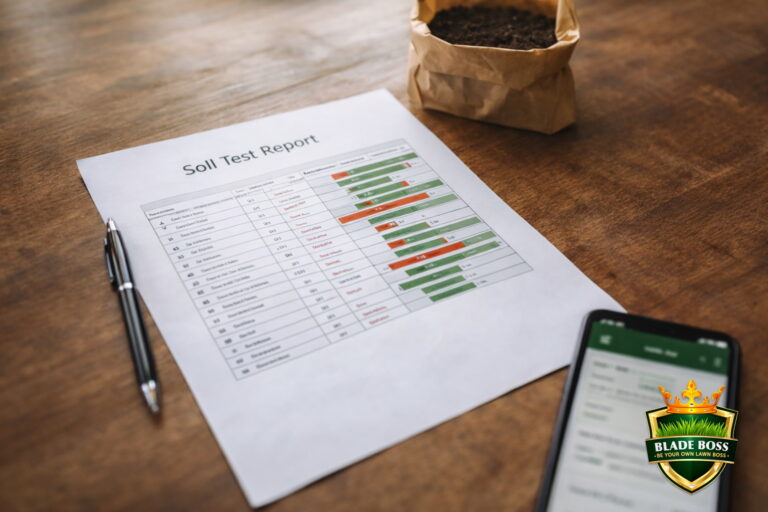 DIY How-To
How to Read a Soil Test Report (And What to Do Next)
Your soil test came back. Now what? This guide walks through every number on the report, explains what...
Mar 24, 2026
16 min
 DIY How-To
The Truth About Lawn Care Services on Long Island (DIY Comparison)
Long Island lawn services cost $1,200 to $3,000 a year and most treat your lawn identically to every...
Mar 25, 2026
15 min
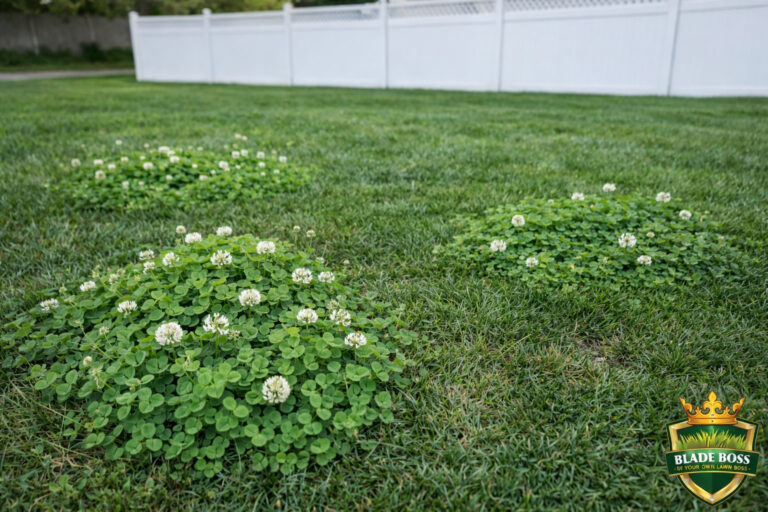 DIY How-To
How to Kill Clover in Your Lawn Without Killing Your Grass
Clover in your lawn means your grass is nitrogen-starved. Here's how to kill it with selective herbicides, fix...
Mar 10, 2026
12 min
What is your lawn actually sitting on?
Pull the soil survey, hardiness zone and current growing conditions for your exact address. Eight government sources, about a minute.
No comments yet. Be the first to share your thoughts.
Create a free account to join the conversation.