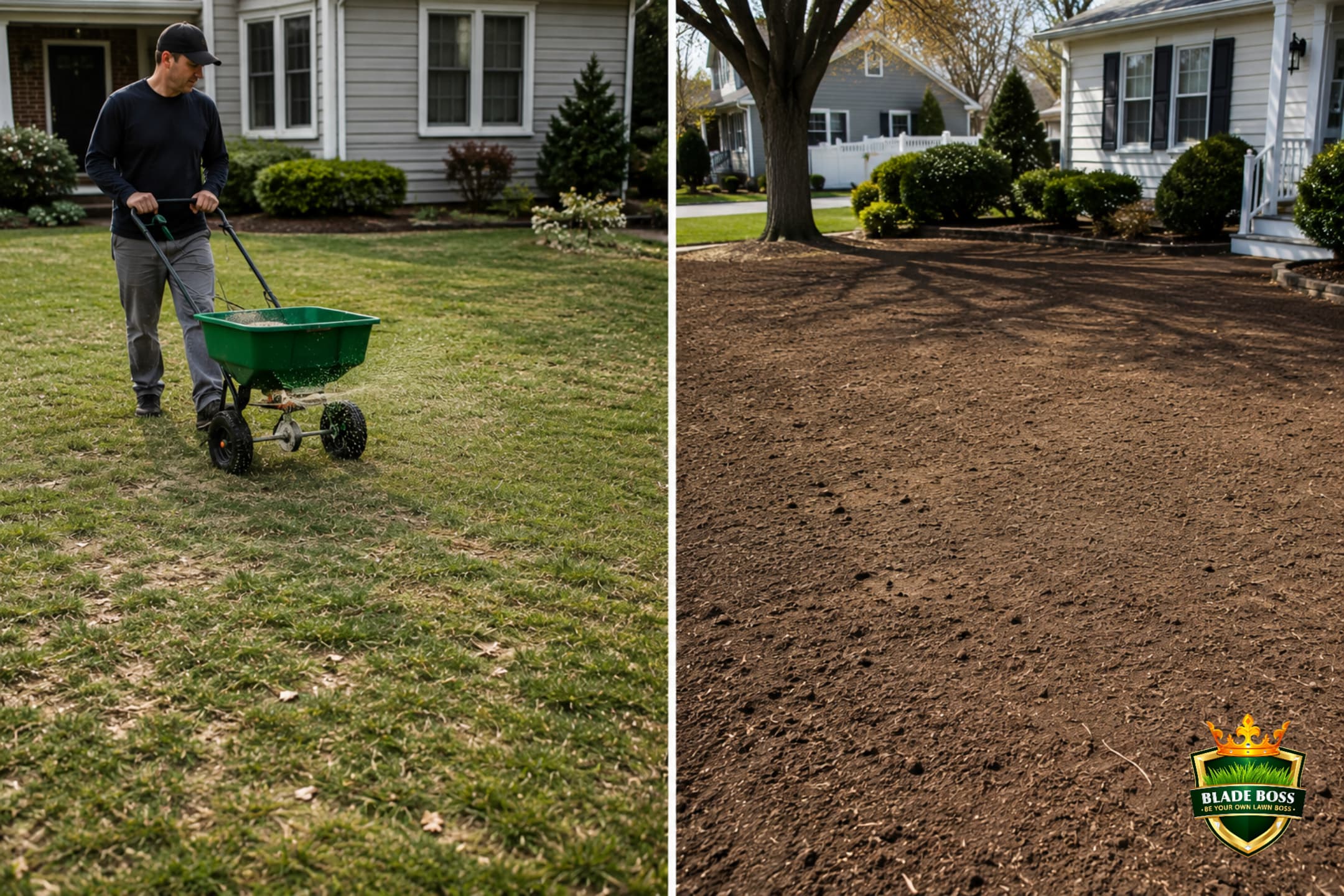
You are standing in your backyard staring at a lawn that is 40% crabgrass, 20% bare dirt, and 40% grass that might be tall fescue or might be something that blew in from the neighbor's yard. You know it needs help. The question is: do you throw seed on top of what is there and hope for the best, or do you kill everything, start from scratch, and build the lawn you actually want? The answer depends on one number.
- The 50% Rule: If more than 50% of your lawn is desirable grass (KBG, tall fescue, perennial ryegrass in decent health), overseed. If less than 50% is desirable, renovate.
- Overseeding adds new grass into existing turf. Faster, cheaper ($300 to $620 total including rental and soil test), less disruption. Works when the lawn is thin but the foundation is good.
- Renovation kills everything and starts from scratch. More expensive ($470 to $940 DIY), more work, 8 to 12 weeks of bare dirt. But the result is a lawn built exactly the way you want it.
- Both share the same window: Late August through mid-September on Long Island. Do not attempt either in spring unless you have no other option.
The Decision Framework
Walk your lawn and honestly assess what is growing. Not what you hope is growing. What is actually there. Get on your hands and knees and look. Pull a few plugs. Identify what percentage is desirable cool-season grass versus weeds, bare dirt, warm-season invaders, or unknown species.
| Your Lawn Condition | Recommendation | Why |
|---|---|---|
| 70%+ desirable grass, thin in spots | Overseed | Foundation is solid. Just fill the gaps. Least cost, least disruption. |
| 50 to 70% desirable grass, some weed patches | Treat weeds first, then overseed | Kill the weeds with broadleaf herbicide, wait 4 weeks, then overseed the bare spots. |
| 30 to 50% desirable grass, significant weeds | Aggressive overseed or partial renovation | Gray zone. Overseed heavily with aeration, or spot-renovate the worst sections. |
| Less than 30% desirable grass | Full renovation | The existing lawn is not a foundation. It is a weed field with some grass. Start over. |
| Wrong grass type entirely | Full renovation | No amount of overseeding turns a Bermuda lawn into tall fescue. Kill and reseed. |
| Severe grub or disease damage (>60% dead) | Full renovation | The root system is destroyed. Overseeding into dead roots fails. Clear and rebuild. |
Most homeowners overestimate how much good grass they have. What looks like "thin grass" from standing height often turns out to be 60% weeds when you get down and look closely. If you are unsure, pull 10 random plugs across the lawn with a screwdriver. Count how many are desirable grass versus weeds or bare soil. That percentage is your answer.
Overseeding: When the Foundation Is Good
Overseeding is the right move when your lawn has a solid base of desirable grass but is thin, patchy, or has bare spots from summer stress, dog traffic, or shade. You are not replacing the lawn. You are reinforcing it. New seed fills gaps, thickens the canopy, introduces newer cultivars with better disease resistance, and crowds out future weed encroachment.
| Factor | Details |
|---|---|
| Best for | Thin lawns, bare spots, post-summer recovery, improving density |
| Window (LI) | August 15 through September 30 (October 5 hard cutoff) |
| Seed rate | 4 to 8 lbs per 1,000 sq ft (TTTF blend) |
| Prep required | Mow short, core aerate, dethatch if >0.5 inches |
| Product cost (5K lawn) | $300 to $620 total (seed, starter fert, aerator rental, soil test) |
| Equipment | Spreader ($60 to $175), aerator rental ($115/day) |
| Time to results | 4 to 6 weeks to visible fill-in |
| Disruption | Low. Lawn stays usable within 3 to 4 weeks. |
| Risk | Low. If it fails, you lost seed money. Existing lawn still there. |
Our complete overseeding guide covers the full 9-step process including the watering schedule that makes or breaks germination.
Full Renovation: When You Need to Start Over
Renovation means killing everything that is currently growing, preparing the soil, and seeding from bare dirt. It is more work, more money, more risk, and more time without a usable lawn. But the result is a lawn built exactly the way you want it: the right grass species, uniform density, zero weed seed bank competition, and a fresh start that can last decades with proper maintenance.
| Factor | Details |
|---|---|
| Best for | Weed-dominated lawns, wrong grass type, severe damage, complete redesign |
| Window (LI) | First glyphosate spray mid-August, seed early to mid-September |
| Seed rate | 8 to 10 lbs per 1,000 sq ft (TTTF blend, renovation rate) |
| Prep required | Glyphosate kill (2 rounds), dethatch dead material, soil test, amendments |
| Product cost (5K lawn) | $470 to $940 total (glyphosate, seed, starter, mulch, rental, soil test) |
| Equipment | Sprayer ($300), overseeder rental ($85/day), spreader ($60 to $175) |
| Time to results | 8 to 12 weeks from seed to established lawn |
| Disruption | High. 2 to 3 weeks of dead/bare lawn. 6+ weeks of restricted traffic. |
| Risk | Moderate. If germination fails (drought, washout), you have bare dirt. |
The Renovation Process (Step by Step)
Soil Test (4 Weeks Before Seeding)
Get a MySoil full panel test before you do anything. You are about to invest serious money in seed and fertilizer. Knowing your pH, N, P, K, and micronutrient levels ensures you are building on the right foundation. Our soil test guide covers interpretation.
First Glyphosate Application (3 Weeks Before Seeding)
Spray the entire lawn with glyphosate (non-selective herbicide). Everything dies: grass, weeds, all of it. Apply when the existing vegetation is actively growing so it absorbs the chemical. Water the lawn well 2 to 3 days before spraying to ensure active growth. Wait 7 to 10 days for full kill. If you have dogs, keep them off for 48 to 72 hours.
Second Glyphosate Application (10 to 14 Days Before Seeding)
Anything that survived the first round or germinated from the soil seed bank gets sprayed again. This second pass is critical. Skipping it means weed seeds that germinated between rounds will compete with your new grass. Two kills, 7 to 10 days apart, is the professional standard. Allow at least 7 days after the second spray before seeding to ensure glyphosate has fully dissipated.
Remove Dead Material
Once everything is brown and dead (7 to 10 days after second spray), mow as low as possible and bag the clippings. Run a power dethatcher or heavy rake to remove the dead thatch layer down to bare soil. On Long Island's sandy soil, this goes faster than on clay. You want to see dirt.
Amend the Soil
Based on your soil test: apply lime if pH is below 6.0, compost topdressing (0.25 to 0.5 inches) if organic matter is low, and any nutrient corrections. This is the one time you can work amendments into the top inch of soil without worrying about existing grass. On sandy LI soils with CEC 3 to 8, a thin layer of compost makes a measurable difference in water and nutrient retention.
Seed (The Main Event)
Use a slit seeder (overseeder rental, $85/day from Home Depot) for the best seed-to-soil contact on bare ground. Make two perpendicular passes at half rate. For a TTTF-dominant blend, apply 8 to 10 lbs per 1,000 sq ft total. Follow with a broadcast spreader pass of the same seed at 1 to 2 lbs per 1,000 for coverage insurance. Apply starter fertilizer (high phosphorus, like Lesco 18-24-12) immediately after.
Cover and Protect
Apply a thin layer (1/4 inch) of peat moss or straw mulch over the seeded area. This retains moisture during the critical germination period and protects from bird predation and rain washout. On slopes, use an erosion control blanket. On flat areas, peat moss is the better choice because it adds organic matter as it decomposes.
Water (The 3-Week Commitment)
This is identical to overseeding watering: 2 to 3 times per day for 5 to 10 minutes per zone for 14 to 21 days. The soil surface must stay moist but not saturated. After seedlings emerge and reach 1 inch, reduce to once daily. After the first mow, transition to deep, infrequent watering. The full watering schedule is in the overseeding guide.
A full renovation means 2 to 3 weeks of a dead, brown lawn followed by 6 to 8 weeks of baby grass you cannot walk on. Your neighbors will ask what happened. Your kids cannot play on it. Your dog needs a temporary area. This is not a weekend project. Commit to the timeline or do not start. Half-effort renovations waste more money than bad overseeding.
Calculate Your Seed, Fertilizer, and Costs in SeedGenius Pro
Enter your lawn size, project type (overseed vs renovation), and grass species. Get exact seed rates, product amounts, a germination timeline, and an aftercare checklist.
The Cost Comparison
| Item | Overseeding | Full Renovation |
|---|---|---|
| Glyphosate (2 rounds) | Not needed | $20 to $40 |
| Aerator rental | $115/day | Not needed (slit seeder instead) |
| Overseeder / slit seeder rental | Not needed | $85/day |
| Grass seed | $100 to $300 (overseed rate) | $200 to $500 (renovation rate) |
| Starter fertilizer | $45 to $80 | $45 to $80 |
| Peat moss / straw mulch | $20 to $40 (spot coverage) | $60 to $100 (full coverage) |
| Soil amendments (lime, compost) | $0 to $50 | $30 to $100 |
| Soil test (MySoil) | $32 | $32 |
| TOTAL DIY COST | $310 to $620 | $470 to $940 |
| Professional service cost | $400 to $800 | $2,000 to $5,000 |
Renovation costs 50 to 100% more than overseeding in product costs, but the professional service markup is where the real savings show. A landscaper charges $2,000 to $5,000 for a full renovation because it involves multiple site visits (spray, wait, spray again, remove dead material, seed, mulch). DIY cuts that to $470 to $940 in products and rentals plus a weekend of work. Our cost comparison guide breaks down the full annual DIY savings.
The Hybrid Approach (Spot Renovation)
If your lawn is in the gray zone (30 to 50% desirable grass), you do not have to choose all-or-nothing. Spot renovation targets the worst sections with glyphosate while preserving the areas that are still decent. Spray and kill the weed-dominated patches, leave the good sections alone, and seed everything at the same time. The good sections get an overseed boost while the bad sections get a fresh start.
This is the approach most experienced DIYers use in practice. Very few home lawns need a complete nuclear renovation. Most need 30 to 40% of the area renovated and the rest thickened up. Sandy soil lawns on Long Island are especially good candidates for this approach because the sandy base makes it easy to work in amendments on the renovated sections while the existing turf sections continue to grow.
After the Seed Is Down: What Comes Next
- Water 2 to 3 times daily for 14 to 21 days. Non-negotiable. A germinating seed that dries out is dead.
- No foot traffic for 4 to 6 weeks. No kids, no pets, no walking on it to check progress.
- First mow at 3 inches when seedlings reach 3.5 to 4 inches. Use a sharp blade. Walk carefully.
- No herbicide for at least 6 weeks after seedlings emerge. Young grass cannot metabolize it.
- Fall fertilizer (0.75 lbs N per 1,000) at your next scheduled fertilizer round after the first mow.
- Fall pre-emergent for Poa annua only after seedlings have been mowed at least twice (6+ weeks post-seeding). See the fall checklist for timing.
Species ratings, seeding rates for overseed vs renovation, overseeding windows, and product recommendations for Long Island. One page, everything you need.
One text when soil temps hit the ideal range for seeding on Long Island. No spam, just the window.
No spam. One seasonal alert per application window. Unsubscribe anytime.
See what Blade Boss members get. The Lawn Command Center tracks soil temperature, GDD, and seeding windows so you know exactly when to start your renovation or overseeding project.
See Plans →Chris is a Combat Search and Rescue pilot turned airline pilot who built Blade Boss to bring military-grade precision to backyard lawn care. He spot-renovated 40% of his Ronkonkoma lawn in September 2024 (the weed-heavy south side) while overseeding the north side. Different problems, different solutions, same weekend. Both sides looked uniform by mid-November.
Related Reads
The overseeding guide covers the full 9-step process if overseeding is your path. The grass types guide helps you pick the right species. The tall fescue vs KBG comparison settles the species debate. And the DIY cost comparison shows how much you save doing this yourself versus hiring a landscaper.
Frequently Asked Questions
When should you renovate a lawn instead of overseeding?
Renovate (kill everything and start over) when more than 50% of the lawn is weeds, bare soil, or the wrong grass type. Overseeding adds new grass into an existing lawn but cannot fix a lawn that is mostly weeds or undesirable species. If the existing grass is less than 50% desirable turf, overseeding just adds good seed into a weed field. Renovation clears the slate and gives the new seed zero competition.
How much does a full lawn renovation cost DIY?
A DIY full lawn renovation on a 5,000 square foot Long Island lawn costs approximately $470 to $940. That includes glyphosate ($20 to $40), overseeder rental ($85/day), quality grass seed at renovation rates ($200 to $500), starter fertilizer ($45 to $80), peat moss or straw mulch ($40 to $80), and a soil test ($30). Compare that to a professional renovation which runs $2,000 to $5,000 for the same area. The biggest cost is seed because renovation rates (8 to 10 lbs per 1,000 sq ft for tall fescue) use significantly more than overseeding rates.
What is the best time to renovate a lawn on Long Island?
Late August through mid-September is the best window for lawn renovation on Long Island. The same timing rules apply as overseeding: soil temperature 50 to 65 degrees, air temperature 60 to 75 degrees, and at least 6 to 8 weeks of growing weather before the first frost. Start the glyphosate kill 2 to 3 weeks before your target seeding date, which means spraying in early to mid-August for a September seeding.
Can you overseed a lawn full of weeds?
Technically yes, but the results will be poor. Overseeding into a weed-heavy lawn means your new grass seed is competing with established weeds for light, water, and nutrients. The weeds have a head start and will outcompete the seedlings. If weeds make up more than 30 to 40% of your lawn, treat the weeds first with a broadleaf herbicide, wait the label-specified interval, and then overseed. If weeds exceed 50%, a full renovation is the better investment.
How long does it take for a renovated lawn to fill in?
A fully renovated lawn on Long Island takes 8 to 12 weeks to fill in from seed, depending on species. Perennial ryegrass germinates in 5 to 10 days and fills fastest. Tall fescue germinates in 7 to 14 days and establishes a solid stand in 8 to 10 weeks. Kentucky bluegrass germinates in 14 to 21 days and takes 10 to 14 weeks to fill via rhizome spreading. A TTTF-dominant blend seeded in early September on Long Island will look like a real lawn by mid-November.

Keep Reading
 DIY How-To
The Truth About Lawn Care Services on Long Island (DIY Comparison)
Long Island lawn services cost $1,200 to $3,000 a year and most treat your lawn identically to every...
Mar 25, 2026
15 min
 DIY How-To
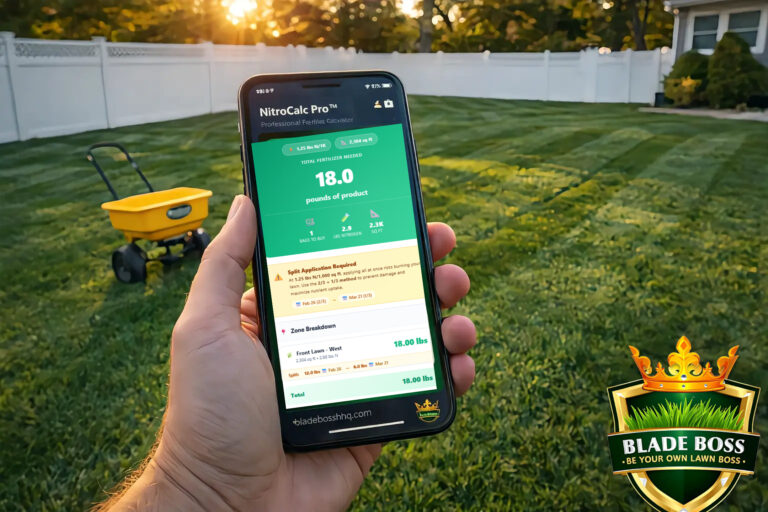
How Much Fertilizer Does Your Lawn Actually Need? (Calculator Inside)
Stop guessing with bag rates. Learn the 4-step nitrogen math, see the Zone 7B fertilizer schedule backed by...
Feb 28, 2026
20 min
 DIY How-To
How to Overseed Your Long Island Lawn in Fall (Step-by-Step)
Fall overseeding on Long Island starts August 15 and closes by October 5. Here's the complete step-by-step: when...
May 8, 2026
11 min
What is your lawn actually sitting on?
Pull the soil survey, hardiness zone and current growing conditions for your exact address. Eight government sources, about a minute.
No comments yet. Be the first to share your thoughts.
Create a free account to join the conversation.