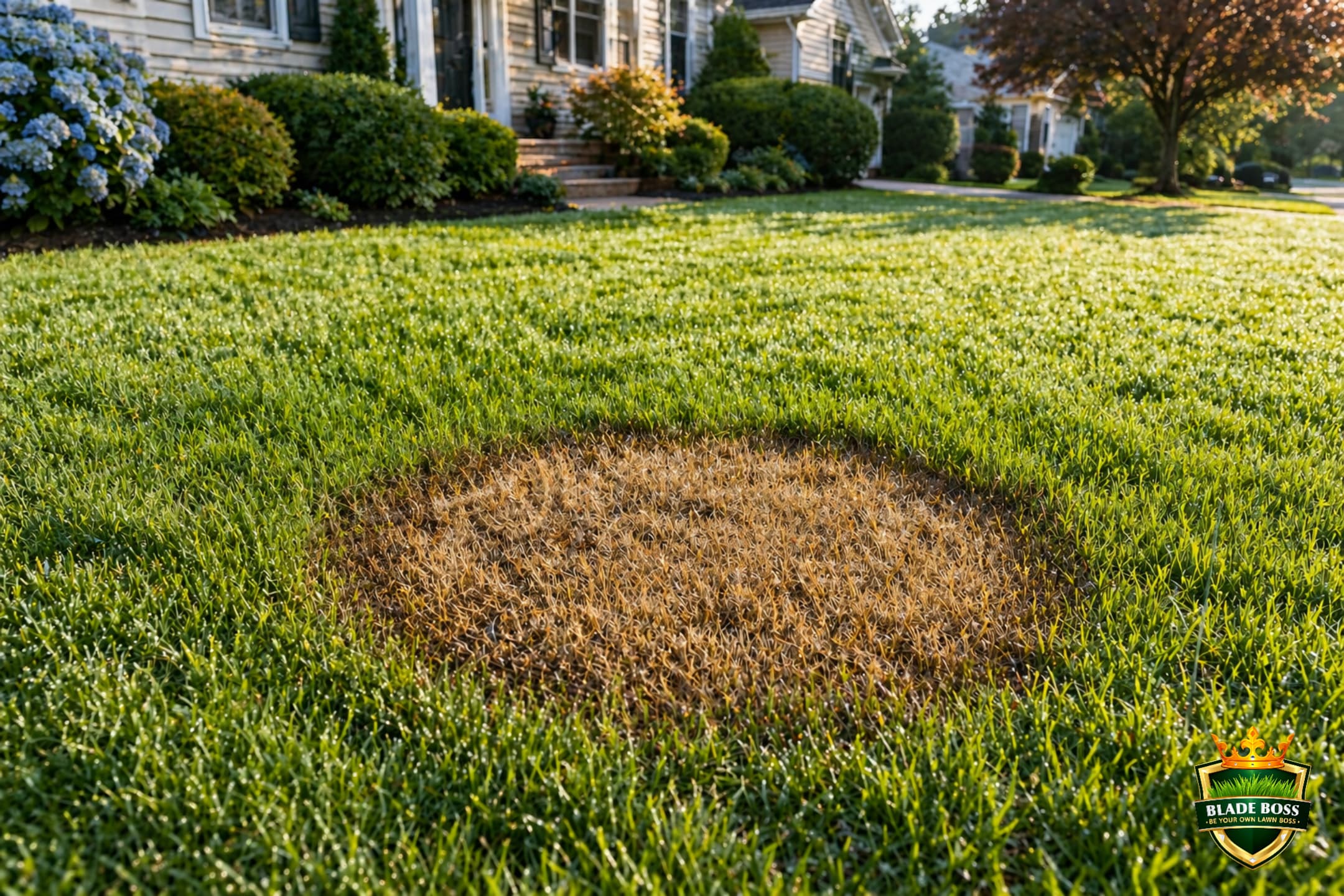
You walk outside and there it is. A brown patch in the middle of your green lawn. Could be 6 inches across. Could be 3 feet. Your brain immediately goes to one of two places: disease or drought. But brown patches have six common causes on Long Island, and each one needs a completely different fix. Throw fungicide at a grub problem and you waste money. Throw water at a fungal infection and you make it worse. The fix starts with the diagnosis.
Brown patches in lawns are caused by six things: fungal disease (brown patch, dollar spot, leaf spot), drought stress, grub damage, dog urine, chemical burn (fertilizer or herbicide), and soil compaction. Each has a distinct visual pattern. Circular patches with a dark outer ring are fungal. Irregular dead areas that pull up like carpet are grubs. Dead centers with dark green rings are dog urine. The tug test (grab and pull) is the fastest field diagnostic: if the grass peels up with no root resistance, you have grubs.
The Quick Diagnostic: What Does Your Brown Patch Look Like?
| Pattern | Size | Key Clue | Most Likely Cause |
|---|---|---|---|
| Circular, dark ring at edge | 6 in to 3+ ft | Smoke ring visible in morning dew | Brown Patch (Rhizoctonia) |
| Small round bleached spots | 2 to 6 in | Tan with reddish-brown border, hourglass lesions | Dollar Spot |
| Irregular, follows terrain | Any size | Blue-gray color before browning, footprints stay visible | Drought Stress |
| Irregular, peels up like carpet | Any size | No roots. White C-shaped grubs underneath. | Grub Damage |
| Dead center, dark green ring | 6 to 12 in | Ring of deep green grass around dead brown center | Dog Urine |
| Sharp-edged dead zones | Follows spreader path | Matches spreader wheel tracks or spray pattern | Chemical Burn |
| Scattered thin spots | Patchy, gradual | Soil feels rock-hard, water puddles on surface | Compaction |
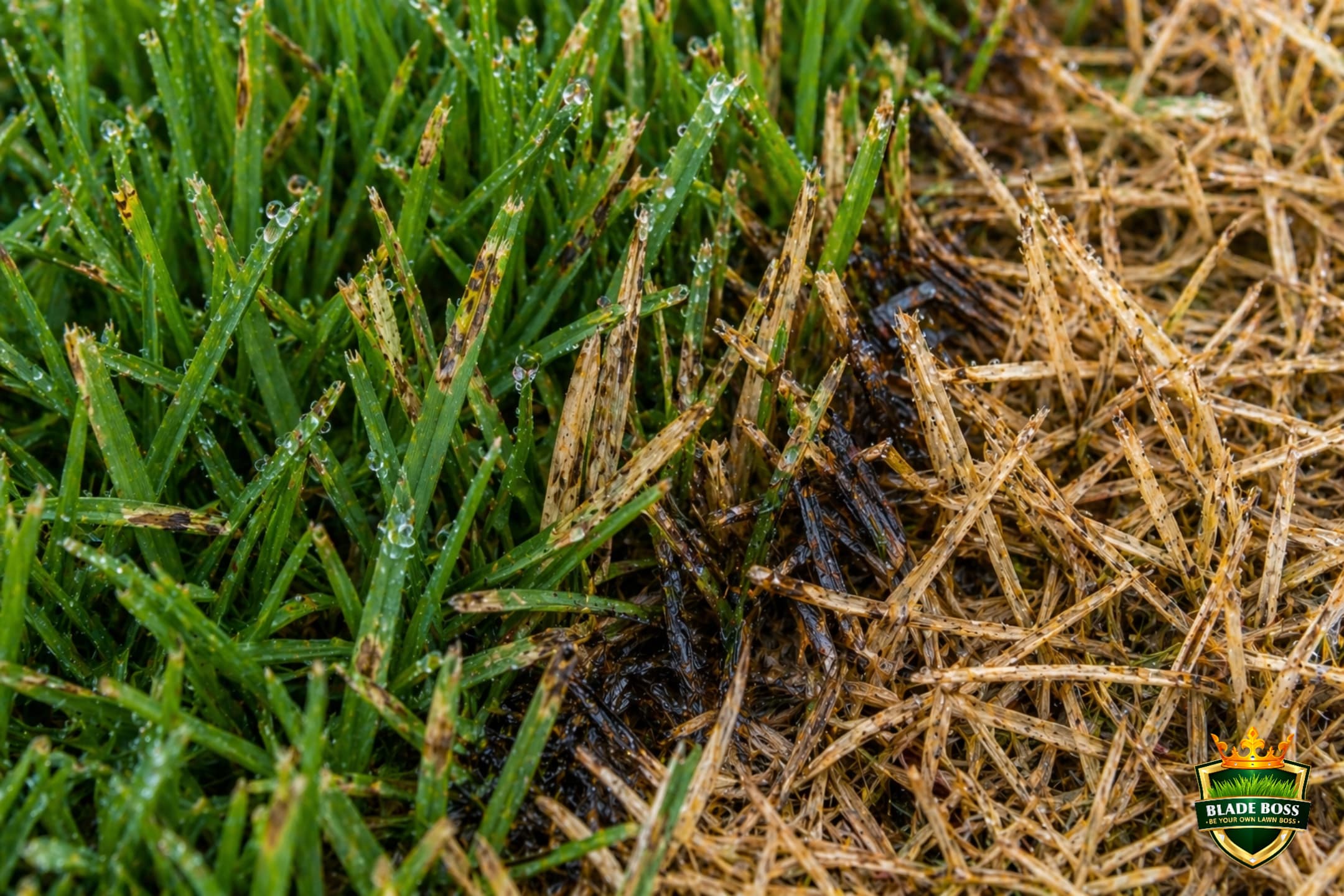
Walk your lawn at dawn when dew is still on the grass. Fungal diseases reveal themselves in dew. Brown patch shows a dark gray or purple "smoke ring" at the edge of the affected area. Dollar spot shows silver dollar-sized patches with white mycelium cobwebs visible on the grass blades. If you only check your lawn in the afternoon, you will miss these diagnostic clues every time.
Cause #1: Brown Patch Disease (Rhizoctonia)
Brown patch is the most common fungal disease in cool-season lawns on Long Island. It is caused by the fungus Rhizoctonia solani, which thrives when nighttime temperatures stay above 65 degrees and humidity is high. On Long Island, this typically means late June through August.
The signature: circular patches from 6 inches to several feet across with a dark "smoke ring" at the outer edge. Individual grass blades have tan, water-soaked lesions with dark brown borders. The grass in the center of the patch may start to recover while the outer ring is still active and advancing.
What makes brown patch worse: excess nitrogen (especially quick-release N in summer), evening watering that keeps grass wet overnight, and poor air circulation from surrounding trees or structures. If you fertilized heavily in June and are seeing brown patch in July, the nitrogen is feeding the fungus.
The Fix
- Curative (active disease): Apply propiconazole 14.3 (FRAC 3) at curative rate (2.0 fl oz per 1,000 sq ft). Repeat in 14 days. For severe outbreaks, rotate to azoxystrobin (FRAC 11) or Affirm WDG (polyoxin D, FRAC 19) on a 14-day interval rather than tank mixing an SDHI (FRAC 7), which is prohibited in Nassau and Suffolk Counties.
- Preventive (next year): Start a FRAC rotation program when GDD50 reaches 500 (typically late May on Long Island). Our fungicide rotation guide covers the complete 4-product protocol.
- Cultural fixes: Stop fertilizing with nitrogen during active disease. Water in the early morning (4 to 8 AM), never in the evening. Improve air circulation by pruning low-hanging branches. Bag clippings from infected areas to reduce fungal spread.
Propiconazole 14.3 Fungicide
Systemic FRAC Group 3 fungicide. The primary curative treatment for brown patch in cool-season turf. Also effective against dollar spot, leaf spot, and rust. Liquid application with a backpack sprayer.
Check PriceCause #2: Dollar Spot
Dollar spot (Clarireedia jacksonii) creates small, bleached circular patches the size of a silver dollar to about 6 inches across. Individual blades have distinctive hourglass-shaped lesions with tan centers and reddish-brown borders. In early morning dew, you may see white cottony mycelium on the grass surface.
Dollar spot thrives in lawns that are low on nitrogen. It is the opposite trigger from brown patch. Where brown patch is fed by excess N, dollar spot is fed by deficiency. If your lawn is pale green (underfed) and developing small bleached circles, dollar spot is the likely culprit.
The Fix
- Curative: Propiconazole 14.3 at 2.0 fl oz per 1,000. Azoxystrobin (FRAC 11) is labeled for dollar spot but has widespread resistance issues in the Northeast and is generally not recommended as a primary treatment. Propiconazole is the better first choice.
- Cultural fix that often solves it: Apply 0.25 to 0.50 lbs N per 1,000 sq ft. Dollar spot frequently resolves with adequate nitrogen alone, without any fungicide. The disease exploits weak, underfed turf.
- Remove morning dew: Drag a hose across the lawn early morning to knock dew off blades. Dew sitting on leaf surfaces for hours is the primary infection window.
Cause #3: Drought Stress
Drought stress is the most commonly misdiagnosed cause of brown patches because it does not create clean patterns. Drought brown spots follow the terrain: slopes, south-facing areas, spots farthest from sprinkler heads, areas near pavement that radiates heat, and shallow-rooted zones.
The key diagnostic: drought-stressed grass turns blue-gray BEFORE it turns brown. If you walk across the area and your footprints stay visible for more than a few seconds (the blades do not spring back), the grass is critically dehydrated. Fungal disease does not cause footprint persistence.
The Fix
- Immediate: Deep soak the affected area. Apply 0.5 inches of water and let it absorb, then another 0.5 inches. On Long Island's sandy soil, you may need to cycle-soak (10 minutes on, 30 minutes off, repeat) to prevent runoff.
- Long-term: Run a catch cup test to verify your sprinkler system actually covers these zones. Gaps in coverage are the #1 cause of drought patches in irrigated lawns. Our irrigation guide covers the full catch cup method.
- Raise mowing height: Taller grass shades the soil, reduces evaporation, and develops deeper roots. During summer stress, mow at 4 inches. See our mowing guide for seasonal height recommendations.
Calculate Your Exact Watering Needs
Enter your soil type, grass type, and zone size. Get the exact inches per week your lawn needs and how long to run each zone.
Cause #4: Grub Damage
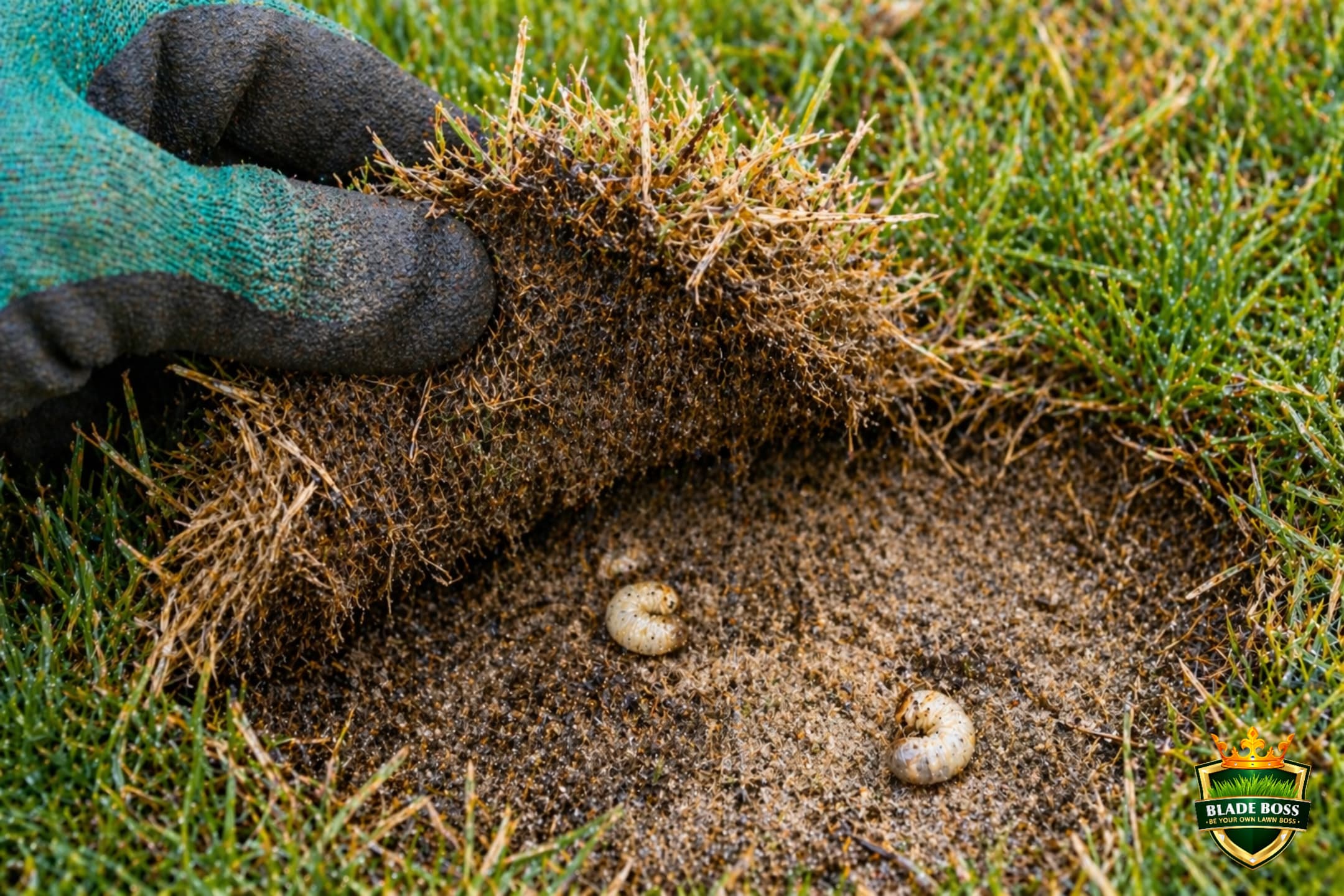
White grubs (the larval stage of Japanese beetles, European chafers, and other scarab beetles) feed on grass roots 1 to 3 inches below the surface. The grass above dies because it has no root system left. By the time you see the brown patch, the grubs have been feeding for weeks.
Grab a handful of brown grass at the edge of the damaged area and pull upward. If the turf peels up like loose carpet with no root resistance, you have grubs. Healthy grass resists pulling because roots anchor it. Grub-damaged grass has no anchoring roots left. You can also peel back a 1-foot square of sod and count the white C-shaped grubs. More than 10 per square foot is the treatment threshold.
The Fix
- Curative (active grubs now): Dylox (trichlorfon) is the fastest-acting curative grub killer. It kills grubs within 24 to 48 hours. Apply and water in immediately with 0.5 inches of irrigation.
- Preventive (next year): On Long Island (Nassau and Suffolk Counties), chlorantraniliprole (GrubEx) is prohibited by NYSDEC. The replacement is imidacloprid (BioAdvanced Season-Long or Merit 0.5G), applied late June to mid-July when adult beetles are laying eggs. Our grub control guide covers the full protocol and the NYSDEC regulation.
- Recovery: After the grubs are dead, rake out the dead turf, apply starter fertilizer, and overseed in September. The roots need to regrow before the grass fills back in.
BioAdvanced 24-Hour Grub Killer Plus
Imidacloprid-based grub control that is legal for use on Long Island (unlike chlorantraniliprole/GrubEx). Apply late June to mid-July for preventive control. Water in immediately after application.
Check PriceOne text when adult beetles are laying eggs and the preventive window opens. No spam, just timing.
No spam. One seasonal alert per application window. Unsubscribe anytime.
Cause #5: Dog Urine
Dog urine spots are the easiest to diagnose because the pattern is unique: a dead brown center (6 to 12 inches) surrounded by a ring of abnormally dark green grass. The green ring is caused by diluted nitrogen in the urine acting as fertilizer at the edges where concentration is lower. The center is dead from nitrogen and salt burn at full concentration.
The Fix
- Repair: Rake out the dead grass. Apply gypsum (calcium sulfate) at 5 lbs per 100 sq ft to neutralize the salts. Reseed with a hardy grass mix. Water deeply to flush remaining salts below the root zone.
- Prevention: Flush the spot with a bucket of water immediately after the dog goes. Train the dog to use a designated mulched or gravel area. Some homeowners install a small "pet turf" section with artificial grass or pea gravel specifically for this purpose.
- Myth: "Lawn spot" supplements that you add to your dog's water do not work reliably. The nitrogen concentration in dog urine is the issue, and diluting it slightly with a supplement does not prevent burn on sensitive turf.
Cause #6: Chemical Burn (Fertilizer or Herbicide)
Chemical burn from fertilizer over-application creates brown patches that follow your spreader pattern exactly. You may see stripes that match wheel tracks (especially with Scotts spreaders that have the wheel striping problem), overlap areas where you double-passed, or edges where the spreader threw too far onto a sidewalk and you over-compensated.
Herbicide burn looks different: it follows the spray pattern and usually shows curling, twisting, or cupping of leaves before browning. Broadleaf herbicides (2,4-D, triclopyr, dicamba) applied in temperatures above 85 degrees volatilize and drift onto non-target grass, creating irregular burn zones that don't match any natural pattern.
The Fix
- Fertilizer burn: Water heavily and immediately. Apply 0.5 to 1.0 inches of water to flush excess salts below the root zone. Repeat daily for 3 to 5 days. Most fertilizer burn recovers within 2 to 3 weeks if caught early. If the crown of the plant is dead (pull a blade and the base crumbles), that spot will not recover and needs reseeding in September.
- Herbicide burn: There is no quick fix. Herbicide damage must grow out. Water deeply and maintain good cultural practices (proper mowing, adequate nutrition) to support recovery. Most cool-season grasses recover from broadleaf herbicide drift within 3 to 4 weeks. If you suspect herbicide damage, stop all herbicide applications until the lawn fully recovers.
- Prevention: Calibrate your spreader for every product. Never apply herbicide above 85 degrees. Never apply to stressed or drought-stricken turf. Read the label.
The Diagnosis Flowchart
Still not sure? Walk through this:
- Do a tug test. Grab the brown grass and pull. Peels up like carpet with no roots? → Grubs. Skip everything else. Treat for grubs.
- Check in early morning. See a dark smoke ring at the edge of the patch in the dew? → Brown Patch disease. See white cobweb mycelium? → Dollar Spot.
- Look at the pattern. Is the brown area circular with defined edges? → Likely disease. Is it irregular and follows slopes, pavement edges, or sprinkler gaps? → Likely drought.
- Check for a green ring. Dead brown center with a ring of dark green grass around it? → Dog urine. No mystery here.
- Check your spreader path. Does the dead zone follow a straight line, match wheel tracks, or line up with where you overlapped on your last application? → Chemical burn.
- Do the screwdriver test. Push a screwdriver into the soil in the brown area and in a healthy area. Cannot penetrate the brown area but slides into the green area? → Compaction. Core aerate.
- Still not sure? Get a soil test and check soil moisture at 4-inch depth. If soil is moist and pH is in range, it is likely disease. Send a sample to your local Cornell Cooperative Extension for a lab diagnosis.
What every number on your soil test means, the optimal ranges for Long Island soils, and exactly what to do when something is off. Print it and keep it with your results.
When to Call a Professional
Most brown patch causes are DIY-fixable. But there are a few situations where professional help is the smart move:
- Pythium blight. Shows as greasy, water-soaked patches that spread rapidly in hot, humid conditions. Standard lawn fungicides (azoxystrobin, propiconazole, thiophanate-methyl, polyoxin D) do NOT treat Pythium, because it is a water mold rather than a true fungus. Mefenoxam (FRAC 4) and propamocarb (FRAC 28) are restricted and not permitted in Nassau and Suffolk Counties. On Long Island, keep a phosphite (FRAC 33) ready to swap into your August slot, or call a licensed applicator.
- Rapid spreading. If a brown patch doubles in size in 48 hours despite treatment, something is wrong with your diagnosis. Get a professional evaluation before you waste more product on the wrong problem.
- Necrotic ring spot. Shows as circular rings of dead grass with green grass surviving in the center (a "frog eye" pattern). This is a soil-borne disease that attacks KBG roots and is extremely difficult to treat. Professional diagnosis and a multi-year management plan are usually necessary.
See what Blade Boss members get. The Lawn Command Center tracks disease risk windows, grub treatment timing, and fertilizer schedules so you catch problems before they become brown patches.
See Plans →Chris is a Combat Search and Rescue pilot turned airline pilot who built Blade Boss to bring military-grade precision to backyard lawn care. He diagnosed his first brown patch problem the expensive way (three wrong guesses) before learning to check the dew line at 6 AM. He's based in Ronkonkoma, Long Island.
Related Reads
The fungicide FRAC rotation guide covers the complete preventive program for disease control. The grub control guide explains the NYSDEC chlorantraniliprole ban and the imidacloprid alternative. The irrigation guide helps you fix the drought zones causing dry patches. And the nutrient guide explains why excess nitrogen feeds brown patch while nitrogen deficiency feeds dollar spot.
Frequently Asked Questions
What causes brown patches in a lawn?
Brown patches in lawns are caused by six common problems: fungal disease (brown patch, dollar spot, or leaf spot), drought stress from inadequate irrigation, grub damage from white grubs feeding on roots, dog urine spots, chemical burn from fertilizer or herbicide over-application, and soil compaction that prevents root growth. Each cause has a distinct visual pattern that helps with diagnosis. Circular patches with a darker outer ring are almost always fungal disease. Irregular dead areas that pull up like carpet are grub damage.
How do you tell the difference between brown patch disease and drought stress?
Brown patch disease (Rhizoctonia solani) creates circular patches 6 inches to several feet across with a distinctive dark smoke ring at the advancing edge, visible in early morning when dew is present. Individual grass blades have tan lesions with dark brown borders. Drought stress creates irregular patterns that follow the lawn's terrain, typically appearing first on slopes, south-facing areas, and spots farthest from sprinkler heads. Drought-stressed grass turns blue-gray before browning, and footprints remain visible for minutes.
How do I know if I have grubs in my lawn?
The classic grub test is the tug test. Grab a handful of brown grass and pull upward. If it peels up like loose carpet with no root resistance, grubs have eaten the roots. You can also cut a 1-foot square section of turf, peel it back, and count the white C-shaped grubs in the top 2 inches of soil. More than 10 grubs per square foot is the treatment threshold recommended by university extension programs.
Will brown patch disease go away on its own?
Brown patch disease (Rhizoctonia) stops spreading when nighttime temperatures drop below 65 degrees Fahrenheit and humidity decreases. The affected areas will eventually recover on their own in fall as the grass grows back into the damaged zones. However, without treatment, the disease will return every year when conditions are right. Preventive fungicide applications (starting when GDD50 reaches 500) are the only way to break the annual cycle.
How do I fix brown patches from dog urine?
Dog urine brown spots have a distinctive ring pattern: a dead brown center surrounded by a ring of unusually dark green grass. The green ring is caused by diluted nitrogen from the urine acting as fertilizer. To repair: rake out the dead grass, apply gypsum (calcium sulfate) to neutralize salts, reseed with a hardy mix, and water thoroughly. The only long-term prevention is training the dog to use a designated area or flushing the spot with water immediately after the dog goes.

Keep Reading
 Long Island Local
When to Apply Pre-Emergent on Long Island: The 2026 Schedule Backed by 30 Years of Data
Exact pre-emergent timing for Long Island lawns in 2026, backed by 30-year NOAA soil temperature data and GDD...
Feb 25, 2026
22 min
 Long Island Local
When to Apply Winterizer Fertilizer on Long Island
The winterizer is the last fertilizer application of the year and the one that fuels your spring green-up....
May 28, 2026
8 min
 Long Island Local
Drought-Proofing Your Long Island Lawn: 8 Things to Do Before July
July is coming. Your lawn will either cruise through it or collapse. Here are 8 things to do...
May 6, 2026
11 min
What is your lawn actually sitting on?
Pull the soil survey, hardiness zone and current growing conditions for your exact address. Eight government sources, about a minute.
No comments yet. Be the first to share your thoughts.
Create a free account to join the conversation.