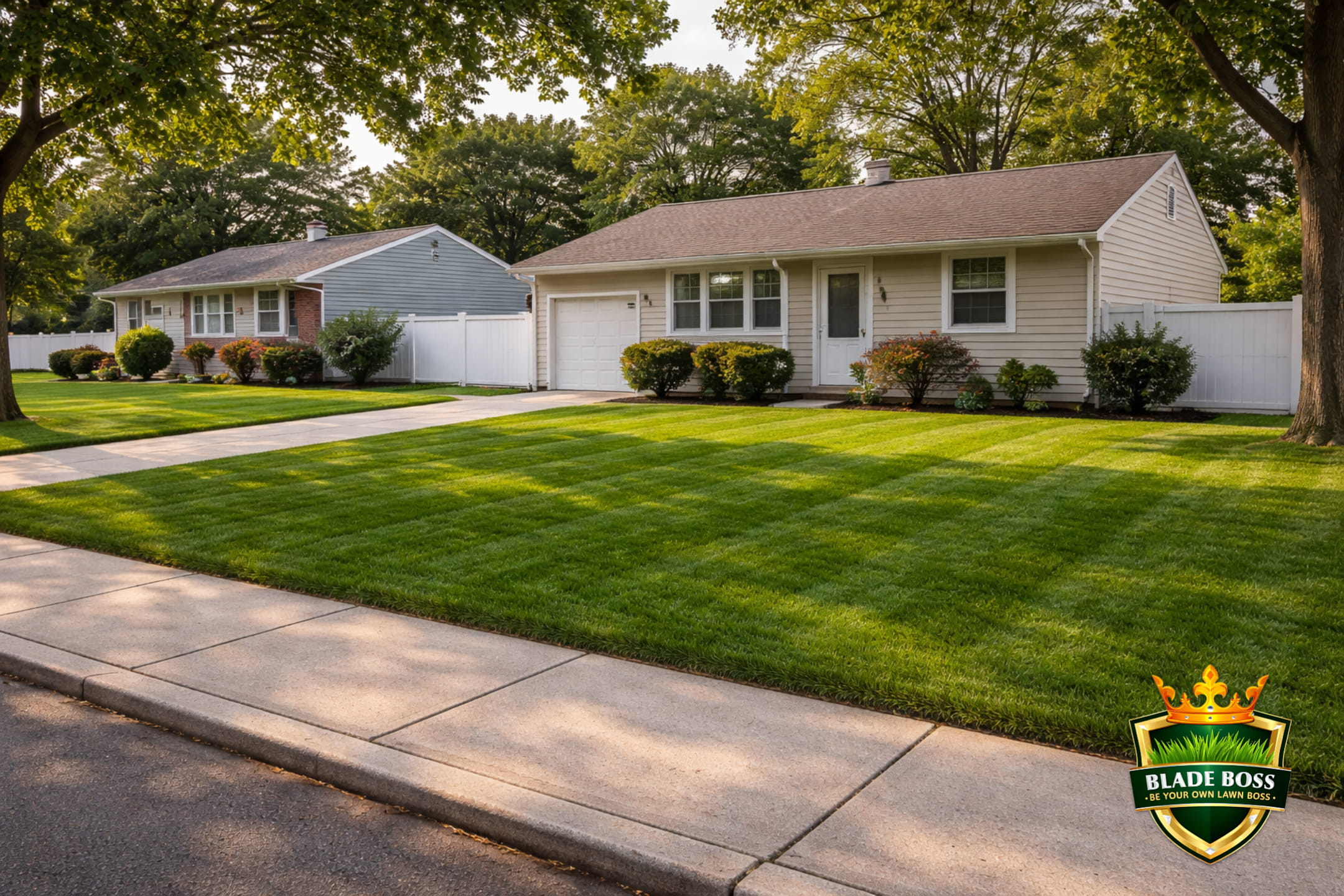
Nassau County is 287 square miles of post-war suburbs where 1.4 million people maintain some of the most obsessed-over lawns in America. From the Gold Coast mansions of Oyster Bay to the Levittown ranches to the salt-sprayed bungalows of Long Beach, every neighborhood has its own soil story. But walk into any garden center on Hempstead Turnpike and they'll sell you the same bag of fertilizer with the same instructions regardless of whether you're on North Shore clay or South Shore sand. That's the problem this guide solves.
- 4 distinct soil zones across Nassau County, each with different textures, drainage, and nutrient-holding capacity.
- North Shore / Gold Coast (Great Neck to Oyster Bay): Glacial moraine clay loam. CEC 12 to 18. Slower drainage. Heavier lime requirements.
- Central Nassau (Garden City, Levittown, Hicksville): Hempstead silt loam, a soil series unique to this county. Best lawn soil on LI when intact. Construction fill is the wildcard.
- South Shore (Bellmore, Merrick, Massapequa): Riverhead sandy loam. CEC 8 to 12. Standard Blade Boss baseline soil.
- Barrier Beaches (Long Beach, Island Park): Deep sand. CEC under 3. Salt spray. Hardest growing conditions in the county.
- Nassau blackout: November 15 through April 1 (Local Law 11-2009). Two weeks later than Suffolk.
- Your rates change by zone: Fertilizer splits, lime amounts, watering frequency, and pre-emergent timing all depend on which zone your property sits on.
If you've already read the Suffolk County guide, this is the matching piece for the western half of the island. Same structure, same approach: find your neighborhood, know your soil, adjust your program. The month-by-month calendar gives you the timing. This guide tells you how to adjust it for your specific Nassau County dirt.
Why Nassau County Needs Its Own Guide
Nassau County has two things that make lawn care here unique: the Hempstead Plains and the post-war building boom. The Hempstead Plains were one of the only natural prairies east of the Appalachians, producing a deep, dark, organic-rich silt loam that's genuinely exceptional for growing grass. Then between 1947 and 1960, developers like Levitt and Sons bulldozed most of it, scraped the topsoil, graded with construction fill, and built 100,000+ homes. The result: some Nassau lawns are growing in pristine Hempstead silt loam. Others are growing in 6 inches of mystery fill over rubble.
Add in the geological divide (the Harbor Hill moraine runs through the North Shore creating heavier clay soils while the outwash plain flows south with progressively sandier soils) and the regulatory difference (Nassau's fertilizer blackout starts November 15, two weeks later than Suffolk's November 1) and you have a county that needs neighborhood-level guidance, not generic advice.
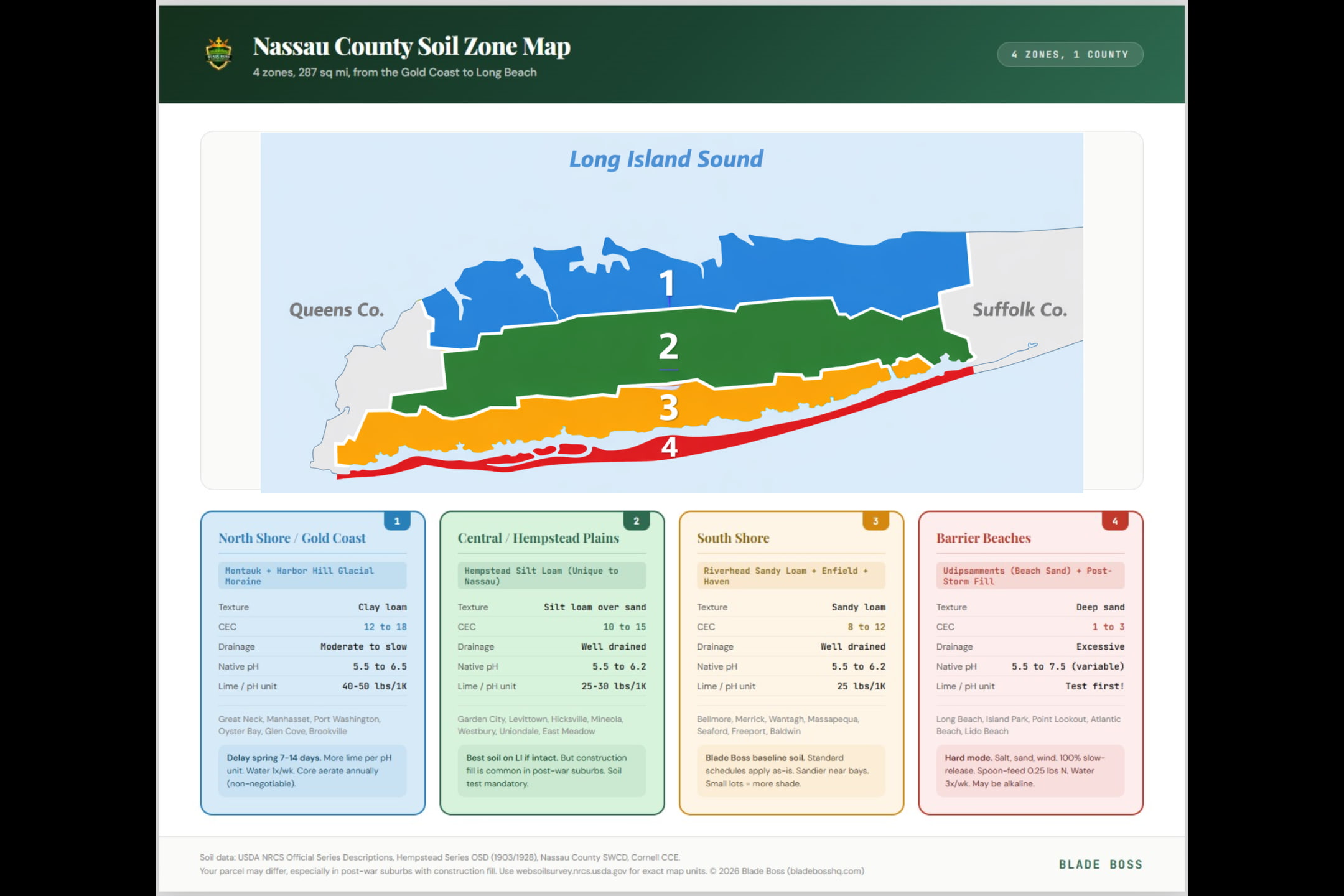
The 4 Nassau County Soil Zones
These follow the same glacial geology as Suffolk County's regions but compressed into a much smaller area. You can drive from Zone 1 to Zone 4 in 20 minutes.
Zone 1: North Shore / Gold Coast (Great Neck, Manhasset, Port Washington, Oyster Bay, Glen Cove)
Dominant soil: Montauk series + Harbor Hill glacial moraine deposits
Texture: Clay loam to silty clay loam
CEC: 12 to 18 (high nutrient-holding capacity)
Drainage: Moderate to slow
pH tendency: 5.5 to 6.5 (better buffered than outwash sand)
The Gold Coast sits on the Harbor Hill moraine, the ridge of rock and clay the glacier left behind when it stopped advancing. This is the heaviest soil in Nassau County. It holds water for days after rain, retains nutrients better than any other zone, and compacts into concrete if you skip aeration. The estates in Old Westbury and Brookville have some of the thickest clay profiles on the island. Smaller lots in Port Washington and Manhasset have the same moraine clay but with decades of compaction from foot traffic.
Spring timing: Delay all spring activities by 7 to 14 days compared to the South Shore. Clay holds cold. Measure your own soil temp at 4-inch depth rather than relying on Islip station data.
Lime rates: Increase by 50 to 75% over sandy soil rates. Where sandy loam needs 25 lbs per 1.0 pH unit, clay loam needs 40 to 50 lbs per 1,000 sq ft. Higher CEC = higher buffering capacity.
Watering: Once a week is often enough in summer. Clay retains moisture. Overwatering on clay causes waterlogging and invites disease. Check soil moisture at 3-inch depth before watering.
Aeration: Absolutely non-negotiable. Core aerate every September. Clay compacts faster than any other soil type. Skip it and you're growing grass on a parking lot.
Not Sure What Adjustment Your Zone Needs?
The Blade Boss Soil Correction Engine takes your actual soil test results, factors in your CEC and soil texture, and calculates exact lime, potassium, and fertilizer rates. No more looking up tables and guessing.
Zone 2: Central Nassau / Hempstead Plains (Garden City, Levittown, Hicksville, Mineola, Westbury, Uniondale)
Dominant soil: Hempstead silt loam (unique to Nassau County)
Texture: Silt loam (20 to 40 inches) over stratified sand and gravel
CEC: 10 to 15 (good nutrient retention)
Drainage: Well drained (moderate in silt layer, rapid in substratum)
pH tendency: 5.5 to 6.2 (moderately acidic)
If you're on actual Hempstead silt loam, you've won the Long Island soil lottery. This series has a thick, dark A horizon (11+ inches of black silt loam) with higher organic matter than anything else on the island. The silt holds nutrients and moisture well while the sand and gravel below provides perfect drainage. It's the ideal combination for turfgrass. The catch: most of central Nassau was mass-developed in the 1940s through 1960s, and many properties had their native topsoil stripped during construction. What's left may be Hempstead silt loam, or it may be 8 inches of construction fill on top of rubble.
If you have intact Hempstead silt loam: This is the easiest soil on LI to manage. Standard 2.75 lbs N/year schedule works as-is. Lime at 25 to 30 lbs per 1.0 pH unit. Water 1 to 2 times per week in summer. You may need less product than your South Shore friends for the same results.
If you have construction fill: All bets are off until you soil test. Fill soil can be alkaline (concrete rubble raises pH), compacted (no root penetration), or nutrient-dead (zero organic matter). Get a soil test and treat what you find. Topdressing with screened compost (0.25 inches per year after aeration) is the long-term fix for fill soil.
Zone 3: South Shore (Bellmore, Merrick, Wantagh, Massapequa, Freeport, Baldwin, Seaford)
Dominant soil: Riverhead sandy loam, Enfield silt loam, Haven loam
Texture: Sandy loam to loam (transitioning to sandier near coast)
CEC: 8 to 12 (moderate)
Drainage: Well drained to somewhat excessively drained
pH tendency: 5.5 to 6.2 (acidic)
The South Shore is classic Long Island outwash plain. Riverhead sandy loam is the dominant series, the same soil that covers most of western Suffolk. It's the soil most of the Blade Boss content is calibrated for. If you're in Bellmore, Merrick, or Wantagh, the standard schedules in the fertilizer guide, pH guide, and irrigation guide apply with minimal adjustment. As you get closer to the bays (south of Merrick Road), soils get sandier and the water table gets higher.
Standard zone: The baseline Blade Boss schedules are calibrated for this soil. 2.75 lbs N/year, 25 lbs lime per 1.0 pH unit, 1 inch/week watering.
Near the bays (south of Merrick Rd): Soils get sandier and saltier. Shift toward the sandy soil adjustments: split applications, 60%+ slow-release, water 2 to 3 times per week. Salt from bay breezes can stress sensitive grass. Rinse after storms.
Shade from neighbors: Nassau's smaller lot sizes (60x100 Levittown lots) mean more shade from neighboring houses and trees. Consider fine fescue blends for shaded sections rather than KBG, which needs 6+ hours of direct sun.
Zone 4: Barrier Beaches (Long Beach, Island Park, Point Lookout, Atlantic Beach, Lido Beach)
Dominant soil: Udipsamments (beach sand), Hooksan-Dune land complex
Texture: Deep sand to loamy sand
CEC: 1 to 3 (extremely low)
Drainage: Excessively drained (water disappears instantly)
pH tendency: Variable (5.5 to 7.5 depending on shell content and salt)
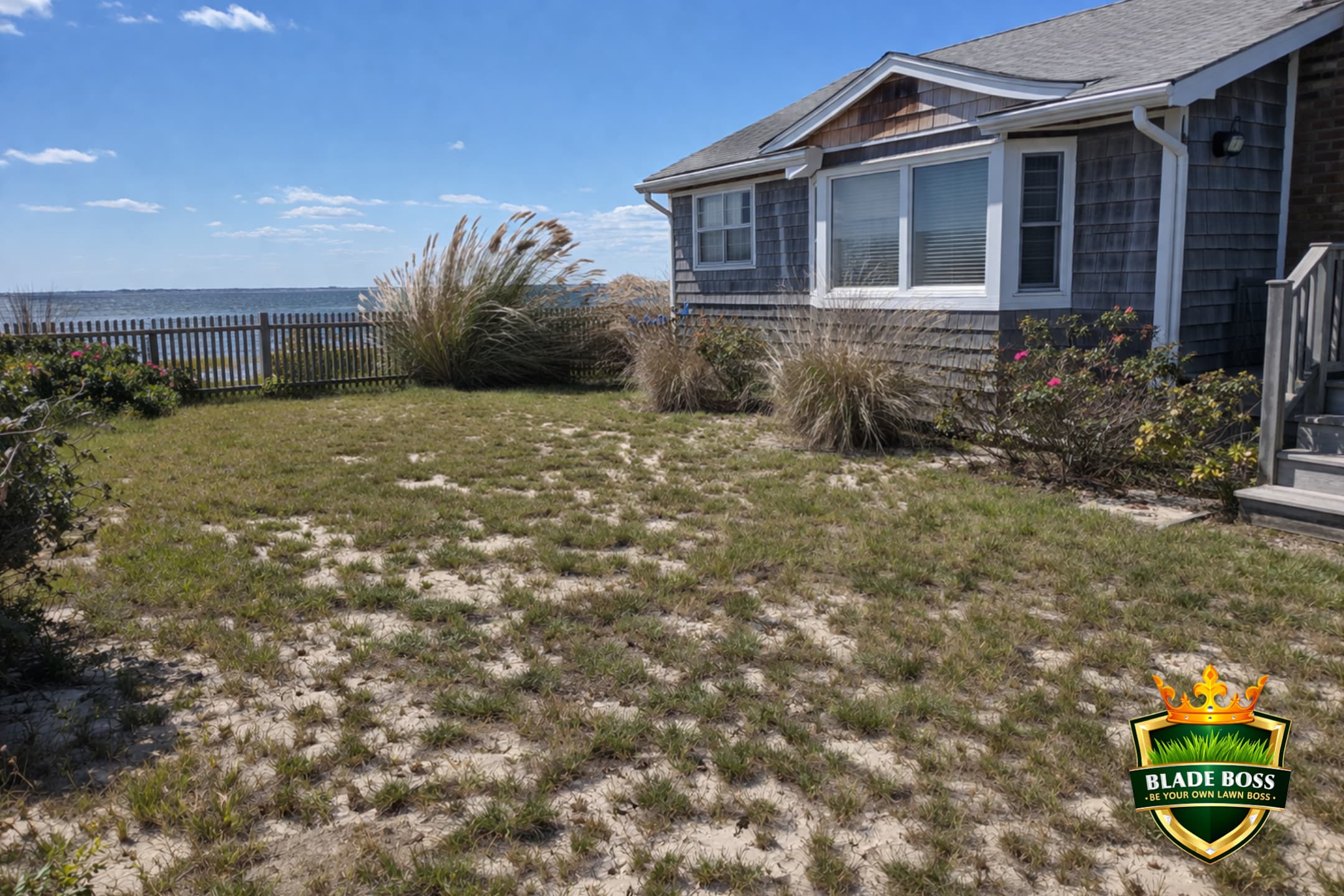
The barrier beaches are the hardest place to grow a lawn in Nassau County. You're dealing with pure sand, salt spray within yards of the ocean, wind exposure that increases evapotranspiration, a high water table that can flood root zones during storms, and soil that has essentially zero ability to hold nutrients. Long Beach and Island Park were also heavily impacted by Hurricane Sandy in 2012, and many properties were re-graded with imported fill afterward.
Grass selection: Tall fescue and perennial ryegrass tolerate salt better than KBG. Use salt-tolerant cultivars. Fine fescue handles the drought but not the salt.
Fertilizer: Split everything. Max 0.50 lbs N per application, all slow-release. CEC under 3 means nutrients are gone within days. Consider spoon-feeding at 0.25 lbs N every 3 to 4 weeks rather than larger applications.
Watering: 3 times per week minimum in summer. Sand holds almost nothing. But watch the water table during wet periods as roots can waterlog from below.
Lime: Test first. Some barrier beach soils run alkaline due to shell fragments in the sand. Don't assume you need lime. You might actually need sulfur.
Realistic expectations: A barrier beach lawn will never look like a Garden City lawn. The soil physics won't allow it. Focus on a healthy, dense stand of salt-tolerant grass rather than chasing the perfect stripe.
Neighborhood Soil Quick Reference
Find your town. Know your zone. Then adjust accordingly.
| Town/Area | Zone | Primary Soil | CEC Range | Key Adjustment |
|---|---|---|---|---|
| Great Neck | North Shore | Moraine clay loam | 12-18 | Heavy soil. Delay spring. More lime. Aerate annually. |
| Manhasset / Plandome | North Shore | Montauk + moraine | 12-18 | Clay. Less watering. Watch for compaction. |
| Port Washington | North Shore | Moraine mix | 12-15 | Hilly terrain. Erosion risk on slopes. |
| Oyster Bay / Brookville | North Shore | Dense moraine clay | 15-18 | Heaviest soil in Nassau. Aeration is survival. |
| Glen Cove / Locust Valley | North Shore | Moraine + Montauk | 12-18 | Wind from LI Sound increases ET. |
| Garden City | Central | Hempstead silt loam | 10-15 | Best soil on LI. Standard schedules work great. |
| Levittown / Hicksville | Central | Hempstead (may be fill) | 10-15* | Soil test mandatory. Construction fill common. |
| Mineola / Westbury | Central | Hempstead / Mineola series | 10-15 | Mineola series is wetter. Watch drainage. |
| Uniondale / East Meadow | Central | Hempstead silt loam | 10-15 | Standard baseline if undisturbed. |
| Floral Park / New Hyde Park | Central | Riverhead / Hempstead mix | 8-12 | Transition zone. Smaller lots, more shade. |
| Bellmore / Merrick | South Shore | Riverhead sandy loam | 8-12 | Standard baseline. Blade Boss default soil. |
| Wantagh / Seaford | South Shore | Riverhead / Haven | 8-12 | Standard. Slightly sandier near coast. |
| Massapequa | South Shore | Riverhead sandy loam | 8-12 | Standard baseline. Near county border. |
| Freeport / Baldwin | South Shore | Riverhead + urban fill | 6-10 | Mixed. Closer to bays = sandier. Test. |
| Long Beach | Barrier Beach | Beach sand / Udipsamments | 1-3 | Hard mode. Salt, sand, wind. See Zone 4. |
| Island Park / Point Lookout | Barrier Beach | Deep sand + fill | 1-3 | Sandy post-storm fill. Test everything. |
Levittown was 17,400 homes built in 4 years (1947 to 1951). The original Hempstead silt loam is excellent lawn soil, but builders scraped and graded aggressively. If your lawn has always struggled despite doing everything right, the answer is probably under the surface. Plug your address into the USDA Web Soil Survey for a free look at your parcel's mapped soil series. Then get an actual soil test. A result showing CEC under 5, organic matter under 1%, or pH above 7.5 (from concrete rubble) tells you you're growing in fill, not native soil. The fix is a multi-year program of core aeration plus compost topdressing to rebuild what the builders removed.
How Your Zone Changes Your Program
| Factor | North Shore (Clay) | Central (Silt Loam) | South Shore (Sandy Loam) | Barrier Beach (Sand) |
|---|---|---|---|---|
| Fertilizer rate | 2.75 lbs N/year | 2.75 lbs N/year | 2.75 lbs N/year | 2.75 (spoon-feed 0.25) |
| Max quick-release N/app | 0.50 lbs/1K | 0.50 lbs/1K | 0.50 lbs/1K | 0.25 lbs/1K |
| Slow-release required? | Optional | Recommended | Recommended | Required (100%) |
| Lime per 1.0 pH unit | 40-50 lbs/1K | 25-30 lbs/1K | 25 lbs/1K | Test first (may be alkaline) |
| Watering frequency | 1x/week summer | 1-2x/week | 2x/week | 3x/week minimum |
| Core aeration | Non-negotiable | Recommended | Optional (sand) | Not needed (sand) |
| K correction multiplier | 2x | 3x | 3x | 5x |
| Spring start offset | +7 to 14 days | Baseline | Baseline | Baseline |
| Pre-emergent splits? | Single may hold | Recommended | Recommended | Essential |
Nassau County Regulations
Nassau's laws are similar to Suffolk's with one key difference: the blackout starts two weeks later. Nassau County enacted Local Law 11-2009 establishing these rules.
| Rule | Details | Reference |
|---|---|---|
| Fertilizer blackout | November 15 through April 1 | Local Law 11-2009 |
| Phosphorus ban | No P unless soil test shows deficiency | NYS ECL 17-2103 |
| Water body setback | No fertilizer within 20 ft of any water body | County code |
| Pre-emergent during blackout? | YES (standalone, no fertilizer) | Not classified as fertilizer |
| Lime during blackout? | YES (excluded from fertilizer definition) | Exempt per statute |
| Chlorantraniliprole (GrubEx) | NYSDEC prohibits sale and use in Nassau County | State pesticide regulation |
| Suffolk vs Nassau key difference | Nassau blackout: Nov 15. Suffolk: Nov 1. | Extra 2 weeks for winterizer |
Nassau's later blackout (November 15 vs Suffolk's November 1) gives you an extra 2 weeks for your winterizer application. While your Suffolk County friends are racing to get it down before October 31, you have until November 14. This is especially useful in warm fall years when soil stays active longer. That said, the science says winterizer is best applied mid to late October regardless of the legal deadline. Don't wait until November 14 just because you can.
The Construction Fill Problem (Nassau's Hidden Challenge)
This is the issue no other lawn care guide talks about because it's specific to mass-developed suburbs. Between 1940 and 1970, Nassau County added roughly 400,000 housing units. Builders in that era routinely stripped native topsoil (sometimes selling it), graded with whatever fill was cheapest, and laid sod or seeded over the top. Sixty to eighty years later, thousands of Nassau homeowners are unknowingly trying to grow grass in construction debris.
Signs you might be on fill soil: your pH tests above 7.0 (concrete rubble raises alkalinity), your organic matter is under 1% (native Hempstead silt loam runs 3 to 5%), your CEC is dramatically lower than your neighbors, you find rocks, bricks, or rubble when you dig, or your lawn has chronic drainage problems on what should be well-drained outwash plain. A soil test reveals all of this.
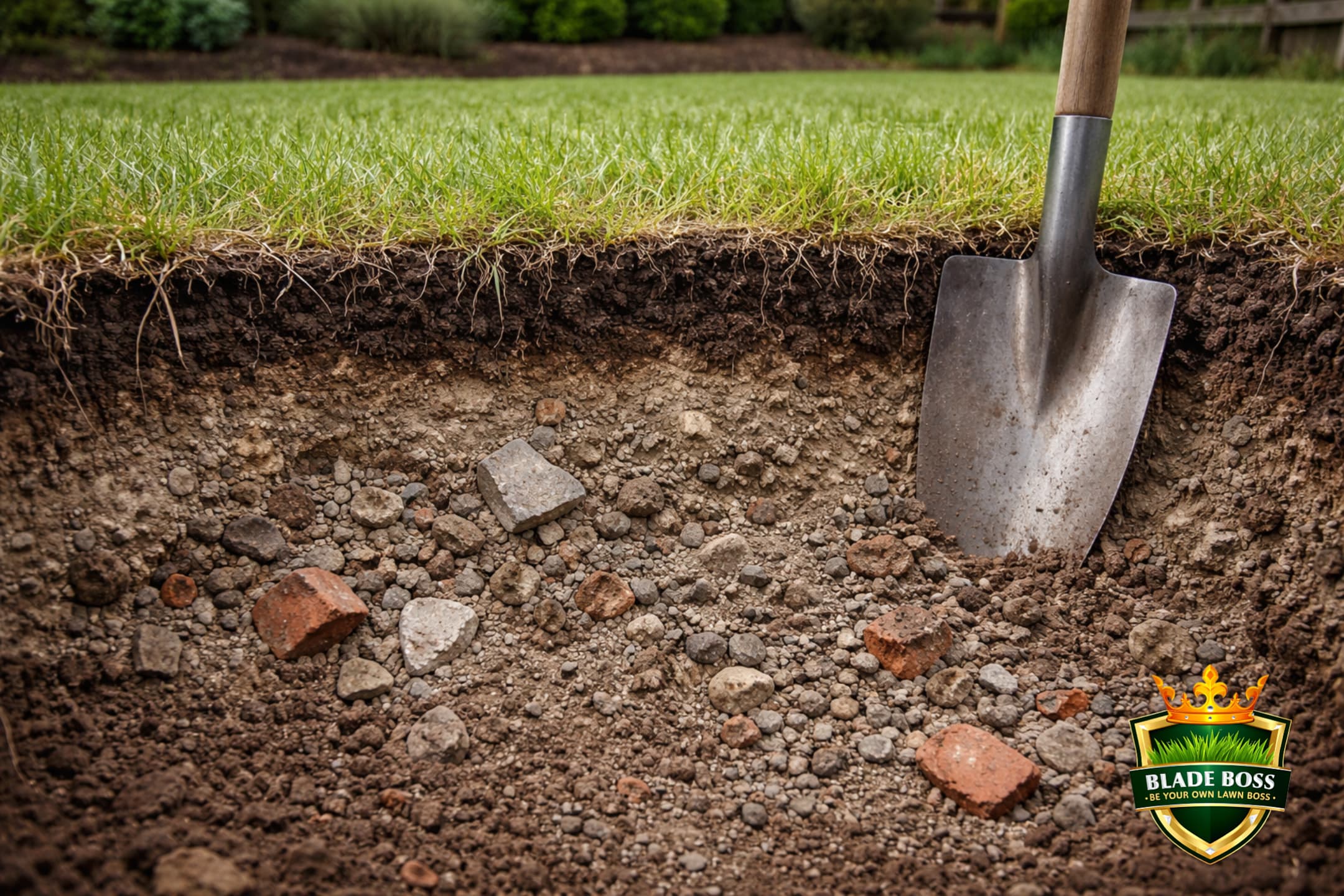
Year 1: Soil test. Core aerate in September (double pass, two directions). Topdress with 0.25 inches of screened compost worked into the aeration holes.
Year 2: Repeat. Add a second compost topdressing in spring (light, 0.125 inches). Continue standard fertilizer program. Retest soil in fall.
Year 3+: Continue annual aeration + topdressing until organic matter reaches 3%+. This is a multi-year rebuild. Each year the soil improves. By year 3 to 4, most fill soils have enough organic matter and biological activity to function like normal soil.
The Blade Boss Soil Correction Engine factors in your current organic matter level and CEC when calculating amendment rates.
What to Do First (Regardless of Zone)
In Nassau County more than anywhere else on Long Island, a soil test is not optional. Construction fill makes it impossible to guess what you're working with based on your neighborhood alone. A soil test through Cornell Cooperative Extension (about $5 per sample) or a MySoil home test kit tells you your actual pH, phosphorus, potassium, CEC, and organic matter. Get the test. Then build your program.
Answer 2 quick questions and get zone-specific adjustments.
We monitor NOAA Islip station daily in spring. When soil hits 55°F at 4-inch depth for 3 consecutive days, you get a text. That's your signal to start mowing and assess spring conditions.
No spam. One seasonal alert per application window. Unsubscribe anytime.
Get the zone map, soil types by neighborhood, and rate adjustment table as a printable 2-page PDF.
See what Blade Boss members get and get instant access to preview our tools, explore Lawn Map Pro, and see what data-driven lawn care looks like. Your Nassau County lawn deserves better than a bag with generic instructions.
See Plans →Chris C. is a Combat Search and Rescue pilot turned airline pilot and the founder of Blade Boss. He built the platform from his garage in Ronkonkoma after realizing that Long Island's unique soil, climate, and regulations make generic lawn care advice useless for the 3 million people living on the island.
Related Reads
The matching Suffolk County guide covers the eastern half of the island with the same region-by-region approach. For your core program, the fertilizer schedule gives you the 5-round nitrogen plan, the pH correction guide covers lime rates by soil texture, and the sandy soil guide is essential for South Shore and barrier beach properties. The soil test decoder walks you through interpreting your results, and the month-by-month calendar is your master timeline for everything.
Frequently Asked Questions
What type of soil does Nassau County have?
Nassau County has 4 distinct soil zones. The North Shore and Gold Coast (Great Neck, Manhasset, Oyster Bay) sit on the Harbor Hill glacial moraine with heavier clay loam soils. Central Nassau (Garden City, Levittown, Hicksville) has the unique Hempstead silt loam, a well-drained silt over sand and gravel that only exists in this county. The South Shore (Bellmore, Merrick, Massapequa) has Riverhead sandy loam transitioning to sandier soils near the coast. The barrier beaches (Long Beach, Island Park) have deep sand with salt spray influence and high water tables.
When can I fertilize in Nassau County?
Nassau County Local Law 11-2009 prohibits lawn fertilization from November 15 through April 1. This is 2 weeks later than Suffolk County's November 1 blackout. Your fertilizer window is April 1 through November 14. New York State also bans phosphorus in lawn fertilizer for established lawns unless a soil test shows a deficiency. Pre-emergent herbicides without fertilizer can be applied year-round since they are classified as pesticides, not fertilizer.
What is Hempstead silt loam?
Hempstead silt loam is a soil series that only exists in central Nassau County, New York. It was first mapped in the 1903 Soil Survey of Long Island and named after the Hempstead Plains. It consists of 20 to 40 inches of dark silt loam (with unusually high organic matter for Long Island) over stratified sand and gravel. This makes it one of the best lawn-growing soils on Long Island: the silty topsoil holds nutrients and moisture well, while the sandy substratum provides excellent drainage. If your property is on Hempstead silt loam, you have a significant natural advantage.
Is Nassau County USDA Zone 7B?
Yes. All of Nassau County is classified as USDA Zone 7B per the 2023 Plant Hardiness Zone Map. Unlike Suffolk County, which has a small Zone 7A area at Montauk, Nassau is uniformly 7B across the entire county. The maritime influence from Long Island Sound on the north and the Atlantic Ocean on the south moderates winter temperatures throughout the county.
Why does my Nassau County lawn have so many problems despite following a standard program?
The most common reason is construction fill. Nassau County was mass-developed in the 1940s through 1960s (Levittown alone was 17,400 homes in 4 years). Builders scraped native topsoil, graded with whatever fill was available, and laid sod on top. Sixty to eighty years later, many lawns are growing in a mix of construction debris, imported fill, and compacted subsoil that bears no resemblance to the native Hempstead or Riverhead soil series. A soil test is the only way to know what you're actually working with.
Keep Reading
 Lawn Science
Long Island Fungicide Guide: FRAC Groups, Rotation Schedule, and What to Buy
The complete beginner's guide to lawn fungicide on Long Island. Learn FRAC groups, build a 4-product rotation schedule...
Mar 27, 2026
17 min
 DIY How-To
Lawn Renovation vs Overseeding: When to Choose Which
If more than 50% of your lawn is weeds, bare dirt, or the wrong grass type, overseeding will...
May 27, 2026
9 min
 Lawn Science
Why Your Lawn Won’t Respond to Fertilizer (5 Hidden Reasons)
You fertilized. You waited. Nothing happened. Here are the 5 reasons your lawn ignores what you put down...
Apr 17, 2026
9 min
What is your lawn actually sitting on?
Pull the soil survey, hardiness zone and current growing conditions for your exact address. Eight government sources, about a minute.
No comments yet. Be the first to share your thoughts.
Create a free account to join the conversation.