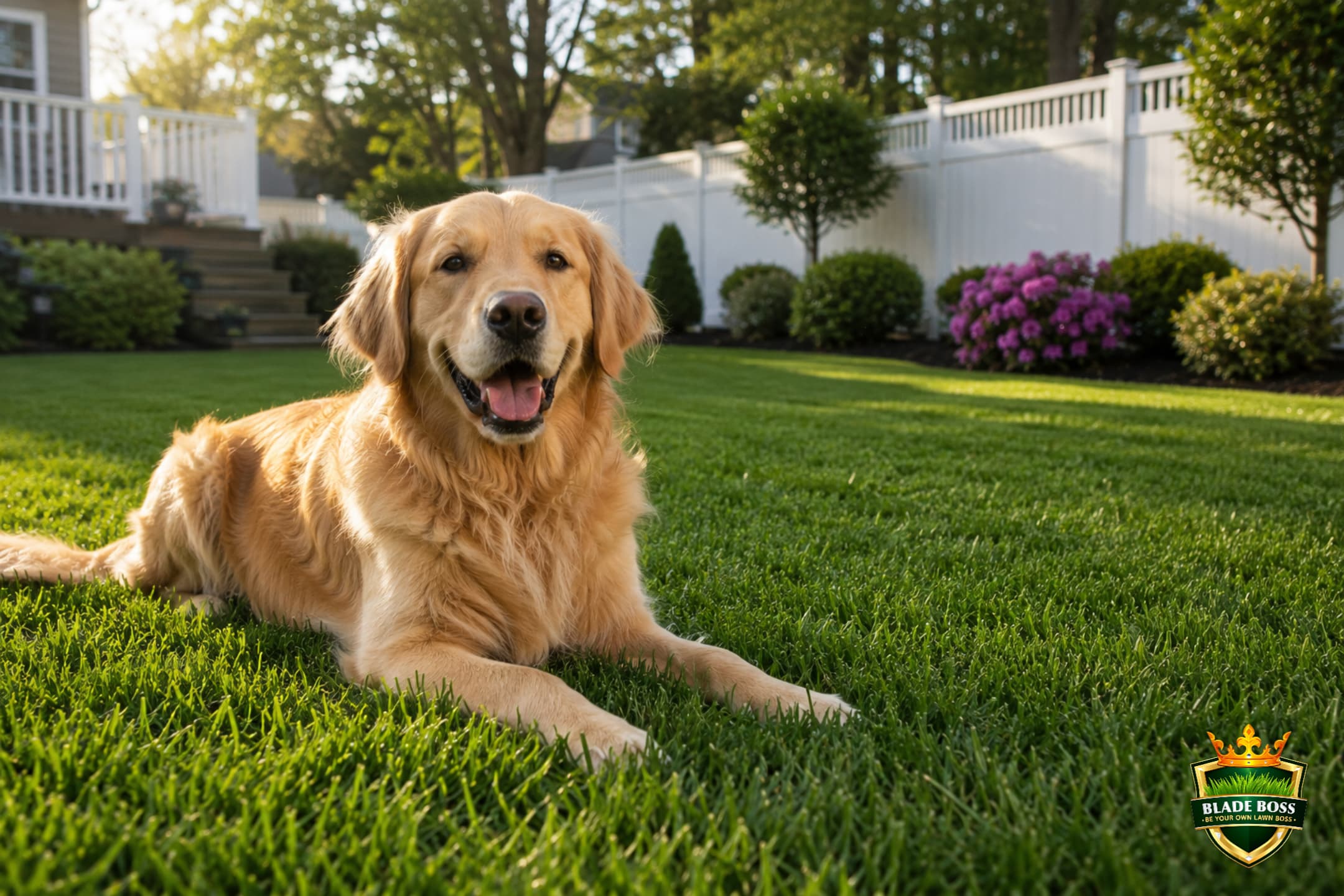
Your dog does not know you just applied weed killer. Your dog does not read product labels. Your dog walks on the lawn, rolls in the grass, chews on blades, licks their paws, and occasionally eats something they definitely should not. Every single product you put on your lawn is something your dog will physically interact with. That is not paranoia. That is reality for every pet owner who also wants a great lawn.
- The universal rule: Apply product → water in thoroughly → let the lawn dry completely → THEN let your dog out. This applies to virtually everything.
- Highest risk for dogs: Broadleaf herbicides (2,4-D, dicamba, triclopyr). University research links these to canine lymphoma. Wait 48 to 72 hours minimum.
- Lowest risk: Plain fertilizers (once watered in and dry), pre-emergents (once watered into soil), and fungicides (once dry). These have low mammalian toxicity.
- "Organic" does NOT mean safe for dogs. Bone meal, blood meal, and fish emulsion attract dogs and can cause serious GI problems if eaten.
- The safest grub control on LI (chlorantraniliprole) is banned. The legal alternative (imidacloprid) requires a 24 to 48 hour wait after watering in.
The Product Safety Table: Every Category, Every Wait Time
This table covers every major lawn care product category with the actual label-based wait times and the risk level for dogs. When in doubt, wait longer than the minimum. Your dog will forgive you for keeping them inside an extra day.
| Product Type | Risk Level | Wait Time | Key Concern |
|---|---|---|---|
| Granular fertilizer (Scotts, Lesco, etc.) | LOW (after watering in) | 24 to 48 hrs | Granule ingestion. Water in, let dry. |
| Milorganite (organic) | LOW (non-toxic) | 24 hrs | Dogs love the smell. May eat granules. GI upset if eaten. |
| Bone meal / blood meal / fish emulsion | MODERATE | 48 hrs | Dogs are attracted to eat it. GI obstruction, pancreatitis. |
| Pre-emergent (prodiamine, dithiopyr) | LOW (once in soil) | 24 hrs | Low mammal toxicity. Water in immediately. |
| Broadleaf herbicide (2,4-D, dicamba) | HIGH | 48 to 72 hrs minimum | Linked to canine lymphoma. Paw absorption, grass licking. |
| Triclopyr (Hi-Yield, Ortho) | HIGH | 48 to 72 hrs minimum | Dogs excrete it more slowly than other mammals. |
| Tenacity (mesotrione) | MODERATE | Until dry (2 to 4 hrs) | Lower mammal toxicity than phenoxy herbicides. |
| Glyphosate (Roundup) | MODERATE to HIGH | 48 to 72 hrs | IARC (WHO) says probable carcinogen. EPA disagrees. Keep dogs off regardless. |
| Propiconazole (fungicide) | LOW (once dry) | Until dry (2 to 6 hrs) | Low mammal toxicity. Same compound class as athlete's foot cream. |
| Azoxystrobin (fungicide) | LOW (once dry) | 24 hrs | Keep dogs off for 24 hours after application. |
| Imidacloprid (grub control) | LOW to MODERATE | 24 to 48 hrs | Water in immediately. Keep off until dry. |
| Trichlorfon / Dylox (grub curative) | MODERATE | 48+ hrs | Most toxic common grub control. Water in, wait longer. |
| Milky spore (biological) | NONE | Immediate | 100% pet safe. Targets Japanese beetle grubs only. |
| Iron supplements (chelated iron) | LOW | Until dry | Non-toxic at lawn rates. Stains paws temporarily. |
The biggest risk is not walking on the lawn. It is what happens after. Dogs walk on treated grass, chemicals stick to their paw pads and fur, and then they lick their paws when they come inside. This oral ingestion pathway is how most lawn chemical exposure occurs in dogs. It is also why simply "waiting until it dries" is not always sufficient for the highest-risk products like 2,4-D, where residues persist on grass blades even after drying.
Fertilizers: What Is Actually Safe
Plain fertilizers (nitrogen, phosphorus, potassium) are the lowest-risk category for dogs once properly applied. The danger is not the nutrients themselves. It is the physical granules. A dog that eats a handful of fertilizer granules can get salt toxicity, stomach irritation, or iron-related GI distress. The fix is simple: water the product in immediately after application and keep dogs off until the granules have dissolved into the soil and the lawn has dried.
The Milorganite Question
Milorganite is the most common "is this safe for my dog" question in every lawn care group. The answer: Milorganite is non-toxic and meets EPA standards that are actually stricter than synthetic fertilizers. It will not poison your dog. But dogs love the smell. It is made from processed biosolids and dogs are attracted to it the way they are attracted to other organic matter (use your imagination). Dogs will roll in it, dig in it, and eat it directly off the lawn or out of an open bag.
If your dog eats Milorganite, the abrasive granule texture can cause vomiting and diarrhea, not because of toxicity but because they just ate gravel-sized pellets. The iron in Milorganite is not soluble and cannot be absorbed in the digestive tract, so iron toxicity is not a concern. Water your Milorganite in after application, keep dogs off for 24 hours, and store the bag somewhere your dog cannot reach it.
Milorganite Organic Nitrogen Fertilizer (6-4-0)
Non-toxic, EPA-regulated, kiln-dried at 900 degrees. The safest conventional fertilizer for dog households. Water in and wait 24 hours. Dogs love the smell, so store the bag out of reach.
Check PriceThis is the most dangerous misconception in pet-owner lawn care. Organic fertilizers made with bone meal, blood meal, feather meal, and fish emulsion are actively attractive to dogs. A dog that eats a pile of bone meal can develop pancreatitis, intestinal blockage, or severe digestive inflammation. These products require the same 24 to 48 hour wait time as synthetic fertilizers and need to be watered in thoroughly. Just because it says organic on the bag does not mean your dog can eat it.
Herbicides: The Highest-Risk Category for Dogs
Broadleaf herbicides are the products you should be most careful with if you own a dog. The most common active ingredients in lawn weed killers are 2,4-D, dicamba, MCPP, and triclopyr. These are in virtually every broadleaf weed killer on the market, including Scotts Weed and Feed, Ortho Weed-B-Gon, and most "3-way" professional herbicides.
Research from Tufts University found that dogs exposed to lawns treated with 2,4-D had higher rates of canine lymphoma. A Purdue University study detected herbicide metabolites in the urine of dogs whose owners had treated their lawns, even when the recommended waiting period was followed. A University of Wisconsin study demonstrated that 2,4-D can cause DNA damage in canine blood cells. These are not fringe studies. They are peer-reviewed research from major veterinary programs.
Additionally, dogs process triclopyr more slowly than rats, monkeys, or humans, according to the National Pesticide Information Center. This means the chemical stays in a dog's system longer and has more time to do damage.
How to Use Herbicides Safely with Dogs
- Wait 48 to 72 hours minimum after application before allowing dogs on the treated area. This is longer than most labels suggest, but the research shows residues persist beyond the standard "wait until dry" recommendation.
- Apply in the morning when dogs are inside. The product needs hours to dry and begin absorbing. Apply early, let it dry all day, keep dogs in until the next day at minimum.
- Spot-treat instead of broadcast spraying. If you have 6 dandelions, spot-spray 6 dandelions. Do not broadcast an entire lawn with herbicide to kill weeds that cover 2% of the surface. Less product on the lawn = less exposure for your dog.
- Rinse paws after every outdoor session during the 48 to 72 hour window. A quick wipe with a wet towel removes surface residue before your dog licks their paws.
- Consider fall-only herbicide applications. Weeds are most vulnerable in fall and your dog likely spends less time on the lawn in cooler weather. Our weed killer guide covers timing.
- Never apply above 85 degrees. Broadleaf herbicides volatilize in heat, creating chemical vapor that drifts across the entire lawn and can irritate your dog's eyes and respiratory system.
Pre-Emergents: Generally Low Risk
Pre-emergent herbicides (prodiamine, dithiopyr, pendimethalin) work by forming a chemical barrier in the top layer of soil. Once watered in and dried, they have very low mammalian toxicity because the active ingredient is bound to soil particles, not sitting on grass blades where your dog contacts it. Water in immediately after application and wait 24 hours. After that, pre-emergents are among the safest lawn chemicals for pet households.
Our pre-emergent comparison covers all 6 products. For dog owners specifically, liquid prodiamine applied through a calibrated backpack sprayer is slightly safer than granular because the liquid absorbs into the soil faster, leaving less surface residue for paws.
Fungicides: Low Risk Once Dry
Propiconazole and azoxystrobin (the two most common lawn fungicides) have low mammalian toxicity and are safe once the application has dried. Propiconazole is in the same chemical family (conazoles) as the active ingredient in human athlete's foot creams. Keep dogs off while the product is wet (2 to 6 hours depending on conditions), and they are fine once it dries.
Our fungicide FRAC rotation guide covers the complete preventive program. For dog owners: apply fungicide in the early morning (4 to 8 AM), let it dry through the morning, and your dog can be out by afternoon.
Time Every Application to Your Dog's Schedule
The Blade Boss Lawn Command Center tracks application windows so you can time treatments for when your dog is at daycare, at the groomer, or on a long walk. Plan around your pet, not around the bag label.
Grub Control: The Long Island Problem
Here is the frustrating reality for Long Island dog owners: the safest grub control product for pets is the one that is illegal here.
Chlorantraniliprole (the active ingredient in Scotts GrubEx and Acelepryn) has the lowest mammalian toxicity of any grub control chemical. The EPA gave it no signal word at all, which is as safe as a pesticide gets. But NYSDEC prohibits it in Nassau, Suffolk, Kings, and Queens Counties. The legal alternative is imidacloprid (BioAdvanced Season-Long), which is a neonicotinoid with low mammalian toxicity but requires more caution than chlorantraniliprole would.
Your Dog-Safe Grub Control Options on LI
- Imidacloprid (BioAdvanced Season-Long): Low mammalian toxicity. Apply in late June to mid-July. Water in immediately with 0.5 inches of irrigation. Keep dogs off for 24 to 48 hours until fully absorbed and dry. The granules are the concern: they must be completely dissolved into the soil before your dog goes out.
- Milky spore powder: 100% pet safe. A biological control that infects and kills Japanese beetle grubs specifically. Zero chemical risk to dogs. The trade-off: it takes 2 to 3 years of consecutive applications to build an effective population in the soil, and it only targets Japanese beetles (not European chafers or other grub species).
- Beneficial nematodes (Heterorhabditis bacteriophora): Completely pet safe. Microscopic organisms that parasitize grubs in the soil. Apply in late summer when grubs are small. Water in immediately. Requires soil temperature above 60 degrees to be effective. Available online and at garden centers.
- Dylox (trichlorfon): The curative option for active grub infestations. More toxic than imidacloprid. Water in immediately and keep dogs off for 48+ hours. Use only when you have confirmed grub damage (the tug test) and need a fast kill. This is not a product to use preventively in a dog household.
One text when adult beetles are laying eggs and it is time to apply. Time it for when your dog is at the groomer or on a long walk.
No spam. One seasonal alert per application window. Unsubscribe anytime.
Fixing Dog Urine Spots (The Damage You Can't Prevent)
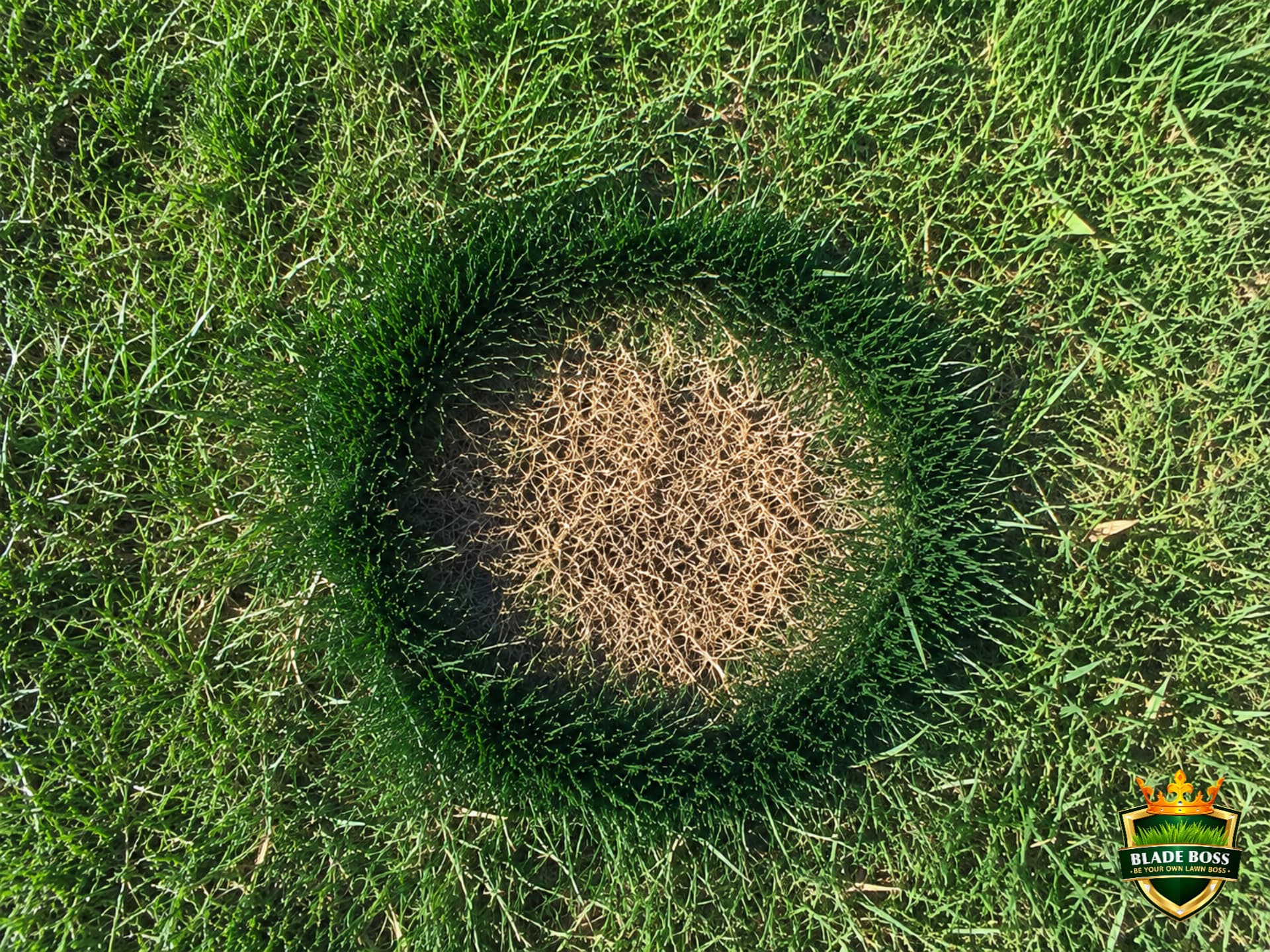
Dog urine contains concentrated nitrogen and salts. When your dog goes in the same area repeatedly, the concentration builds up and burns the grass exactly like an over-application of fertilizer. The signature pattern is unmistakable: a dead brown center surrounded by a ring of unusually dark green grass (the diluted nitrogen at the edges acting as a low-dose fertilizer).
How to Repair Urine Spots
Rake Out the Dead Grass
Remove the dead material from the center of the spot. Get down to bare soil.
Apply Gypsum
Spread gypsum (calcium sulfate) at 5 lbs per 100 sq ft over the damaged area. Gypsum neutralizes the sodium salts in urine that are killing the grass. It also adds calcium without changing pH.
Water Heavily
Soak the area with 0.5 to 1.0 inches of water to flush remaining salts below the root zone. On Long Island's sandy soil, this happens quickly.
Reseed
Apply a hardy grass blend at the patch repair rate (4 to 6 lbs per 1,000 for TTTF, 1 to 2 lbs for KBG). Cover lightly with peat moss. Keep moist until germination.
Prevent Future Damage
Train your dog to use a designated area (mulched pad, pea gravel section, or artificial turf patch). Or flush the spot with a bucket of water immediately after the dog goes. The dilution prevents salt concentration from reaching burn levels.
MySoil Home Soil Test Kit
Test your soil before adding any products. Knowing your pH and nutrient levels means fewer applications, less chemical on the lawn, and a safer yard for your dog. Results in 6 to 8 days.
Check PriceProducts marketed as dietary supplements that "prevent urine burn" by changing your dog's urine chemistry do not work reliably and some contain ingredients that can affect your dog's urinary pH in ways that promote bladder stones. The nitrogen concentration in dog urine is the issue, and no supplement meaningfully reduces it. Flushing the spot with water is free, immediate, and actually works.
The Dog-Friendly Lawn Care Calendar
Here is how to plan your entire year so that every application is timed around your dog's safety:
- Early spring (March to April): Apply pre-emergent (prodiamine or dithiopyr). Water in. Keep dog inside for 24 hrs. Low risk once in soil.
- Spring fertilizer (April to May): Apply granular or Milorganite. Water in. 24 hrs off the lawn. Store the bag out of reach.
- Late spring weeds (May): Spot-treat only. Apply in morning when dog is inside. 48 to 72 hrs before dog access. This is the highest-risk application of the year.
- Grub preventive (late June to mid-July): Apply imidacloprid. Water in 0.5 inches immediately. 24 to 48 hrs before dog access. Plan for a dog park day.
- Summer (July to August): No fertilizer, no herbicides. This is the safest period for your dog. Fungicide applications (if needed) only require waiting until dry.
- Fall fertilizer (September): Apply fall round. Water in. 24 hrs. Same low-risk protocol as spring.
- Fall weed treatment (September to October): If treating broadleaf weeds, this is the BEST time. Cooler temps reduce volatilization risk. Same 48 to 72 hr wait.
- Winterizer (late October): Final fertilizer app. Water in. 24 hrs. Low risk.
- Year-round: Rinse dog's paws with a wet towel after every outdoor session during any treatment window. Takes 30 seconds. Prevents the #1 exposure pathway (paw licking).
The Bottom Line for Dog Owners
You do not have to choose between a great lawn and a safe dog. You just have to plan. Apply products when your dog is inside, at the groomer, or at the park. Water in immediately. Wait for the recommended period. Rinse paws when they come in. Spot-treat weeds instead of broadcasting. And understand that the broadleaf herbicide step is the one that deserves the most caution.
A thick, healthy lawn actually protects your dog. Dense turf crowds out weeds, which means fewer herbicide applications. Deep roots resist drought, which means less chemical intervention overall. The fertilizer schedule, drought-proofing guide, and overseeding guide all build toward a lawn that needs fewer chemicals, which is the safest lawn of all for your dog.
Every lawn product, every risk level, every wait time for dogs. Plus the year-round dog-safe calendar. Print it and tape it to your shed.
See what Blade Boss members get. The Lawn Command Center lets you schedule every application around your life, your dog, and your lawn's actual needs. Data-driven timing means fewer products, better results, and a safer yard for your pup.
See Plans →Chris is a Combat Search and Rescue pilot turned airline pilot who built Blade Boss to bring military-grade precision to backyard lawn care. He runs every product decision past a simple test: would he let his dog on this lawn? If the answer is not an immediate yes, the application gets replanned. His lawn in Ronkonkoma is proof that you can have both.
Related Reads
The weed killer guide covers temperature restrictions and timing for every major herbicide. The grub control guide explains the NYSDEC chlorantraniliprole ban and the imidacloprid alternative. The brown patch diagnosis guide helps you identify whether damage is from disease, drought, or dog urine. And the fertilizer schedule maps every application with timing you can plan around your dog's routine.
Frequently Asked Questions
How long after fertilizing can my dog go on the lawn?
For granular fertilizers, water the product in thoroughly and keep dogs off for 24 to 48 hours. For liquid fertilizers, wait until the lawn is completely dry (2 to 6 hours depending on conditions). The universal rule is: apply, water in, let dry, then allow pets. Organic fertilizers like Milorganite require the same wait time because dogs are attracted to the smell and may eat the granules, which can cause gastrointestinal upset. Store all fertilizer bags where dogs cannot reach them.
Is Milorganite safe for dogs?
Milorganite is non-toxic and meets the strictest EPA safety criteria. It will not poison your dog. However, many dogs are attracted to its smell (it is made from processed biosolids) and will roll in it or eat it off the lawn. If a dog eats Milorganite, the granules can cause mild to moderate stomach upset, vomiting, and diarrhea due to the abrasive texture, not toxicity. Water Milorganite into the lawn after application and keep dogs off for 24 hours to prevent ingestion.
Are lawn weed killers safe for dogs?
Most broadleaf herbicides (2,4-D, dicamba, triclopyr, MCPP) are the highest-risk lawn products for dogs. Research from Tufts University, Purdue University, and the University of Wisconsin has linked 2,4-D exposure to increased rates of canine lymphoma and bladder cancer. Dogs absorb these chemicals through their paw pads and by licking treated grass. The minimum wait time is 48 to 72 hours after the product has dried, but studies have detected herbicide residues on lawns and in dog urine even after the recommended waiting period.
What is the safest grub control for dogs on Long Island?
On Long Island (Nassau, Suffolk, Kings, and Queens Counties), chlorantraniliprole (the active ingredient in Scotts GrubEx and Acelepryn) is banned by NYSDEC despite being the safest option for pets. The legal alternative is imidacloprid (BioAdvanced Season-Long), which has low mammalian toxicity but should be watered in immediately and dogs kept off for 24 to 48 hours. For a completely pet-safe biological option, milky spore powder targets Japanese beetle grubs specifically with zero chemical risk to pets, though it takes 2 to 3 years to fully establish.
How do I fix dog urine spots in my lawn?
Dog urine burns grass because of concentrated nitrogen and salts. The dead spot typically has a distinctive pattern: brown center with a ring of dark green grass around it (the diluted nitrogen at the edges acts as fertilizer). To repair: rake out dead grass, apply gypsum at 5 lbs per 100 sq ft to neutralize salts, reseed with a hardy grass blend, and water thoroughly. The only prevention that works is flushing the spot with water immediately after the dog goes. Dietary supplements marketed for this purpose do not reliably prevent urine burns.

Keep Reading
 DIY How-To
Long Island Lawn Irrigation Guide: How Much Water Does Your Lawn Actually Need?
Long Island gets 46 inches of rain a year. Your lawn still needs supplemental water. Learn exactly how...
Mar 19, 2026
19 min
 DIY How-To
Lawn Renovation vs Overseeding: When to Choose Which
If more than 50% of your lawn is weeds, bare dirt, or the wrong grass type, overseeding will...
May 27, 2026
9 min
 DIY How-To
Best Spreader Settings for Scotts, Lesco, and Echo Spreaders
Bag settings are starting points, not guarantees. Here are verified label settings for 9 common products, the SiteOne...
Apr 2, 2026
13 min
What is your lawn actually sitting on?
Pull the soil survey, hardiness zone and current growing conditions for your exact address. Eight government sources, about a minute.
No comments yet. Be the first to share your thoughts.
Create a free account to join the conversation.