Lesco vs Scotts Fertilizer: Which Is Better for Northeast Lawns?
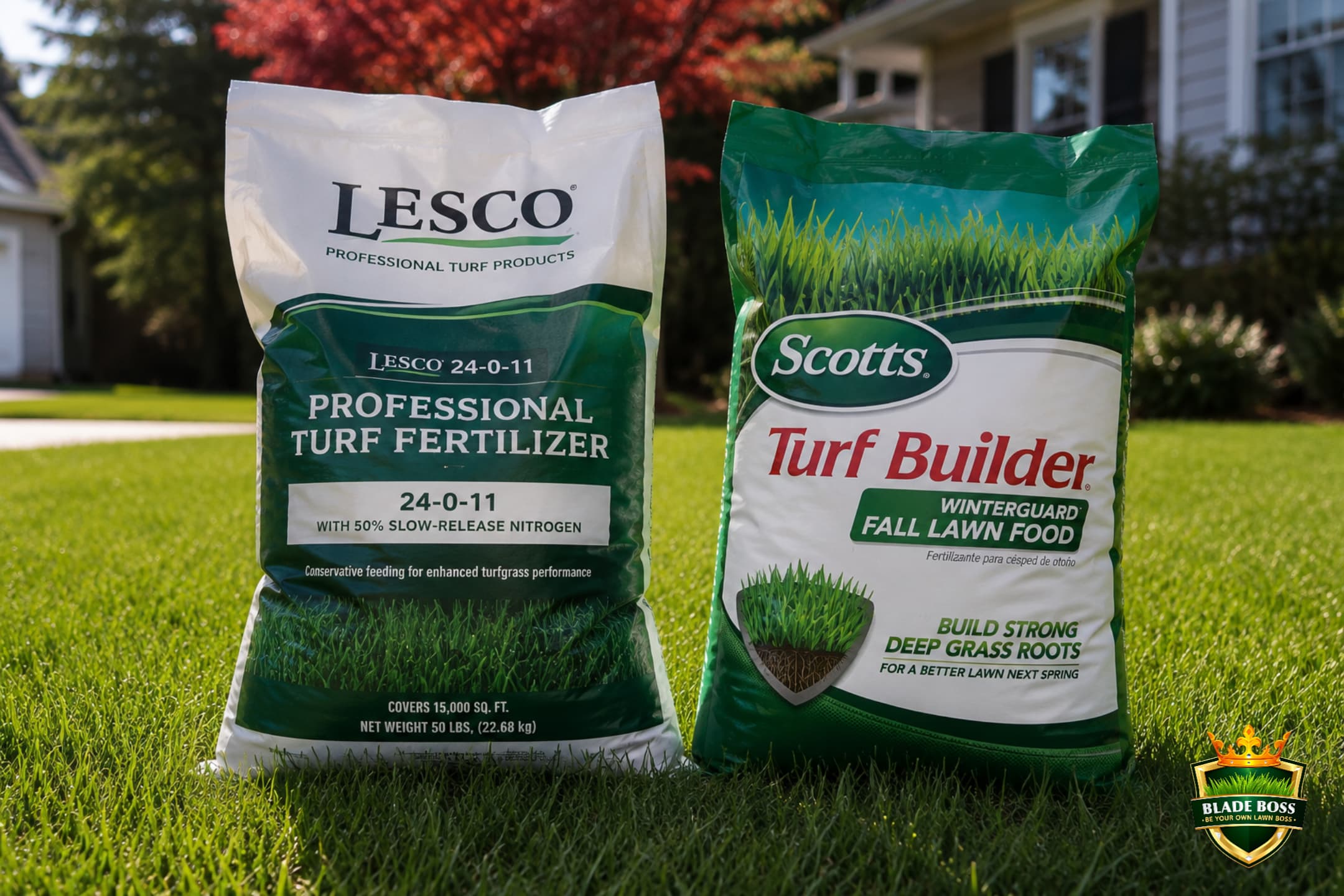
You are standing in the fertilizer aisle at Home Depot looking at a wall of Scotts bags. Green bag, yellow bag, blue bag, purple bag. They all say "Turf Builder" and they all promise a beautiful lawn. Then your neighbor mentions he drives to SiteOne and buys Lesco. Costs about the same. But he swears his lawn looks better. Is he right? Or is he just justifying the 20-minute drive? Let's break it down with actual numbers, not opinions.
- Scotts Turf Builder is convenient, available everywhere, and works fine for most homeowners. But it uses smaller granules (SGN 150-180), has lower slow-release nitrogen (28%), and costs more per pound of actual N.
- Lesco uses professional-grade larger granules (SGN 240), higher slow-release N (75%), distributes more evenly, and costs less per pound of nitrogen. Available at SiteOne only.
- The premium tier (Andersons PGF, Yard Mastery) beats both on nitrogen quality, granule technology, and soil health additives. Costs more per bag but less per pound of results.
- Bottom line: If you own a broadcast spreader and can get to SiteOne, Lesco is the better product. If convenience matters more, Scotts works. If you want the best available, the Andersons PGF is the move.
The 5 Things That Actually Matter in a Fertilizer
Before we compare brands, you need to understand what separates a good fertilizer from a great one. It is not the bag color or the marketing. It comes down to five measurable factors that directly affect how the product performs on your lawn.
Slow-Release N Percentage
What percentage of the nitrogen is slow-release (gradual feeding over weeks) vs quick-release (fast green-up that fades in days). Higher slow-release = steadier growth, less burn risk, less leaching on sandy soil.
Granule Size (SGN)
Larger granules spread more evenly from broadcast spreaders and resist clumping in humid conditions. Smaller granules get trapped in Scotts' hollow wheels and cause striping. SGN 240 is pro standard.
Cost Per Pound of Nitrogen
Price per bag is meaningless. What matters is how much actual nitrogen you get per dollar. A $30 bag and a $50 bag can deliver the same N per 1,000 sq ft at very different costs.
Nutrient Ratio (N-P-K)
Does the ratio match what your soil actually needs? Most established LI lawns need high N, zero P (already high from buildup), and moderate K. A 32-0-4 or 24-0-11 fits better than a 29-0-3.
Soil Health Additives
Premium fertilizers include humic acid, biochar, or iron that feed soil biology and build organic matter over time. Budget products deliver nutrients but do nothing for long-term soil health.
The Head-to-Head Comparison
| Factor | Scotts Turf Builder | Lesco | Andersons PGF |
|---|---|---|---|
| Flagship Product | 32-0-4 | 24-0-11 | 16-4-8 |
| SGN (Granule Size) | 150 to 180 (small) | 240 (standard pro) | 230 (DG technology) |
| Slow-Release N % | 28% | 75% | 42% + humic acid |
| N per 1,000 sq ft | 0.80 lbs | 0.72 to 1.00 lbs | 0.64 lbs |
| Potassium (K) | 4% (minimal) | 11% (good) | 8% (moderate) |
| Soil Health Additives | None | None | Humic DG included |
| Availability | Home Depot, Lowe's, everywhere | SiteOne only | Online only |
| Spreader Compatibility | Scotts settings on bag | SiteOne chart | Universal SGN 230 |
| Wheel Striping Risk | High (small SGN) | Low (large SGN) | Low (large SGN) |
Scotts Turf Builder: The Convenience Play
Scotts dominates the consumer market because of distribution, not formulation. You can buy it at Home Depot, Lowe's, Ace Hardware, Walmart, Amazon, and probably your local gas station. The bag has spreader settings printed right on it for Scotts spreaders. It is genuinely easy to use. For a homeowner who wants to walk out of Home Depot and apply fertilizer that afternoon, Scotts works.
But the formulation has weaknesses. The flagship Turf Builder (32-0-4) is 28% slow-release nitrogen. That means 71% of the nitrogen is quick-release: it dissolves on contact with water, gives you a fast green surge for 2 to 3 weeks, then fades. On Long Island's sandy soils (CEC 3 to 8), that quick-release N flushes through the root zone and into the aquifer within days of a heavy rain. You get a short color pop and then you are back to where you started.
The granule size (SGN 150 to 180) is smaller than professional products. This causes two problems: the granules get trapped in the hollow wheels of Scotts' own EdgeGuard spreaders (creating the wheel striping problem), and they clump more easily in humid Long Island summers. If you have ever opened a bag of Scotts in July and found a solid brick of fertilizer, this is why.
Scotts Turf Builder Lawn Food (32-0-4)
The most widely available lawn fertilizer in America. 32% nitrogen (28% slow-release). Available at every hardware store. Settings printed on bag for Scotts spreaders. Covers 12,000 sq ft per bag.
Check PriceLesco: The Pro-Grade Upgrade
Lesco is what professional lawn care companies use. It is manufactured by the same parent company that runs SiteOne Landscape Supply (formerly John Deere Landscapes). The products are formulated for performance, not shelf appeal. There are no fancy bag designs or TV commercials. Just larger granules, better nitrogen technology, and a product lineup designed for people who understand what N-P-K means.
The flagship Lesco 24-0-11 is a fundamentally different product from Scotts 32-0-4. The nitrogen percentage is lower (24% vs 32%), but 75% of that nitrogen is slow-release. That means a more gradual, sustained feeding over 6 to 8 weeks instead of a 2-week spike and crash. The potassium is dramatically higher (11% vs 4%), which matters for heat tolerance, drought resistance, and disease defense. And the SGN 240 granules spread evenly, resist clumping, and clear the spreader wheels without striping.
The downside: availability. On Long Island, SiteOne has locations in Hicksville, Bohemia, and Riverhead. If you live near one, the drive is worth it. If you are an hour away, the convenience factor drops. Some Lesco products are available on Amazon but typically at a markup over in-store pricing.
Lesco 24-0-11 Pro Turf Fertilizer
75% slow-release polymer-coated nitrogen. 11% potassium for stress protection. SGN 240 pro-grade granules. Available at SiteOne and on Amazon. The fertilizer professionals use on their own lawns.
Check PriceCalculate Your Exact Fertilizer Amount
Enter your lawn size, your product's N-P-K, and your target N rate. Get the exact pounds of product you need and the starting spreader setting. Works for any brand.
The Premium Tier: Andersons, Yard Mastery, and Beyond
If Scotts is the Honda Civic and Lesco is the Accord, the Andersons PGF and Yard Mastery lines are the Lexus. They cost more per bag but deliver measurably better results through superior nitrogen technology, soil health additives, and granule engineering.
The Andersons PGF 16-4-8 includes Humic DG (dispersible humic acid granules) that feed soil biology and build organic matter over time. On Long Island's sandy soils where organic matter is typically 1 to 2% (ideal is 3 to 5%), this long-term soil building is genuinely valuable. The nitrogen is 42% slow-release with a methylene urea base that breaks down via microbial activity rather than simple dissolution.
Yard Mastery Double Dark 16-0-0 is a pure nitrogen product with a chelated iron kicker that delivers deep, dark color without the growth surge of high-N consumer products. The Yard Mastery Summer Stress Blend 7-0-20 is designed specifically for heat stress with low N and high K, which is exactly what Long Island lawns need from late June through August.
The Andersons PGF Complete 16-4-8 with Humic DG
Professional-grade with Humic DG soil health technology. 42% slow-release N, balanced NPK, and humic acid that builds organic matter long-term. The fertilizer that keeps giving after the bag is empty.
Check PriceThe Cost Breakdown (Price Per Pound of Nitrogen)
This is the comparison nobody makes because it requires math. Price per bag is marketing. Price per pound of actual nitrogen is reality. Here is what you actually pay to put 1 pound of nitrogen on 1,000 sq ft of lawn:
| Product | N-P-K | Bag Price | Bag Weight | N per Bag | Cost per lb N |
|---|---|---|---|---|---|
| Scotts Turf Builder | 32-0-4 | ~$56 | 37.5 lbs | 12.0 lbs N | ~$4.67/lb N |
| Lesco 24-0-11 (in-store) | 24-0-11 | ~$45 | 50 lbs | 12.0 lbs N | ~$3.75/lb N |
| Andersons PGF | 16-4-8 | ~$100 | 40 lbs | 6.4 lbs N | ~$15.63/lb N |
| Yard Mastery Double Dark | 16-0-0 | ~$80 | 45 lbs | 7.2 lbs N | ~$11.11/lb N |
| Scotts WinterGuard | 32-0-10 | ~$70 | 37.5 lbs | 12.0 lbs N | ~$5.83/lb N |
| YM Summer Stress | 7-0-20 | ~$80 | 45 lbs | 3.15 lbs N | ~$25.40/lb N |
Note: Andersons PGF and Yard Mastery cost more per pound of N, but include humic acid, iron, and soil health additives that Scotts and Lesco do not. You are paying for more than nitrogen. The Summer Stress Blend is intentionally low-N/high-K for heat protection, not feeding. Prices checked May 2026. Amazon and SiteOne pricing fluctuates. The cost-per-lb-N framework is what matters. Run the math on whatever the current price is.
If your annual N budget is 2.75 lbs per 1,000 sq ft (the Blade Boss standard for LI) on a 5,000 sq ft lawn, you need 13.75 lbs of actual nitrogen per year. At Scotts pricing (~$4.67/lb N) that is about $64/year. At Lesco in-store (~$3.75/lb N) that is about $52/year. The savings add up, but the real advantage is the nitrogen quality: Lesco's 75% slow-release means that $52 feeds your lawn for 6 to 8 weeks per app vs 2 to 3 weeks from Scotts.
Why SGN Matters More on Long Island
Granule size is the factor that separates the consumer experience from the professional experience, and it matters more on Long Island than in most places because of two things: our humidity and our sandy soil topography.
Smaller granules (SGN 150, like Scotts) absorb humidity faster and clump in the bag. They also get trapped in the hollow wheels of broadcast spreaders, causing the checkerboard striping pattern that drives homeowners crazy. Larger granules (SGN 240, like Lesco) resist clumping, clear the wheels, and bounce more evenly across uneven sandy terrain. The result is more uniform distribution, which means more uniform green-up instead of dark and light stripes.
If you have ever applied Scotts and seen a striped pattern 5 to 7 days later, the SGN is the reason. Switching to an SGN 240 product often fixes the striping problem entirely without changing your spreader.
One text when growing degree days reach your next fertilizer window. No spam, just timing.
No spam. One seasonal alert per application window. Unsubscribe anytime.
Why Slow-Release N Matters More on Sandy Soil
Quick-release nitrogen (urea, ammonium sulfate) dissolves the moment it contacts water. On clay soil (CEC 15+), this is fine because the clay particles hold onto the dissolved N ions and release them gradually. On Long Island's sandy soil (CEC 3 to 8), those dissolved N ions flush straight through the root zone with the next rain or irrigation cycle. Your grass gets a 2-day meal followed by 12 days of nothing.
Slow-release nitrogen (methylene urea, polymer-coated urea, sulfur-coated urea) must be broken down by soil microbes before the plant can absorb it. This breakdown happens over weeks, not hours. Even on sandy soil where water moves fast, the slow-release granules stay in the root zone because they are still solid particles, not dissolved ions. The plant gets a steady trickle of N over 6 to 8 weeks instead of a flood followed by a drought.
This is why Scotts at 28% slow-release performs dramatically differently on Long Island sand than on a clay lawn in Westchester. The product is the same. The soil changes everything. Our sandy soil guide covers the full science.
Which One Should YOU Use?
I want the easiest possible option
Scotts Turf Builder (32-0-4). Available at every store, spreader settings on the bag, and it works. Not optimal, but effective. If you just want to feed your lawn without thinking about it too much, this is fine. Apply at the rate on the bag, calibrate your spreader, and you are ahead of 80% of homeowners.
I want better results and can get to SiteOne
Lesco 24-0-11. Better nitrogen technology, higher potassium for stress protection, larger granules for even distribution, and cheaper per pound of N. The drive to SiteOne (Hicksville, Bohemia, or Riverhead on LI) pays for itself in product quality. Tell them your lawn size and grass type and they will recommend the right Lesco product for the season.
I want the best available and don't mind paying for it
Andersons PGF 16-4-8 with Humic DG. Premium nitrogen technology plus humic acid that builds soil health over time. On Long Island sand where organic matter is low, the humic acid is a genuine long-term investment. Order online. Pair it with Andersons Humic DG as a standalone soil amendment for maximum benefit.
I want summer-specific stress protection
Yard Mastery Summer Stress Blend 7-0-20. Low nitrogen (won't push growth in heat), high potassium (strengthens cell walls, improves drought tolerance). Apply in early June before heat arrives. This is the product that replaces your summer N app with something that actually helps instead of making things worse.
I want deep color without growth surge
Yard Mastery Double Dark 16-0-0. Nitrogen plus chelated iron for dark green color without the excessive top growth that comes from high-N products. Good for homeowners who are tired of mowing twice a week after a Scotts app.
I need a winterizer for fall
Scotts WinterGuard 32-0-10. This is actually one of Scotts' better products. The 10% potassium builds cold hardiness, and the fall application timing means quick-release N is less of an issue (cooler temps slow leaching). Apply late October to early November per the fertilizer schedule.
The Verdict
Scotts is not bad. It is convenient and it works. But on Long Island's sandy soils where nitrogen leaching is a real environmental and performance issue, the slow-release advantage of Lesco and the premium products is not marketing. It is chemistry. The product that keeps feeding your lawn for 6 weeks after application will always outperform the product that gives you 2 weeks of green and then washes into the aquifer.
If you are going to make one upgrade to your fertilizer program this year, switch from Scotts to Lesco or Andersons PGF. The results will show within one application cycle. Combine that with understanding your N rate and calibrating your spreader, and you are operating at a level that 95% of Long Island homeowners never reach.
The complete 5-round fertilizer program for Long Island lawns. Exact timing, rates, and product recommendations for every round. Print it and plan your year.
See what Blade Boss members get. The Lawn Command Center tracks GDD, soil temperature, and fertilizer timing so every application hits the right window with the right product at the right rate.
See Plans →Chris is a Combat Search and Rescue pilot turned airline pilot who built Blade Boss to bring military-grade precision to backyard lawn care. He switched from Scotts to Andersons PGF in 2024 and the difference was visible within 10 days. His Ronkonkoma lawn sits on Suffolk County sand with a CEC of 6, which is exactly the soil type where nitrogen quality matters most.
Related Reads
The fertilizer schedule maps all 5 rounds across the year with exact timing. The fertilizer calculator guide explains how to think in lbs of N per 1,000 instead of bag rates. The spreader settings guide has verified settings for both Scotts and Lesco products. And the troubleshooting guide explains why fertilizer sometimes doesn't work, no matter which brand you use.
Frequently Asked Questions
Is Lesco fertilizer better than Scotts?
Lesco fertilizer is generally better for lawn performance because it uses larger granules (SGN 240 vs Scotts SGN 150-180) for more uniform distribution, contains a higher percentage of slow-release nitrogen (typically 75% vs Scotts at 28% in Turf Builder), and costs less per pound of actual nitrogen when compared at equivalent rates. The trade-off is availability: Scotts is at every Home Depot and Lowe's while Lesco requires a trip to SiteOne Landscape Supply.
What does SGN mean on fertilizer bags?
SGN stands for Size Guide Number and measures the average granule diameter in hundredths of an inch. SGN 240 means the average granule is 0.24 inches (about 6mm). SGN 150 means 0.15 inches (about 4mm). Larger granules (higher SGN) distribute more evenly from broadcast spreaders, are less likely to get trapped in hollow spreader wheels, and are less prone to clumping in humid conditions. Professional fertilizers typically use SGN 200 to 280 while consumer products like Scotts use SGN 150 to 180.
What is slow-release nitrogen and why does it matter?
Slow-release nitrogen (also called controlled-release, WIN, or water-insoluble nitrogen) breaks down gradually over 6 to 12 weeks, feeding the grass steadily instead of all at once. Quick-release nitrogen dissolves immediately, causes a fast green-up surge that fades in 2 to 3 weeks, and is more likely to burn grass if over-applied. On Long Island's sandy soils, quick-release N flushes through the root zone in days. Slow-release stays in the root zone longer because it must be broken down by soil microbes before the plant can absorb it.
Where can I buy Lesco fertilizer?
Lesco is sold exclusively through SiteOne Landscape Supply stores. On Long Island, there are SiteOne locations in Hicksville, Bohemia, and Riverhead. The stores are open to homeowners despite being a professional supply chain. Bring your lawn square footage and they will help you pick the right product and calculate the amount you need. Some Lesco products are also available on Amazon, though prices are typically higher than in-store.
Are there fertilizers better than both Lesco and Scotts?
Yes. The Andersons Professional PGF with Humic DG (16-4-8) and Yard Mastery branded fertilizers are considered premium tier above both Lesco and Scotts. They use larger granule sizes (SGN 200 to 280), higher slow-release nitrogen percentages, and include soil health additives like humic acid and biochar. They cost more per bag but deliver more actual nitrogen per dollar and better long-term soil health. They are available online but not at retail stores.
Keep Reading
 Lawn Science
What Every Lawn Nutrient Actually Does (And What Happens When They’re Wrong)
Every nutrient in your soil does something specific to your grass. Here's what happens when each one is...
Apr 15, 2026
13 min
 Lawn Science
Suffolk County Lawn Care Guide: East End to Huntington
Suffolk County is 86 miles long. Your lawn in Huntington has completely different soil than a lawn in...
Mar 31, 2026
13 min
 DIY How-To
Lawn Renovation vs Overseeding: When to Choose Which
If more than 50% of your lawn is weeds, bare dirt, or the wrong grass type, overseeding will...
May 27, 2026
9 min
What is your lawn actually sitting on?
Pull the soil survey, hardiness zone and current growing conditions for your exact address. Eight government sources, about a minute.
No comments yet. Be the first to share your thoughts.
Create a free account to join the conversation.