Lawn Dethatching Guide for the Northeast: Timing, Tools, and Why Fall Beats Spring

Every spring, homeowners across the Northeast rent power dethatchers and rip their lawns apart on the first warm weekend. Most of them shouldn't be doing it. Not because dethatching is bad, but because spring is the wrong time for most lawns, and a lot of the lawns getting dethatched don't even need it. This guide breaks down when dethatching actually helps, when it hurts, and why September is almost always the better choice.
For Northeast lawns (USDA Zones 5A through 7B), lawn dethatching in the Northeast should be done in September, not spring, for best results. Dethatch only if the thatch layer exceeds 0.5 inches (measured by cutting a small wedge from your lawn). Kentucky Bluegrass is the heaviest thatch producer and the most likely to need it. Tall Fescue and Perennial Ryegrass rarely need dethatching. Core aeration alone manages thatch under 0.5 inches. If you must dethatch in spring, wait until late April or May when grass is actively growing, but expect slower recovery and broken pre-emergent barriers.
What Thatch Actually Is (And What It Isn't)
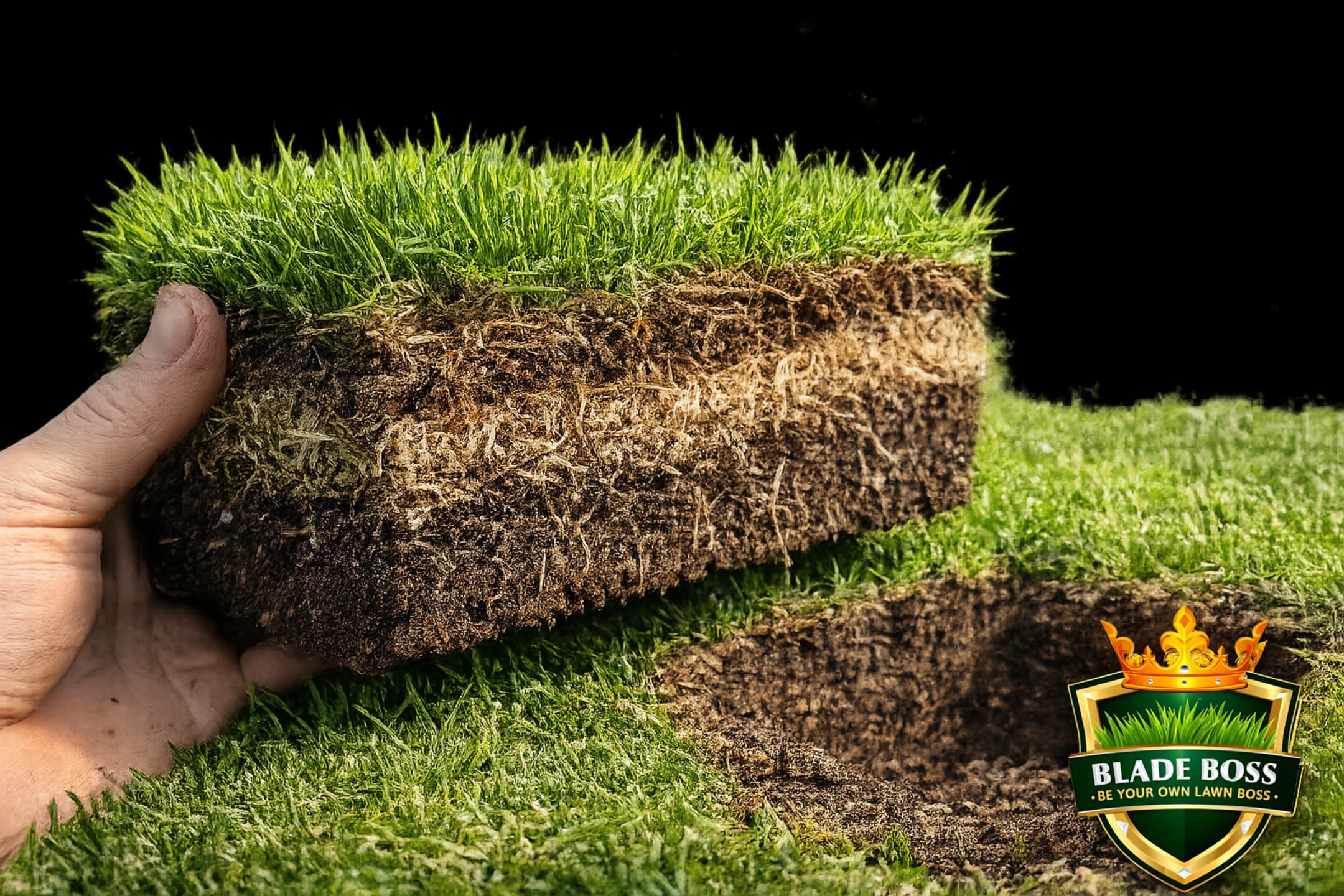
Thatch is the spongy, brown layer of dead and living organic material that accumulates between the green grass blades above and the soil surface below. It's made of dead stems, crowns, roots, and runners, not grass clippings. That distinction matters because it changes how you think about the problem.
A thin thatch layer (under 0.5 inches) is actually beneficial. It insulates roots from temperature extremes, retains moisture during dry spells, and cushions the turf against foot traffic. The problem starts when thatch builds up beyond 0.5 inches. At that point, it blocks water, air, and fertilizer from reaching the soil. Roots start growing into the thatch layer instead of the soil, making the grass shallow-rooted and vulnerable to drought and heat stress. Disease organisms like brown patch and dollar spot harbor in thick thatch because it retains moisture against the crown. Lawn Map Pro puts all this data on your satellite map with zone-by-zone tracking. Our Stripe Master members get the complete 15-step Lawn Playbook that covers exactly this.
This is the most common thatch myth. Grass clippings are 80 to 85% water and decompose within days. Research from Cornell, Rutgers, and Penn State confirms that mulching clippings does not increase thatch accumulation. In fact, mulched clippings return up to 1 pound of nitrogen per 1,000 square feet per year to your lawn. Thatch buildup comes from aggressive rhizome-producing grasses (primarily Kentucky Bluegrass), over-fertilization, and lack of core aeration.
How to Measure Your Thatch Layer
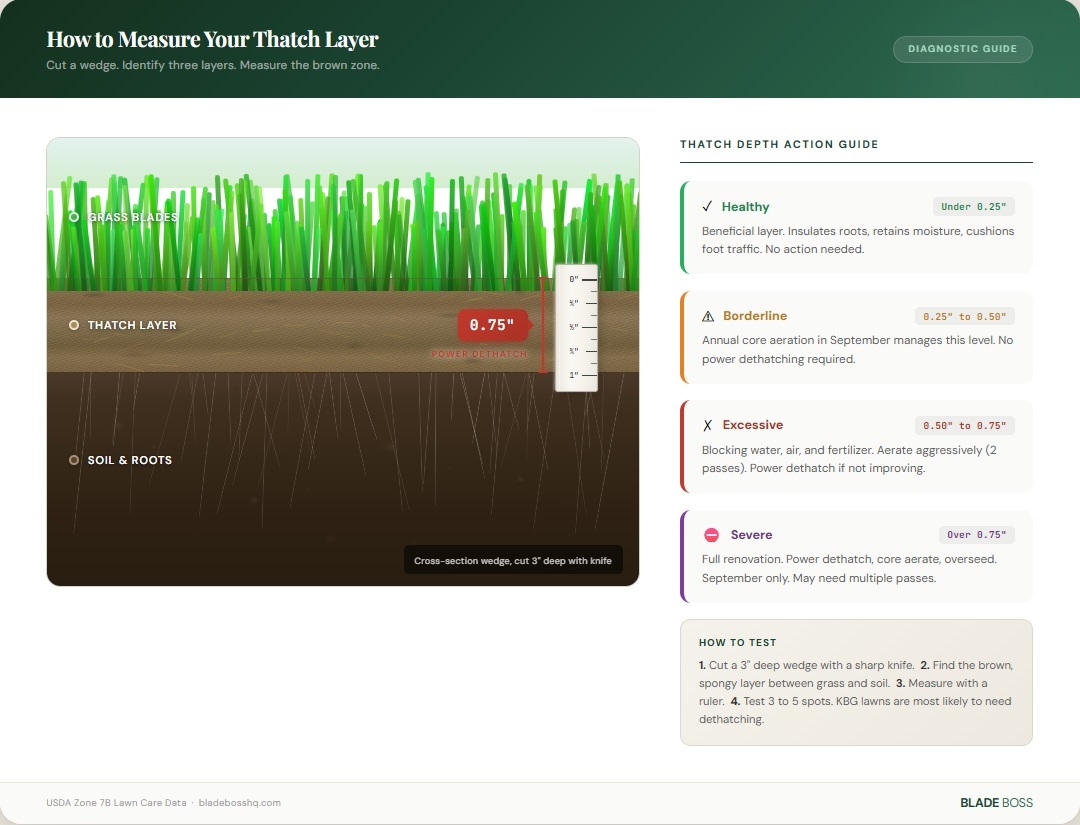
Before you rent any equipment, measure your thatch. This takes 60 seconds and saves you from dethatching a lawn that doesn't need it.
Cut a Small Wedge
Use a sharp knife or garden trowel to cut a 3-inch deep wedge from your lawn. Choose a representative area, not the edge of a driveway or a thin spot. Pull the wedge out and look at the cross-section.
Identify the Three Layers
From top to bottom: green grass blades, then the brown spongy thatch layer, then the soil with visible roots. The thatch is the brown material between the living grass and the dirt.
Measure the Thatch
Use a ruler or tape measure on the brown layer. Under 0.5 inches: you do not need to dethatch. 0.5 to 0.75 inches: core aeration alone may manage it. Over 0.75 inches: power dethatching is recommended.
Test Multiple Spots
Thatch accumulation isn't uniform. Test at least 3 to 5 spots across your lawn, especially areas with heavy Kentucky Bluegrass concentration. KBG's aggressive rhizome growth makes it the heaviest thatch producer among cool-season grasses.
Map Your Thatch Zones with Lawn Map Pro
Draw your KBG zones, TTTF zones, and shade areas on satellite imagery. Know exactly which sections of your lawn are dethatching candidates before you rent equipment.
| Thatch Depth | Condition | Action | When |
|---|---|---|---|
| Under 0.25 in | Healthy, beneficial | Nothing. Leave it alone. | N/A |
| 0.25 to 0.5 in | Acceptable | Annual core aeration manages it | September |
| 0.5 to 0.75 in | Borderline | Core aerate aggressively (2 passes). Consider power dethatch if not improving. | September |
| Over 0.75 in | Excessive | Power dethatch, then core aerate, then overseed | September (strongly preferred) |
| Over 1.0 in | Severe | Power dethatch at aggressive setting. May need multiple passes. Plan full renovation. | September only |
Why September Beats Spring for Dethatching
Every university extension program in the Northeast recommends fall over spring for dethatching cool-season lawns. The reasons are biological, not just practical. Our Dynamic Calendar tracks these windows automatically with GDD alerts.
Power dethatching is violent. Vertical blades slice through the turf, ripping out dead material along with some living grass. The lawn looks terrible afterward, sometimes worse than before you started. Recovery depends entirely on how fast the grass can regrow. In September, cool-season grass is entering its peak fall growth phase. Soil temperatures on Long Island average 68°F in September and 57°F in October, right in the 50 to 65°F optimal range for root growth. Air temperatures moderate into the 60 to 75°F range that drives the strongest shoot growth of the year. The grass has 5 to 6 weeks of aggressive growth before the first hard freeze (around November 4th on Long Island) to heal the damage.
In spring? The math is much worse. Soil doesn't consistently cross 55°F on Long Island until mid-April. The grass is barely out of dormancy. You have maybe 6 to 8 weeks before summer heat stress arrives in late June. And here's the killer: if you applied pre-emergent herbicide for crabgrass, dethatching rips right through that chemical barrier. Every groove cut by the vertical mower is an open invitation for crabgrass seeds sitting in the soil.
| Factor | Fall (September) | Spring (Late April to May) |
|---|---|---|
| Soil temperature | 68°F dropping (ideal root growth) | 52 to 61°F rising (still cool) |
| Growth phase | Peak fall surge | Just exiting dormancy |
| Recovery time before stress | 5 to 6 weeks before freeze | 6 to 8 weeks before summer heat |
| Pre-emergent conflict | None (fall pre-em comes later) | Destroys spring crabgrass barrier |
| Overseeding opportunity | Excellent (ideal seeding window) | Fair (crabgrass competes with new seed) |
| Disease risk | Low (cooling temps) | Moderate (humidity rising) |
| University recommendation | Strongly preferred | Secondary option only |
If your thatch is over 0.5 inches and you can wait until September, wait. The grass recovers faster, you can overseed the same day, and you don't sacrifice your crabgrass defense. Spring dethatching is a last resort for lawns with thatch so thick (over 1 inch) that waiting through another summer would cause more harm than the spring disruption.
Plan Your Fall Renovation
The Blade Boss Calendar tracks soil temperatures and GDD for your ZIP code so you know exactly when your September window opens.
Which Grasses Produce the Most Thatch
Not all grasses build thatch at the same rate. Thatch accumulation is driven primarily by rhizome and stolon production, which is why spreading grasses create more thatch than bunch-type grasses. The stems, runners, and crowns from lateral growth decompose slowly and accumulate faster than soil microbes can break them down.
| Grass Type | Thatch Production | Typical Dethatching Need | Why |
|---|---|---|---|
| Kentucky Bluegrass (KBG) | High | Every 2 to 3 years | Aggressive rhizome growth produces the most dead organic material of any cool-season grass on Long Island. |
| Perennial Ryegrass (PRG) | Low | Rarely | Bunch-type grass with no rhizomes. Minimal dead runner production. |
| Turf-Type Tall Fescue (TTTF) | Low | Rarely | Bunch-type grass. Deep roots decompose in place. Minimal surface buildup. |
| Fine Fescue | Low to Moderate | Every 3 to 5 years | Creeping Red Fescue produces some thatch via stolons. Chewings and Hard Fescue produce less. |
| Zoysia | Very High | Annually | Extremely dense stoloniferous growth. Not common on Long Island but included for reference. |
If your lawn is predominantly Tall Fescue, you probably don't need to dethatch at all. Annual core aeration in September is sufficient for thatch management on TTTF and PRG lawns. KBG-dominant lawns are the primary candidates for power dethatching, and even then, only when the thatch layer exceeds 0.5 inches.
What Causes Excessive Thatch (And How to Prevent It)
Thatch accumulates when organic material is produced faster than soil microbes can decompose it. Three factors drive this imbalance on Northeast lawns.
Aggressive Rhizome Growth
KBG's underground runners constantly produce new shoots and leave behind dead stems. This is the primary thatch source on Long Island.
Over-Fertilization
Excess nitrogen pushes top growth faster than the soil ecosystem can decompose the die-back. Follow your fertilizer schedule and don't exceed recommended rates.
Skipping Annual Aeration
Core aeration deposits soil microbes on the thatch surface, accelerating decomposition. Lawns that skip aeration for multiple years accumulate thatch faster.
If you core aerate every September, you rarely need to power dethatch at all. The soil cores deposited on the lawn surface introduce microorganisms directly into the thatch layer, dramatically speeding up natural decomposition. Annual aeration typically keeps thatch under 0.5 inches on most Northeast lawns, including KBG-dominant properties.
How to Dethatch: Equipment and Method
There are three levels of dethatching equipment, each suited to a different severity of thatch buildup.
Thatching Rake (Manual)
A thatching rake has short, sharp, curved tines designed to dig into the thatch layer and pull it out. Effective for small areas (under 500 square feet) with moderate thatch. Physical labor is significant. For anything larger than a garden bed or small side yard, go mechanical.
Power Dethatcher (Vertical Mower)
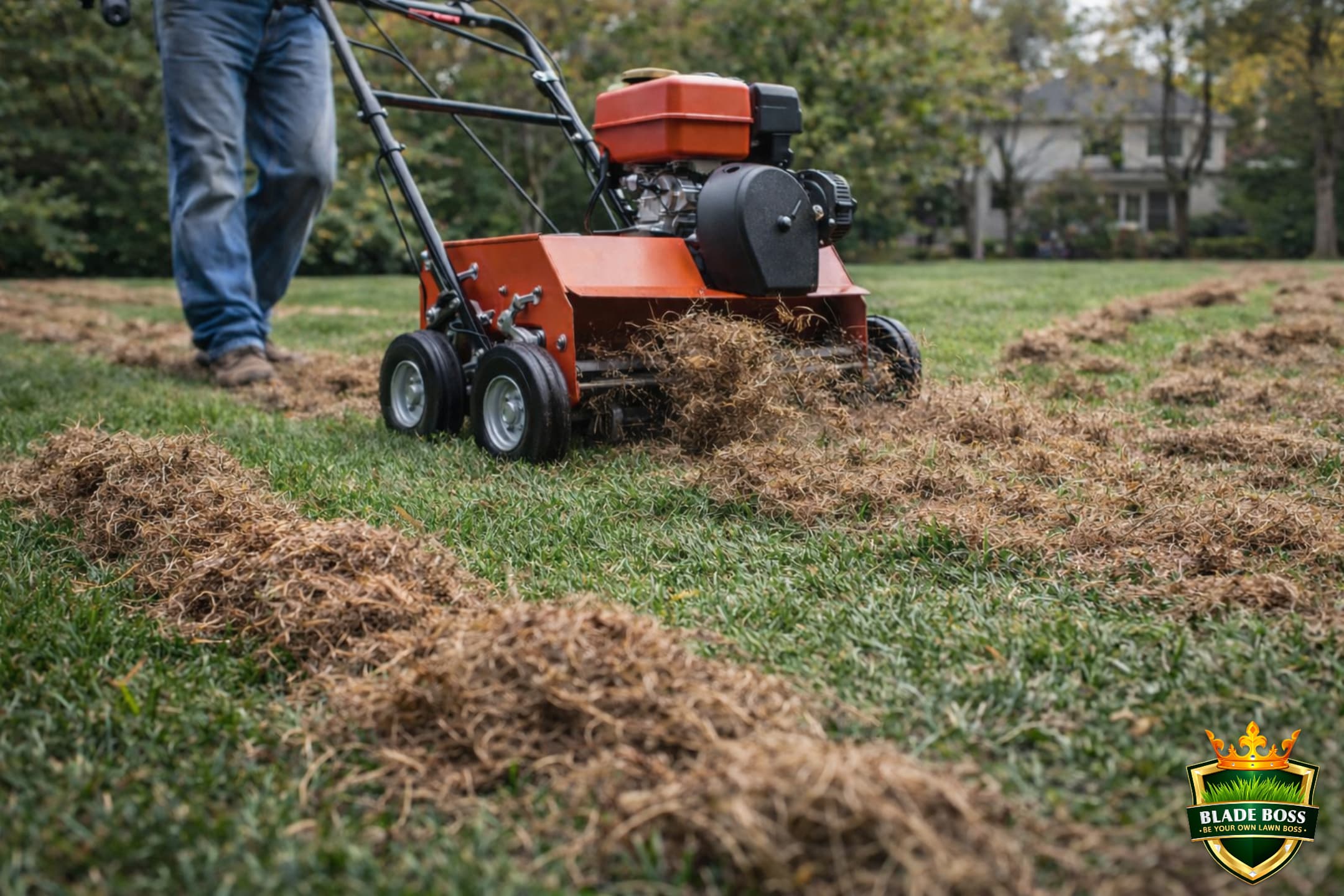
This is the standard tool for dethatching a full lawn. A power dethatcher (also called a vertical mower or verticutter) has a rotating shaft with vertical blades that slice into the thatch layer, cutting it loose and bringing it to the surface. You'll rake or bag the debris afterward. Rental runs about $70 to $100 for a half day at Home Depot or Sunbelt on Long Island.
Set the blade depth to cut into the thatch layer but not deeply into the soil. On most Northeast lawns, a depth setting of 0.25 to 0.5 inches into the thatch is right. Make one pass in a single direction, then a second pass perpendicular to the first for thorough coverage. The lawn will look rough afterward. That's normal.
Join Northeast homeowners who get dethatching timing, seasonal reminders, and data-driven lawn care tips every week.
Scarifier (Aggressive)
A scarifier is a more aggressive version of a power dethatcher with fixed knife blades instead of flexible tines. It cuts deeper and removes more material. Use this only for severe thatch (over 1 inch) as part of a full lawn renovation. The lawn will look destroyed afterward and must be overseeded immediately.
June through August is off-limits for dethatching in the Northeast. Cool-season grass is under heat and drought stress during this period and cannot recover from the trauma of power dethatching. Soil temperatures on Long Island peak at 76°F in July and 75°F in August. Dethatching during summer stress can kill large sections of your lawn.
The September Dethatching Playbook (Step by Step)
Fall dethatching pairs perfectly with aeration and overseeding. Doing all three in one weekend is the most efficient approach and gives you the best results because the processes complement each other.
Mow Low (2 to 2.5 Inches)
Before dethatching, drop your mowing height one to two notches below your normal setting. This makes the power dethatcher more effective by reducing the grass canopy that the blades have to cut through. Bag the clippings from this mow.
Run the Power Dethatcher
Make your first pass in one direction across the lawn. Then make a second pass perpendicular to the first. Set blade depth to penetrate the thatch layer without digging deeply into soil. The lawn will look terrible. Don't panic.
Rake and Remove All Debris
Use a leaf rake or lawn sweeper to collect the pulled-up thatch material. This is dead organic matter you want off the lawn. Compost it or bag it. Do not leave it sitting on the grass.
Core Aerate Immediately After
With the thatch layer thinned, core aeration can now penetrate cleanly into the soil. The combination of dethatching plus aeration opens up the root zone dramatically. Make two perpendicular passes with the core aerator.
Overseed the Same Day
The freshly dethatched and aerated lawn is the ideal seedbed. Broadcast your seed blend over the entire lawn. Seed will fall into the aeration holes and the grooves left by the dethatcher, giving perfect seed-to-soil contact.
Apply Starter Fertilizer
Use a starter fertilizer with phosphorus (permitted by New York law for new seed establishment). Follow with your Round 3 fall fertilizer application on schedule.
Water Consistently
Keep the seedbed moist for 2 to 3 weeks until germination is complete. Light watering 2 to 3 times per day for the first 10 days, then transition to deeper, less frequent watering as seedlings establish.
Calculate Your Exact Seed Rate
Enter your lawn size, grass type, and overseeding intensity. SeedGenius Pro calculates exactly how many pounds of seed you need.
When Spring Dethatching Actually Makes Sense
Spring dethatching is the secondary option. It works, but it comes with real tradeoffs. Here are the only scenarios where spring dethatching is justified.
Thatch over 1 inch and lawn is suffering
If thatch is so thick that water literally runs off instead of soaking in, and your lawn is visibly declining, waiting until September means losing another growing season. In this case, dethatch in late April to early May once the grass is actively growing and soil exceeds 55°F.
Lawn renovation that can't wait
If you're doing a full renovation (kill, dethatch, reseed), spring can work if you accept the trade-off of skipping pre-emergent and fighting crabgrass manually through summer. Use mesotrione (Tenacity) at seeding for partial weed suppression.
No pre-emergent applied this spring
If you didn't apply pre-emergent (maybe you moved into a new house in March), there's no barrier to disrupt. Dethatching in late April followed by overseeding is reasonable since you weren't going to have crabgrass protection anyway.
Wait until late April to early May. Soil must be above 55°F and grass must be actively growing (not just green).
Never dethatch in March. The grass is too fragile. Light raking for debris is fine, but power dethatching in early spring can kill sections of turf that haven't fully broken dormancy.
Accept the pre-emergent loss. If you applied crabgrass pre-emergent, dethatching destroys the barrier. Plan for post-emergent crabgrass treatment with quinclorac (Drive XLR8) in May and June.
Overseed immediately. Every open groove is an invitation for weeds. Fill them with grass seed before the weeds find them.
Dethatching vs. Core Aeration: When to Choose Which
This is where most homeowners get confused. Dethatching and aeration are not the same thing, and most lawns need aeration, not dethatching.
| Situation | Best Action | Why |
|---|---|---|
| Thatch under 0.25 inches | Neither needed (just mow and fertilize on schedule) | Thatch is beneficial at this level |
| Thatch 0.25 to 0.5 inches | Core aerate only (September) | Aeration manages thatch by introducing decomposing microbes |
| Thatch 0.5 to 0.75 inches | Core aerate aggressively (2 passes, September) | Aeration may be sufficient. Measure again next year. |
| Thatch over 0.75 inches | Dethatch first, then aerate (September) | Thatch is too thick for aeration alone to manage |
| Compacted soil, thin thatch | Core aerate only | The problem is compaction, not thatch. Dethatching won't help. |
| Spongy lawn, water runs off | Dethatch first, then aerate | Thatch is repelling water. Must be physically removed. |
| KBG lawn, never dethatched | Measure thatch first, then decide | KBG is the heaviest thatch producer. Check before assuming. |
Thatch and Disease: The Hidden Connection
Excessive thatch does more than block water. It creates the perfect microenvironment for lawn disease. Brown patch (Rhizoctonia solani) produces sclerotia that survive in the thatch layer. Dollar spot (Clarireedia spp.) overwinters as dormant mycelium in thatch and plant debris. Leaf spot (Bipolaris/Drechslera) harbors inoculum in thick thatch, creating a self-reinforcing disease cycle where damaged turf produces more dead material that feeds more disease.
On Long Island specifically, the maritime humidity during summer already elevates disease pressure. Adding a thick thatch layer that retains moisture against the grass crowns compounds the problem. Managing thatch to 0.5 inches or less is one of the most effective cultural practices for reducing fungicide dependence.
The "Liquid Aeration" Question
You'll see liquid aeration and liquid dethatcher products marketed as spray-on alternatives to mechanical equipment. They claim to break down thatch using surfactants, humic acids, or biological agents applied as a liquid.
The reality: no university extension research supports liquid products as a replacement for mechanical dethatching. Some may improve soil biology and water penetration at the margins, but they cannot physically remove a 0.75-inch thatch layer. If your thatch exceeds 0.5 inches, you need mechanical intervention. There are no shortcuts.
Zone Adjustments: Dethatching Across the Northeast
The September recommendation is calibrated to Zone 7B on Long Island. If you're further north, shift the window earlier to account for shorter fall growing seasons.
| USDA Zone | Ideal Dethatching Window | Adjustment vs Zone 7B |
|---|---|---|
| Zone 7B (Long Island) | Sep 1st to Oct 1st | Baseline |
| Zone 7A (Coastal CT/NJ) | Aug 25th to Sep 25th | 5 to 7 days earlier |
| Zone 6B (NYC metro, central NJ) | Aug 20th to Sep 20th | 10 to 14 days earlier |
| Zone 6A (SE PA, southern CT) | Aug 15th to Sep 15th | 14 to 21 days earlier |
| Zone 5B (Upstate NY, western MA) | Aug 10th to Sep 10th | 21 to 28 days earlier |
| Zone 5A (VT, NH, northern ME) | Aug 1st to Sep 1st | 28+ days earlier |
These dates are 30-year averages. Your actual dethatching window depends on when soil temperature at 4-inch depth is in the 55 to 70°F range and grass is actively growing. Track growing degree days for precision timing.
Common Dethatching Mistakes
1. Dethatching when you don't need to
The most common mistake. If your thatch is under 0.5 inches, power dethatching does more harm than good. It tears up living grass, opens the lawn to weeds, and solves a problem that doesn't exist. Measure before you act.
2. Dethatching in March or early April
The grass is barely out of dormancy. It cannot recover from aggressive mechanical dethatching until it's actively growing with soil above 55°F. Early spring dethatching is the number one cause of "I dethatched and my lawn looks worse" complaints.
3. Dethatching during summer heat
Never dethatch from June through August. Cool-season grass is under heat stress and cannot recover. Dethatching during summer can kill large sections of turf outright.
4. Setting blades too deep
The vertical mower blades should penetrate the thatch layer, not carve into the soil below. Cutting too deep damages crowns and roots. Start at a shallow setting and make a test pass on a small area before doing the full lawn.
5. Skipping overseeding after dethatching
Dethatching opens up bare soil. If you don't overseed, weeds will fill those openings. Always overseed immediately after dethatching, especially in fall when the seeding window is ideal.
6. Confusing thatch with dead grass from winter
Brown, matted grass in March is usually dormant turf or winter damage, not thatch. Wait until mid-April to assess. Most dormant grass greens up on its own once soil warms.
Your Annual Thatch Management Plan
Prevention is easier than treatment. Here's the year-round approach that keeps thatch under control.
Light Raking Only
Gently rake to remove winter debris, matted leaves, and dead material. Do NOT power dethatch. The grass is too fragile.
Mow at Proper Height
Mow at 3 to 3.5 inches in spring. Mulch your clippings (they do not cause thatch). Follow the one-third rule.
Mow High, Don't Dethatch
Raise mowing height to 4 inches for summer. Never dethatch during summer stress. Thatch decomposition actually accelerates in warm, moist soil.
Measure, Dethatch If Needed, Aerate, Overseed
Cut a wedge and measure thatch. If over 0.5 inches, dethatch then aerate. If under 0.5 inches, core aerate only. Overseed. Apply fall fertilizer.
Final Mow and Leaf Management
Final mow at 2.5 to 3 inches. Mulch leaves in place or remove if thick. Don't let a heavy leaf layer smother turf (simulates snow cover and promotes snow mold).
Dethatching, Aeration, and the Fall Trifecta
The most effective lawn renovation strategy on Long Island is doing everything in one September weekend: dethatch (if needed), core aerate, overseed, and fertilize. Each step amplifies the others. Dethatching removes the barrier. Aeration opens the soil. Seed fills the gaps. Fertilizer fuels the recovery. This single weekend of work produces more improvement than months of incremental effort spread across the year.
If your lawn already gets annual core aeration and you're following a consistent fertilizer schedule, you likely don't need to power dethatch at all. Core aeration, proper mowing, and balanced fertilization are the three pillars that keep thatch in check year after year.
For more on building the complete lawn care system, check out our complete lawn care calendar, soil pH guide, fertilizer calculator, grub control guide, and clover control guide. For zone-specific guidance, Cornell Cooperative Extension Suffolk County is an excellent local resource. Penn State Extension offers additional cool-season grass management resources for the Northeast.
Chris C. is a Combat Search and Rescue pilot turned airline pilot and the founder of Blade Boss. Every recommendation in this guide is backed by university extension research and calibrated to USDA Zone 7B conditions using 30-year NOAA climate normals climate data.
Dethatching pairs with blade maintenance. Get the complete seasonal mower checklist: spring startup, mid-season, and end-of-season storage.
See what Blade Boss members get and get instant access to preview our tools, explore Lawn Map Pro, and see what data-driven lawn care looks like.
See Plans →Frequently Asked Questions
When is the best time to dethatch a lawn in the Northeast?
September is the best month to dethatch a cool-season lawn in the Northeast. Soil temperatures average 60 to 70 degrees Fahrenheit, which supports rapid recovery after the stress of dethatching. Grass is entering its peak fall growth phase and can heal the damage within 3 to 4 weeks. On Long Island (Zone 7B), the ideal dethatching window is September 1st through October 1st. Spring dethatching (late April through mid-May) is a secondary option but carries higher risk because it disrupts pre-emergent barriers, stresses grass heading into summer heat, and gives the lawn less recovery time before the June stress window.
How do I know if my lawn needs dethatching?
Cut a small wedge from your lawn using a sharp knife or garden trowel. Look at the cross-section and identify the brown, spongy layer between the green grass blades above and the soil below. That is thatch. If it measures under 0.5 inches, your lawn does not need dethatching. If it measures 0.5 to 0.75 inches, core aeration alone may be sufficient. If it exceeds 0.75 inches, power dethatching is recommended. Kentucky Bluegrass lawns are the most likely to need dethatching because KBG is the heaviest thatch producer among common cool-season grasses.
What is the difference between dethatching and aerating?
Dethatching and aerating address different problems. Dethatching uses a machine with vertical blades to slice through and remove the layer of dead organic matter (stems, roots, runners) that accumulates between the grass and soil surface. Aeration uses a machine that pulls cylindrical plugs of soil out of the ground to relieve compaction and improve air and water penetration. If your thatch is under 0.5 inches, aeration alone manages it because the soil cores deposited on the surface introduce microbes that accelerate thatch decomposition naturally. If thatch exceeds 0.5 inches, dethatch first, then aerate.
Does spring dethatching damage your lawn?
Spring dethatching can damage your lawn if done too early or at the wrong time. Power dethatching is aggressive and tears through the root zone. In March and early April, cool-season grass is just breaking dormancy and cannot recover from that trauma. If you must dethatch in spring, wait until late April or May when the grass is actively growing and soil temperature exceeds 55 degrees Fahrenheit at 4-inch depth. Even then, spring dethatching disrupts any pre-emergent herbicide barrier you applied for crabgrass, opening your lawn to weed invasion. Fall dethatching avoids all of these risks.
Do grass clippings cause thatch buildup?
No. This is one of the most persistent lawn care myths. Thatch is composed of dead stems, crowns, roots, and runners, not grass clippings. Grass clippings are 80 to 85 percent water and decompose within days when left on the lawn surface. Research from Cornell, Rutgers, and Penn State has confirmed that returning clippings does not increase thatch accumulation. The primary causes of excessive thatch are aggressive rhizome-producing grasses like Kentucky Bluegrass, excessive nitrogen fertilization, and infrequent or absent core aeration.
Keep Reading
 DIY How-To
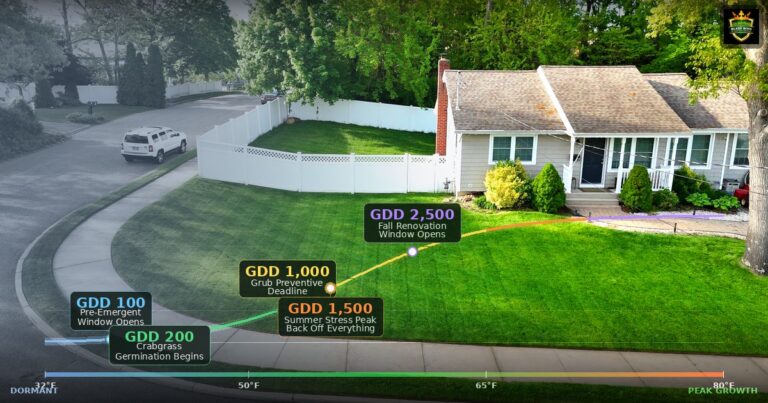
GDD Explained: The Secret to Perfect Lawn Timing
Growing degree days (GDD) predict exactly when to apply pre-emergent, fertilize, and treat for pests on your lawn....
Feb 25, 2026
14 min
 DIY How-To
How Much Fertilizer Does Your Lawn Actually Need? (Calculator Inside)
Stop guessing with bag rates. Learn the 4-step nitrogen math, see the Zone 7B fertilizer schedule backed by...
Feb 28, 2026
20 min
 DIY How-To
How to Kill Clover in Your Lawn Without Killing Your Grass
Clover in your lawn means your grass is nitrogen-starved. Here's how to kill it with selective herbicides, fix...
Mar 10, 2026
12 min
What is your lawn actually sitting on?
Pull the soil survey, hardiness zone and current growing conditions for your exact address. Eight government sources, about a minute.
No comments yet. Be the first to share your thoughts.
Create a free account to join the conversation.