Long Island Soil pH Guide: How to Test and Fix Your Lawn’s Foundation
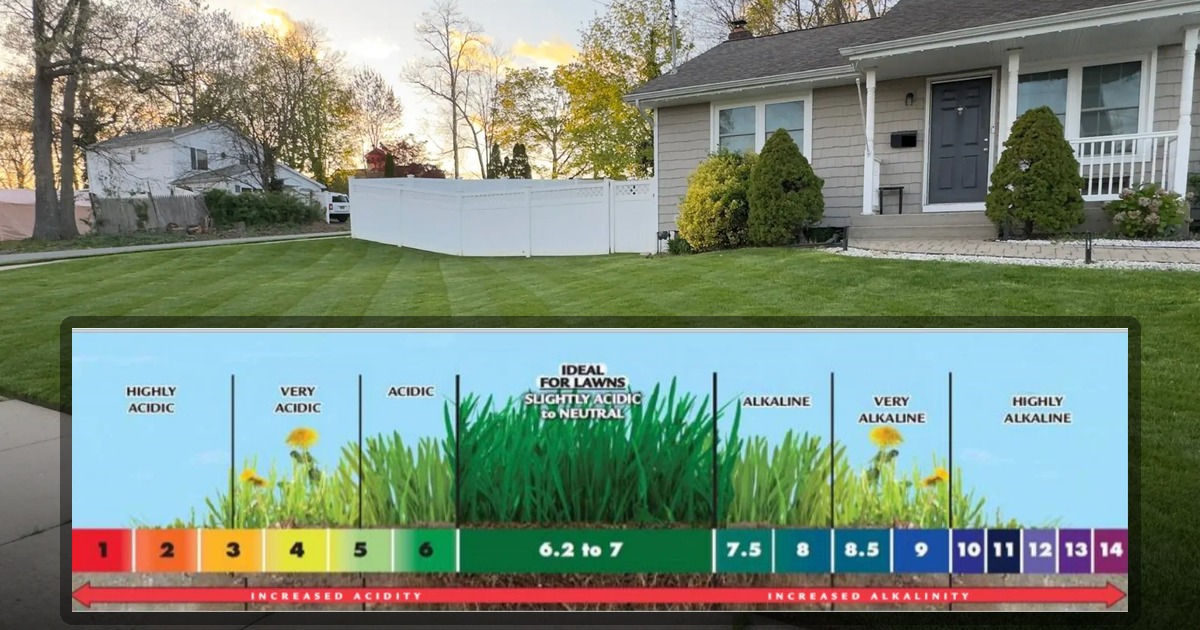
You can buy the best fertilizer on the market, apply it at the perfect rate, and time it to the exact GDD threshold, and your lawn will still underperform if your soil pH is wrong. That's because pH controls nutrient availability. If your soil is too acidic or too alkaline, the nutrients you're paying for get chemically locked in the soil where your grass roots can't access them. On Long Island, where soils naturally trend acidic, this is one of the most common and most fixable reasons lawns struggle.
Long Island native soils are strongly acidic (pH 4.5 to 5.5). Most maintained residential lawns test between pH 5.9 and 6.2 from years of liming, but this is still below the optimal 6.2 to 6.8 sweet spot where all nutrients reach maximum availability. Apply calcitic lime at 15 to 25 lbs per 1,000 sq ft per pH unit (varies by soil type), with a maximum of 50 lbs per application. Fall is ideal. Test through Cornell CCE Suffolk ($5 per sample) or a mail-in kit like MySoil before buying anything.
Why pH Is the Single Most Important Soil Number
Think of soil pH as the gatekeeper for every nutrient your lawn needs. Nitrogen, phosphorus, potassium, iron, calcium, magnesium, and every micronutrient all have a pH range where they're available to plant roots. When pH drifts outside that range, nutrients start getting locked up in chemical compounds that grass roots physically cannot absorb. You could pour a hundred dollars worth of fertilizer on a lawn with a pH of 5.0 and your grass would barely notice. And thin, underfed turf is exactly where crabgrass invades. Once your pH is in range, follow our Long Island fertilizer schedule to get the most out of every application. Our Dynamic Calendar tracks these windows automatically with GDD alerts. Our Stripe Master members get the complete 15-step Lawn Playbook that covers exactly this.
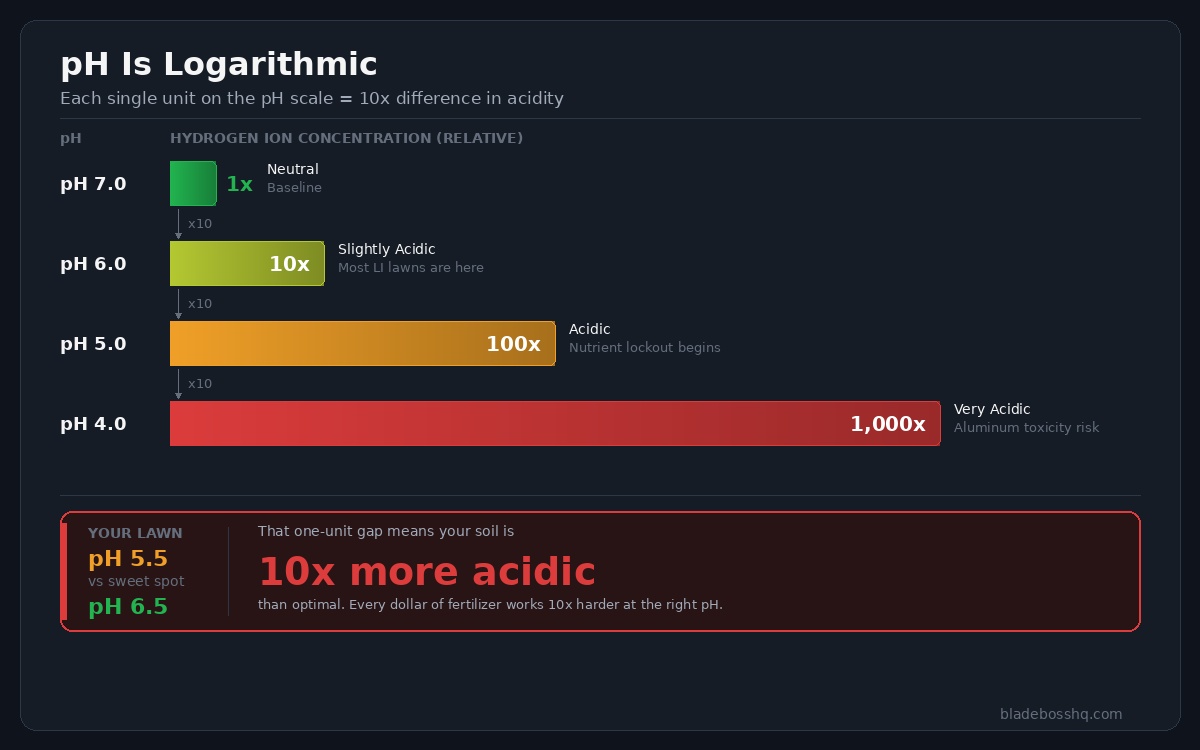
The pH scale runs from 0 to 14, with 7.0 being neutral. Below 7.0 is acidic, above 7.0 is alkaline. But here's the critical detail most guides skip: the scale is logarithmic. A soil with pH 5.0 is not "a little more acidic" than pH 6.0. It's ten times more acidic. And pH 4.0 is one hundred times more acidic than pH 6.0. Small numbers on the scale represent enormous chemical differences in your soil.
The Nutrient Availability Window
Between pH 6.0 and 7.0, all major and minor nutrients are simultaneously available to your grass. This is the window you're aiming for. Below 5.5, phosphorus gets locked up by aluminum and iron compounds, calcium and magnesium become deficient, and microbial activity slows dramatically. Above 7.5, iron, manganese, zinc, and boron become unavailable, causing chlorosis (yellow grass) even when those nutrients are physically present in the soil.
| Nutrient | Locked Out Below | Locked Out Above | Sweet Spot |
|---|---|---|---|
| Nitrogen (N) | Below 5.5 (slow microbial conversion) | Not typically locked | 6.0 to 7.0 |
| Phosphorus (P) | Below 5.5 (Al/Fe precipitation) | Above 7.5 (Ca precipitation) | 6.0 to 7.0 |
| Potassium (K) | Below 5.0 | Not typically locked | 6.0 to 7.0 |
| Iron (Fe) | Not typically locked low | Above 7.0 (severe above 7.5) | 5.5 to 6.5 |
| Calcium (Ca) | Below 5.0 | Not typically locked | 6.0 to 7.0 |
| Magnesium (Mg) | Below 5.0 | Not typically locked | 6.0 to 7.0 |
| Manganese (Mn) | Not typically locked low | Above 7.0 | 5.5 to 6.5 |
| Zinc (Zn) | Not typically locked low | Above 7.0 | 5.5 to 6.5 |
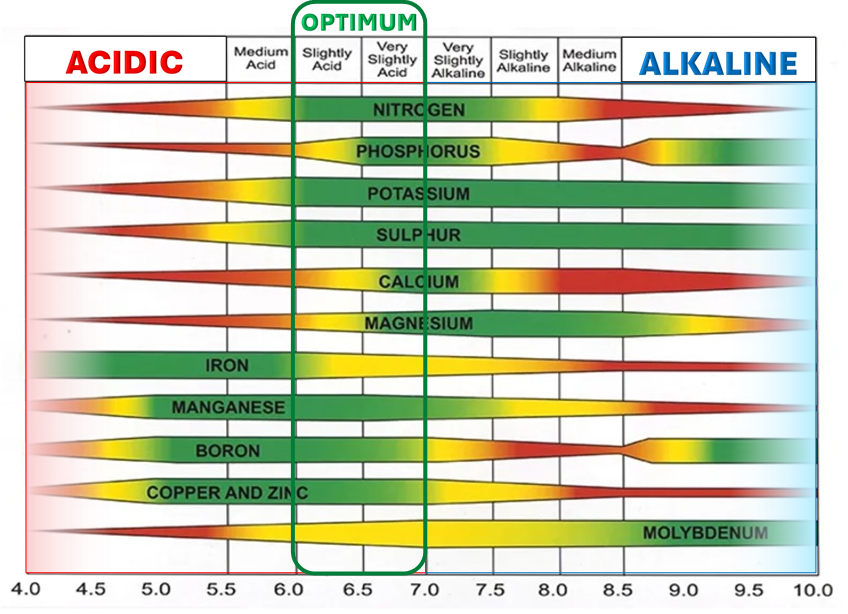
The range where ALL nutrients overlap in maximum availability is pH 6.2 to 6.8. That is your target. Every dollar you spend on fertilizer works harder when your pH is in this range.
Check Your Lawn's pH with pH Balance Pro
pH Balance Pro™ inside Lawn Map Pro™ calculates the exact amendment rate for your soil type and lawn zones. Enter your test results, get a step-by-step correction plan.
Why Long Island Soils Trend Acidic
Long Island's geology works against your lawn's pH. (For the full picture of how Zone 7B's sandy soils affect every aspect of lawn care, see our complete zone guide.) The island was formed by glacial deposits during the last Ice Age, leaving behind soils composed primarily of sand and gravel outwash. These sandy soils have low buffering capacity, meaning they can't resist pH changes the way clay-rich soils can. When acidic rain falls (and New York's precipitation averages pH 4.4 to 4.6, among the lowest in the nation according to the National Atmospheric Deposition Program), calcium and magnesium leach out of sandy soil quickly, driving pH downward. Long Island's glacial outwash sand creates unique challenges beyond just pH. Our complete sandy soil guide covers the nutrient retention, watering, and fertilizer adjustments that LI homeowners need.
On top of that, every bag of ammonium-based nitrogen fertilizer you apply makes the soil slightly more acidic over time. The nitrification process (where soil bacteria convert ammonium to nitrate) releases hydrogen ions as a byproduct. After years of fertilizing without correcting, many Long Island lawns drift into the 5.0 to 5.5 range, well below where nutrients are available.
Data from the Cornell NY Soil Health Initiative shows Long Island native soils are strongly acidic, with pH ranging from 4.5 to 5.5 according to the Suffolk County BMP report. Most maintained residential lawns, however, test between 5.9 and 6.2 because years of lime applications have raised the pH. Cornell data shows sandy loam averaging 6.2, loam averaging 6.1, and silt loam averaging 5.9 among submitted residential samples. That's close to the optimal window but usually just below it, which is why periodic liming is standard practice here.
If your lawn borders a road or driveway that gets salted in winter, soil pH within 200 to 300 feet can shift alkaline (above 7.0) due to sodium and calcium chloride accumulation. Test these areas separately from the rest of your lawn. They may need sulfur while the rest of your lawn needs lime.
Get the lime rates, application calendar, and correction timeline as a printable reference.
How to Test Your Soil pH on Long Island
You would never fly an approach without instruments, and you should never amend soil without a test. There are several ways to test, ranked by accuracy. My personal pick for the easiest option is the MySoil Test Kit (available in our shop). Once you get your results back, knowing the numbers is half the battle. Our soil test report guide walks you through every line and tells you exactly what to do next.
Option 1: Cornell Cooperative Extension Lab (Best)
The Cornell Cooperative Extension of Suffolk County runs a soil testing lab at 423 Griffing Avenue in Riverhead, NY. A basic pH test costs $5 per sample ($3.50 each for five or more samples). For comprehensive nutrient analysis (pH plus phosphorus, potassium, calcium, magnesium, and micronutrients), expect $15 to $25 per sample depending on the panel. Results take 2 to 3 weeks and come with specific amendment recommendations calibrated to Long Island soils. This is the gold standard for homeowners.
MySoil Test Kit
If you don't want to drive to Riverhead, this is the easiest way to get a professional lab analysis. Order the kit, scoop your soil, mail it back in the prepaid envelope. Results come to your phone in about a week with pH, macronutrients, and micronutrients. I use this on every zone of my lawn.
Check Price on AmazonOption 2: Private Labs (Detailed)
Labs like Waypoint Analytical and Logan Labs offer comprehensive soil panels including pH, CEC (cation exchange capacity), organic matter percentage, and full nutrient profiles. These run $25 to $50 per sample. If you're serious about data-driven lawn care, a full panel once per year gives you everything you need to build a precision fertilizer plan.
Option 3: Home Test Kits (Quick Estimate)
DIY pH meters and chemical test kits from hardware stores cost $10 to $30 and give you a reading in minutes. They're useful for checking whether you're in the ballpark, but they're not accurate enough to calculate amendment rates. A meter that reads 6.0 might be off by 0.3 to 0.5 units, which is the difference between needing lime and not needing it. Use home kits for quick checks between lab tests, not as your primary data source.
Import Your Lab Results Automatically
The Blade Boss Soil Test Manager uses OCR to import your Cornell CCE, MySoil, or private lab results in seconds. Each nutrient gets analyzed against optimal ranges with clear pass/fail indicators and specific correction recommendations.
How to Collect a Proper Soil Sample
A bad sample gives you bad data. Follow this process and your results will actually mean something.
Gather clean tools
Use a clean plastic bucket (not galvanized metal, which contaminates samples), a stainless steel or plastic trowel, and a quart-size zip bag. Avoid tools with rust.
Take 10 to 15 subsamples
Walk a zigzag pattern across your lawn. At each stop, push your trowel to 3 to 4 inch depth, pull a thin slice of soil, and drop it in the bucket. If you use Lawn Map Pro™, your drawn zones make natural sampling boundaries. Skip any areas with obvious issues (near foundations, under trees, along salt-treated roads) unless you're testing those areas separately.
Mix thoroughly
Combine all subsamples in the bucket. Remove rocks, roots, thatch, and debris. Mix well so the final sample represents your entire lawn, not just one spot.
Dry and bag
Spread the mixed soil on newspaper or a paper plate and let it air dry for 24 hours. Scoop two cups of dried soil into your zip bag. Label it with the date and area name.
Submit or test
Mail or drop off at the lab with the submission form. For CCE Suffolk, forms are available at ccesuffolk.org. Office hours are Monday through Friday, 8:30 AM to 4:30 PM.
Your front lawn in full sun, your shaded backyard, and the strip next to the driveway are different environments. Test each zone separately for the most accurate amendment plan. The pH Balance Pro™ calculator in Lawn Map Pro™ lets you map each zone and calculate amendments independently.
How to Read Your Soil Test Results
When your results come back, the pH number is the first thing to check. Here's how to interpret it for a cool-season lawn on Long Island.
| pH Range | Classification | What It Means | Action |
|---|---|---|---|
| Below 5.0 | Critically Acidic | Severe nutrient lockout. Aluminum toxicity possible. | Heavy lime application (multiple split apps). Retest in 12 weeks. |
| 5.0 to 5.5 | Very Acidic | Phosphorus, calcium, and magnesium deficient. Poor microbial activity. | Lime application needed. 50 lbs/1,000 sq ft per app, split if more needed. |
| 5.5 to 6.0 | Moderately Acidic | Below optimal. Some nutrient availability reduced. | Moderate lime application to bring into 6.2 to 6.5 range. |
| 6.0 to 6.5 | Slightly Acidic (Optimal) | Ideal for cool-season grass. All nutrients available. | Maintain. Test annually. Light lime if drifting below 6.0. |
| 6.5 to 7.0 | Near Neutral (Optimal) | Excellent. Full nutrient availability. | No amendment needed. Monitor annually. |
| 7.0 to 7.5 | Slightly Alkaline | Iron and manganese becoming limited. Watch for yellowing. | Consider elemental sulfur if above 7.2. Test for iron chlorosis. |
| Above 7.5 | Alkaline | Iron, manganese, zinc, boron locked out. Chlorosis likely. | Elemental sulfur needed. Max 5 lbs/1,000 sq ft per application. |
Raising pH: The Lime Guide for Long Island
If your test shows pH below 6.0, lime is your solution. Lime is ground limestone (calcium carbonate or calcium-magnesium carbonate) that neutralizes soil acidity. The two main types are calcitic lime (high calcium, low magnesium) and dolomitic lime (moderate calcium, moderate magnesium). Which one you need depends on your soil test.
Join Long Island homeowners who get data-driven soil care tips, pH correction reminders, and seasonal guidance every week.
Calcitic Lime
36 to 40% calcium, less than 5% magnesium. Use when your magnesium levels are adequate. The standard choice for most Long Island lawns.
Dolomitic Lime
22% calcium, 12% magnesium. Use when both pH AND magnesium are low. One product fixes two problems. Check your soil test before choosing.
Fast-Acting (Pelletized)
Finely ground lime in pellet form. Dissolves faster than standard ground limestone. Good for quick corrections, but you still need the same total amount.
How Much Lime Per 1,000 Square Feet
The amount of lime you need depends on two things: how far you need to move the pH, and your soil's buffer capacity (which is determined by soil type). Sandy soils change pH easily with small amounts of lime. Clay soils resist change and need much more. Here are the rates from our pH Balance Pro™ calculator, sourced from university extension research.
| Soil Type | Lime (lbs per 1,000 sq ft) | Buffer Capacity | Common on Long Island? |
|---|---|---|---|
| Sand | 15 lbs | Very Low | South shore barrier beaches |
| Loamy Sand | 17.5 lbs | Low | South shore outwash plains |
| Sandy Loam | 20 lbs | Low to Moderate | Most common LI soil type |
| Loam | 25 lbs | Moderate | North shore glacial till areas |
| Clay Loam | 30 lbs | Moderate to High | Rare on LI, some moraine areas |
| Silty Clay | 35 lbs | High | Very rare on Long Island |
| Clay | 40 lbs | Very High | Almost never on Long Island |
For example, if your sandy loam lawn tests at pH 5.5 and you want to reach 6.5 (one full pH unit increase), you need approximately 20 lbs of ground limestone per 1,000 sq ft. If your lawn is 5,000 sq ft, that's 100 lbs total. Since the maximum single application is 50 lbs per 1,000 sq ft, you'd apply the full 20 lbs at once (well under the max) and retest in 12 weeks.
Never apply more than 50 pounds of ground limestone per 1,000 square feet in a single application. If your soil needs more than that (for example, raising pH 2 full units on a loam soil would require 50 lbs), split the application. Apply the first 50 lbs, wait 3 to 6 months, retest, and apply the remainder if still needed.
When to Apply Lime on Long Island
Fall is the ideal lime application window, specifically September through November. Winter rain and snowmelt dissolve the lime and carry it into the soil profile. The 3 to 6 month reaction time means your pH correction is in place by the time spring growth starts. You can apply lime in spring (mid-March onward, once soil is unfrozen), but fall applications consistently outperform spring applications because of the extended dissolution period.
Earliest Lime Application
Soil above 32°F and unfrozen. Spring lime works but takes longer to react than fall applications.
Ideal Window Opens
Best time to apply. Rain helps dissolution, and the product has all winter to react before spring.
Peak Lime Month
Combine with fall aeration for maximum soil penetration. See our monthly calendar for the complete October task list. The absolute best single month for liming.
Window Closes
Apply before ground freezes. Suffolk County's fertilizer blackout starts November 1, but lime is NOT a fertilizer and is not restricted.
Lime is a soil amendment, not a fertilizer. It is NOT subject to Suffolk County's November 1 to April 1 fertilizer blackout or Nassau County's November 15 to April 1 blackout. You can apply lime year-round, though fall is most effective. The NY DEC Nutrient Runoff Law restricts nitrogen and phosphorus fertilizers, not calcium carbonate amendments.
Lowering pH: When and How to Use Sulfur
Alkaline soil (above 7.0) is less common on Long Island, but it does occur, especially near foundations (where concrete leaches calcium), along salted roads and driveways, and in lawns irrigated with municipal tap water (which is typically pH 7.5 to 8.5 after treatment for corrosion control). If your test shows pH above 7.2, elemental sulfur is the standard correction.
Unlike lime, sulfur requires soil microbes (Thiobacillus bacteria) to convert it into sulfuric acid, which is what actually lowers the pH. This biological process only works when soil is warm (above 55°F, which you can track via GDD and soil temperature monitoring) and moist. Applying sulfur in winter is a waste of product because the bacteria are dormant.
| Soil Type | Sulfur (lbs per 1,000 sq ft) | Notes |
|---|---|---|
| Sand | 3 lbs | Reacts fastest. Start here, retest in 16 weeks. |
| Loamy Sand | 3.5 lbs | Common on LI south shore. |
| Sandy Loam | 4.5 lbs | Most common LI soil type. |
| Loam | 6 lbs | North shore areas. |
| Clay Loam | 7.5 lbs | Rare on LI. Reacts slowly. |
| Silty Clay | 9 lbs | Very rare. Multiple applications needed. |
| Clay | 10 lbs | Almost never on LI. Extremely slow reaction. |
Elemental sulfur is caustic at high rates. Never exceed 5 lbs per 1,000 sq ft in a single application, and never apply when air temperature exceeds 85°F. The microbial conversion accelerates in heat, and high rates plus high heat can cause acid burn on grass. Apply in spring (late April through May) or fall (September through October) when temperatures are moderate and soil is warm.
Calculate Your Exact Amendment Rate
pH Balance Pro™ inside Lawn Map Pro™ does the math for you. Enter your current pH, target pH, soil type, and zone size. Get exact lime or sulfur rates, product recommendations, application schedule, and split-application plans for large corrections.
The Timing Rules: What Not to Mix and When to Wait
Soil amendments interact with fertilizers and with each other. Getting the timing wrong doesn't just waste product; it can create chemical reactions that harm your lawn. Here are the key timing rules from university extension research.
- Lime then nitrogen: Wait 4 to 6 weeks after lime before applying ammonium or urea-based nitrogen fertilizer. Lime raises soil pH at the surface, which converts ammonium to ammonia gas that evaporates before your grass can use it.
- Nitrogen then lime: Wait at least 2 weeks after ammonium/urea fertilizer before applying lime, for the same ammonia volatilization reason.
- Lime and sulfur: Never apply within 6 weeks of each other. Lime raises pH, sulfur lowers it. Applying both wastes money because they neutralize each other.
- Sulfur and warm soil: Only apply sulfur when soil temperature exceeds 55°F. Below that, microbial activity is too slow for conversion. On Long Island, this means late April at the earliest.
- Retest after lime: Wait a minimum of 12 weeks (3 months) before retesting pH. Lime reacts slowly and continues working for 3 to 6 months.
- Retest after sulfur: Wait a minimum of 16 weeks (4 months). Sulfur's microbial conversion is slower than lime's chemical dissolution.
The Summer Patch Warning: Don't Over-Lime Kentucky Bluegrass
This is one of the most important things you won't find in generic pH guides. If you have a Kentucky Bluegrass lawn and have ever had summer patch disease (circular brown patches that appear in July and August), do NOT push your pH above 6.5. Research from Penn State and Rutgers has shown that summer patch severity increases significantly at pH above 6.5, with the pathogen (Magnaporthiopsis poae) thriving in neutral to slightly alkaline conditions. Combined with proper mowing height, balanced pH creates the foundation for a lawn that fights weeds on its own.
For KBG lawns with a summer patch history, target pH 6.0 to 6.2 instead of the general 6.2 to 6.8 range. Use ammonium sulfate (21-0-0-24S) as your nitrogen source during summer months, as it has a natural acidifying effect that helps keep pH in the lower range where summer patch is less aggressive.
This is exactly why "just throw some lime down" is bad advice. Your pH target should account for your grass species and your disease history. The Blade Boss Soil Test Manager considers grass type, disease history, and target pH range when generating amendment recommendations.
Hidden pH Influencers on Long Island
Several factors specific to Long Island can shift your pH in ways you might not expect.
Municipal Tap Water (pH 7.5 to 8.5)
Long Island's municipal water is treated and pH-adjusted for corrosion control, typically to pH 7.5 to 8.5. If you irrigate regularly with tap water, it slowly pushes soil pH upward over time. Homeowners who water heavily may find they never need lime and may eventually need sulfur. Well water on Long Island typically tests pH 7.2 to 8.0, with a similar alkalinizing effect.
Concrete and Foundation Leaching
Concrete is alkaline (pH 12 to 13 when fresh). Rain hitting your foundation, patio, or sidewalk picks up dissolved calcium and carries it into adjacent soil. Lawns within 2 to 3 feet of concrete structures often test 0.5 to 1.0 pH units higher than the rest of the yard. Test these areas separately.
Road Salt (Sodium and Calcium Chloride)
Winter road salt can shift soil pH within 200 to 300 feet of treated surfaces. Calcium chloride pushes pH up. Sodium chloride damages soil structure and disperses clay particles. If your lawn borders a salted road, test that strip separately and expect it to need different treatment than the rest of your lawn.
Pine Trees and Oak Leaf Mulch
Contrary to popular belief, pine needles and oak leaves have minimal long-term effect on soil pH. Fresh pine needles are slightly acidic (pH 3.5 to 4.5), but by the time they decompose, their pH impact is negligible. If your soil under a pine tree is acidic, it's more likely because the tree canopy blocks lime-containing rain from reaching the soil, not because of the needles themselves. If you have lawn under a pine canopy, test that area separately and expect to lime more frequently than open areas of your yard.
Nitrogen Fertilizer Type
Ammonium-based fertilizers (ammonium sulfate, urea, ammonium nitrate) acidify soil over time. Each pound of ammonium nitrogen eventually requires approximately 1.8 lbs of calcium carbonate (lime) to neutralize the acidity it creates. Nitrate-based fertilizers (calcium nitrate, potassium nitrate) have a neutral or slightly alkaline effect. If you fertilize heavily with ammonium sulfate (a common recommendation in our pre-emergent timing guide), budget for annual lime maintenance.
Common Mistakes to Avoid
- Liming without a soil test. You could be raising pH on soil that's already neutral or alkaline, which locks out iron and creates chlorosis. Always test first.
- Using the wrong lime type. Dolomitic lime adds magnesium. If your magnesium is already high, you're creating a calcium-to-magnesium ratio imbalance. Let the soil test guide your product choice.
- Applying too much at once. More than 50 lbs lime per 1,000 sq ft or more than 5 lbs sulfur per 1,000 sq ft can shock the soil biology and burn turf. Split large corrections across multiple applications.
- Not waiting long enough to retest. Lime takes 3 to 6 months for full effect. Sulfur takes 4 to 6 months. If you retest after 4 weeks and add more lime, you're likely overshooting.
- Ignoring soil type. A sandy south shore lawn and a loamy north shore lawn need completely different amendment rates for the same pH change. Soil type determines buffer capacity.
- Applying sulfur in cold soil. Below 55°F, the Thiobacillus bacteria that convert sulfur to sulfuric acid are dormant. Winter sulfur applications sit on the surface doing nothing until spring.
The Annual pH Maintenance Plan
Once your pH is in range, maintaining it is straightforward. Here's the annual routine that our lawn care calendar builds into the schedule.
Test in fall (September to October)
Submit your annual soil sample to the lab. Fall testing gives you time to apply corrections before winter and have them in place for spring. This aligns with our monthly calendar recommendations.
Apply amendments in October (if needed)
Based on test results, apply lime or sulfur at the calculated rate. October is the single best month because rain helps dissolution and the product has maximum reaction time before spring.
Retest in spring (March to April)
If you applied amendments in fall, verify the correction worked. This is your pre-season pH check before your first fertilizer application.
Track with the dashboard
The Blade Boss Soil Test Manager stores your historical results and the Weather Hub inside Lawn Map Pro™ tracks conditions that affect amendment timing (soil temperature for sulfur, freeze dates for lime).
Chris C. is a Combat Search and Rescue pilot turned airline pilot and the founder of Blade Boss. His own Long Island soil tested at 5.9 when he started. Three seasons of data-driven amendments later, it sits at 6.5. Every recommendation in this guide comes from that experience plus Cornell Cooperative Extension research.
Getting your pH right is foundational. Next, build on it with our aeration guide (aeration improves amendment penetration), the grub control guide (healthy soil grows stronger turf), and the spring recovery playbook. The TTTF vs KBG comparison shows how pH tolerance varies by species, and our clover guide explains why low-nitrogen, low-pH lawns are clover magnets. See also: fertilizer troubleshooting.
See what Blade Boss members get and get access to pH Balance Pro™, the Soil Test Manager, and zone-by-zone amendment planning inside Lawn Map Pro™. Your soil test becomes an action plan, not just a number on a page.
See Plans →Frequently Asked Questions
What is the ideal soil pH for a lawn on Long Island?
The ideal soil pH for a cool-season lawn on Long Island is between 6.0 and 7.0, with the sweet spot at 6.2 to 6.8. This range provides maximum simultaneous nutrient availability for nitrogen, phosphorus, potassium, iron, and all essential micronutrients. Long Island native soils are strongly acidic (pH 4.5 to 5.5). Most maintained residential lawns test between 5.9 and 6.2 from years of liming. Both scenarios benefit from periodic lime application to reach the optimal range.
How do I test my soil pH on Long Island?
The most accurate and affordable option is Cornell Cooperative Extension of Suffolk County's soil testing lab in Riverhead, NY, at $5 per sample. For the easiest mail-in experience, the MySoil Test Kit lets you scoop soil, mail it in a prepaid envelope, and get results on your phone in about a week. Collect 10 to 15 subsamples from your lawn at 3 to 4 inch depth, mix them together, and submit about two cups of dried soil. Fall is the best time to test so you can apply corrections before winter.
How much lime do I need for my Long Island lawn?
The amount of lime depends on your current pH, target pH, and soil type. For sandy soil (common on Long Island's south shore), you need approximately 15 pounds of ground limestone per 1,000 square feet to raise pH by one full unit. Sandy loam requires about 20 pounds, and loam about 25 pounds per 1,000 square feet per pH unit. Never apply more than 50 pounds per 1,000 square feet in a single application. If your total need exceeds 50 pounds, split it across multiple applications 3 to 6 months apart.
When should I apply lime to my lawn on Long Island?
Fall is the best time to apply lime on Long Island, ideally September through November. Winter rain and snowmelt help the lime dissolve and penetrate the soil, and the 3 to 6 month reaction time means your pH will be corrected by the time spring growth begins. You can also apply lime in early spring (March through April), but fall applications are more effective. Avoid applying lime in summer when equipment traffic and heat stress the turf.
What is the difference between calcitic and dolomitic lime?
Calcitic lime contains approximately 36 to 40 percent calcium with minimal magnesium (less than 5 percent). Dolomitic lime contains approximately 22 percent calcium and 12 percent magnesium. Both raise soil pH at similar rates. Use calcitic lime when your soil test shows adequate magnesium levels. Use dolomitic lime when both pH and magnesium are low, as it corrects both deficiencies with a single product. On Long Island, calcitic lime is the more common recommendation unless a soil test reveals magnesium deficiency.
Why is my Long Island lawn soil acidic?
Long Island soils are naturally acidic for several reasons. The soil was formed from glacial outwash deposits (primarily sand and gravel) that have low buffering capacity. New York receives acidic precipitation with an average pH of 4.4 to 4.6, which leaches calcium and magnesium from the soil over time. Sandy soils lose alkaline minerals faster than clay soils because water moves through them quickly. Additionally, nitrogen fertilizers (especially ammonium-based products) acidify soil over time as a byproduct of the nitrification process.
Keep Reading
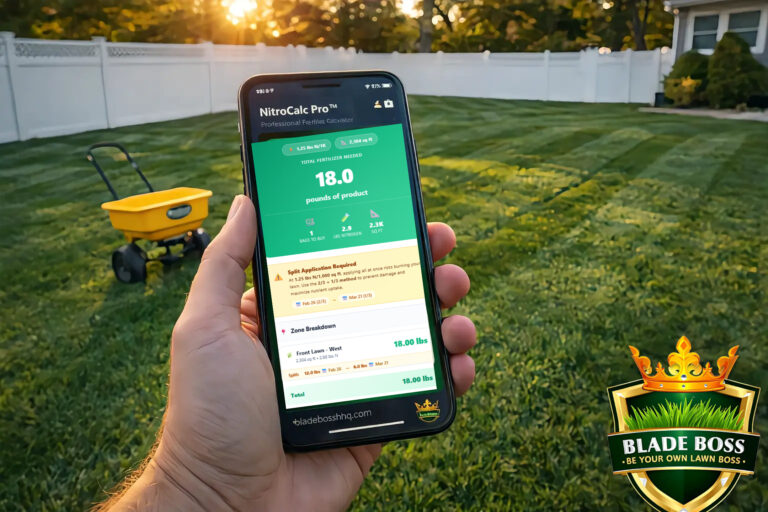 DIY How-To
How Much Fertilizer Does Your Lawn Actually Need? (Calculator Inside)
Stop guessing with bag rates. Learn the 4-step nitrogen math, see the Zone 7B fertilizer schedule backed by...
Feb 28, 2026
20 min
 Lawn Science
Long Island Fungicide Guide: FRAC Groups, Rotation Schedule, and What to Buy
The complete beginner's guide to lawn fungicide on Long Island. Learn FRAC groups, build a 4-product rotation schedule...
Mar 27, 2026
17 min
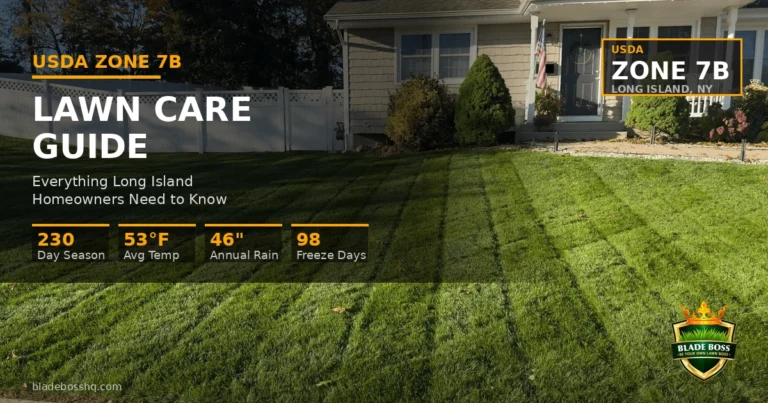 Lawn Science
USDA Zone 7B Lawn Care Guide: Everything Long Island Homeowners Need to Know
The definitive Zone 7B lawn care guide for Long Island. 30-year NOAA data, Cornell research, and real soil...
Mar 3, 2026
21 min
What is your lawn actually sitting on?
Pull the soil survey, hardiness zone and current growing conditions for your exact address. Eight government sources, about a minute.
No comments yet. Be the first to share your thoughts.
Create a free account to join the conversation.