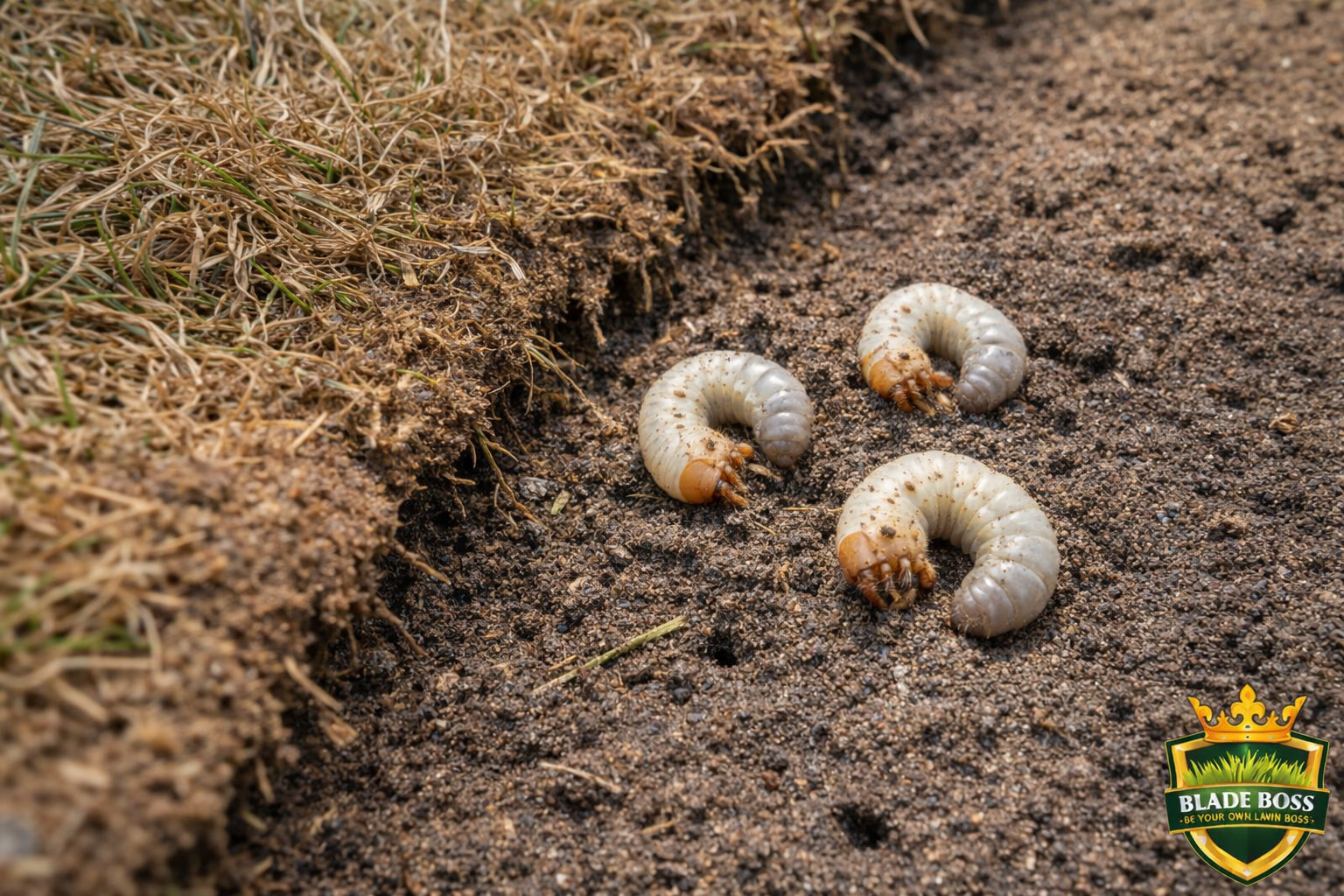
Every August on Long Island, the same scene plays out. Brown patches appear in the lawn that don't respond to watering. Skunks start tearing up the yard at night. Crows gather in groups on the grass, pecking holes. And the homeowner assumes Japanese beetles are to blame. Here's what most people don't know: the number one grub on Long Island isn't the Japanese beetle. It's the oriental beetle. And the treatment window most people miss closed back in July.
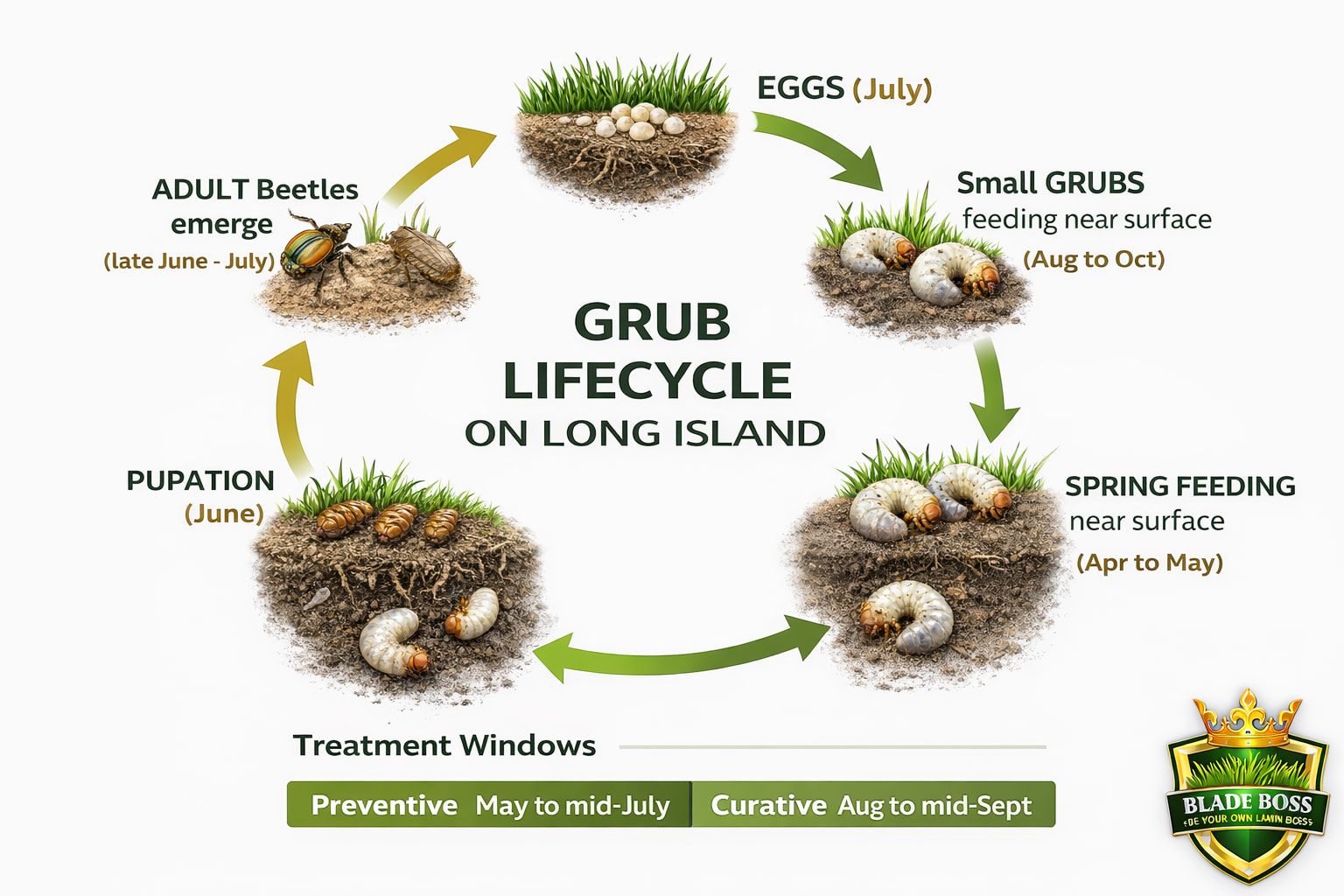
- Preventive treatment (BEST legal option): Apply imidacloprid (BioAdvanced Season-Long Grub Control or Merit 0.5G) from late June through mid-July. Must be watered in with 0.5 inches immediately. Mow first to remove flowering weeds (pollinator safety). Note: chlorantraniliprole (GrubEx) is the most effective grub preventive nationally, but NYSDEC prohibits its sale and use in Nassau and Suffolk Counties due to Long Island's sole-source aquifer.
- Curative treatment (RESCUE): Trichlorfon (Dylox) from August 1st through September 15th. Grubs must be small and near the surface. Water in immediately with 0.5 inches.
- Damage threshold: 8 to 10 grubs per square foot in healthy, irrigated turf. Lower threshold (5 to 6) for non-irrigated or stressed lawns.
- Peak species on Long Island: Oriental beetle, not Japanese beetle. Both respond to imidacloprid preventive treatment.
This guide is built on Rutgers NJAES FS1009 (the definitive white grub management publication for the Northeast), Michigan State University Extension product timing research, and our Zone Science data calibrated to Long Island's USDA Zone 7B climate, soil, and pest species composition. Our Dynamic Calendar tracks these windows automatically with GDD alerts. Lawn Map Pro puts all this data on your satellite map with zone-by-zone tracking. Our Stripe Master members get the complete 15-step Lawn Playbook that covers exactly this.
What Are White Grubs (And Why Long Island Gets Hit Hard)
White grubs are the larval stage of scarab beetles. They live in the top 1 to 3 inches of soil, feeding on grass roots. When populations are high enough, they prune so many roots that the turf can't take up water, causing brown patches that appear drought-stressed even when you're watering. The turf feels spongy underfoot, and in severe cases you can roll it back like carpet because there are no roots holding it down.
On Long Island, Rutgers NJAES FS1009 identifies the primary white grub species complex as: oriental beetle (Anomala orientalis), the single most common grub on LI lawns; Japanese beetle (Popillia japonica); European chafer (Rhizotrogus majalis); and Asiatic garden beetle (Maladera castanea). Species composition varies by property, but most chemical treatments are effective against all of them.
Most grub control guides on the internet focus exclusively on Japanese beetles. On Long Island, the oriental beetle is often the dominant species in grub counts. According to Rutgers, "in New Jersey and neighboring areas, the oriental beetle has become by far the most important white grub species." This matters because some treatments (like Heterorhabditis nematodes and halofenozide) are less effective against oriental beetle grubs than against Japanese beetle grubs. On Long Island, imidacloprid is the primary chemical preventive since chlorantraniliprole (GrubEx) is NYSDEC-restricted in Nassau and Suffolk Counties. Imidacloprid works well against both oriental beetle and Japanese beetle grubs.
How to Tell If You Have Grubs (The Diagnosis Guide)
Grub damage is one of the most misdiagnosed lawn problems. Brown patches in August could be drought stress, fungal disease, chinch bugs, or grubs. Before you spend money on grub treatment, confirm the problem.
The Warning Signs
Brown Patches Despite Watering
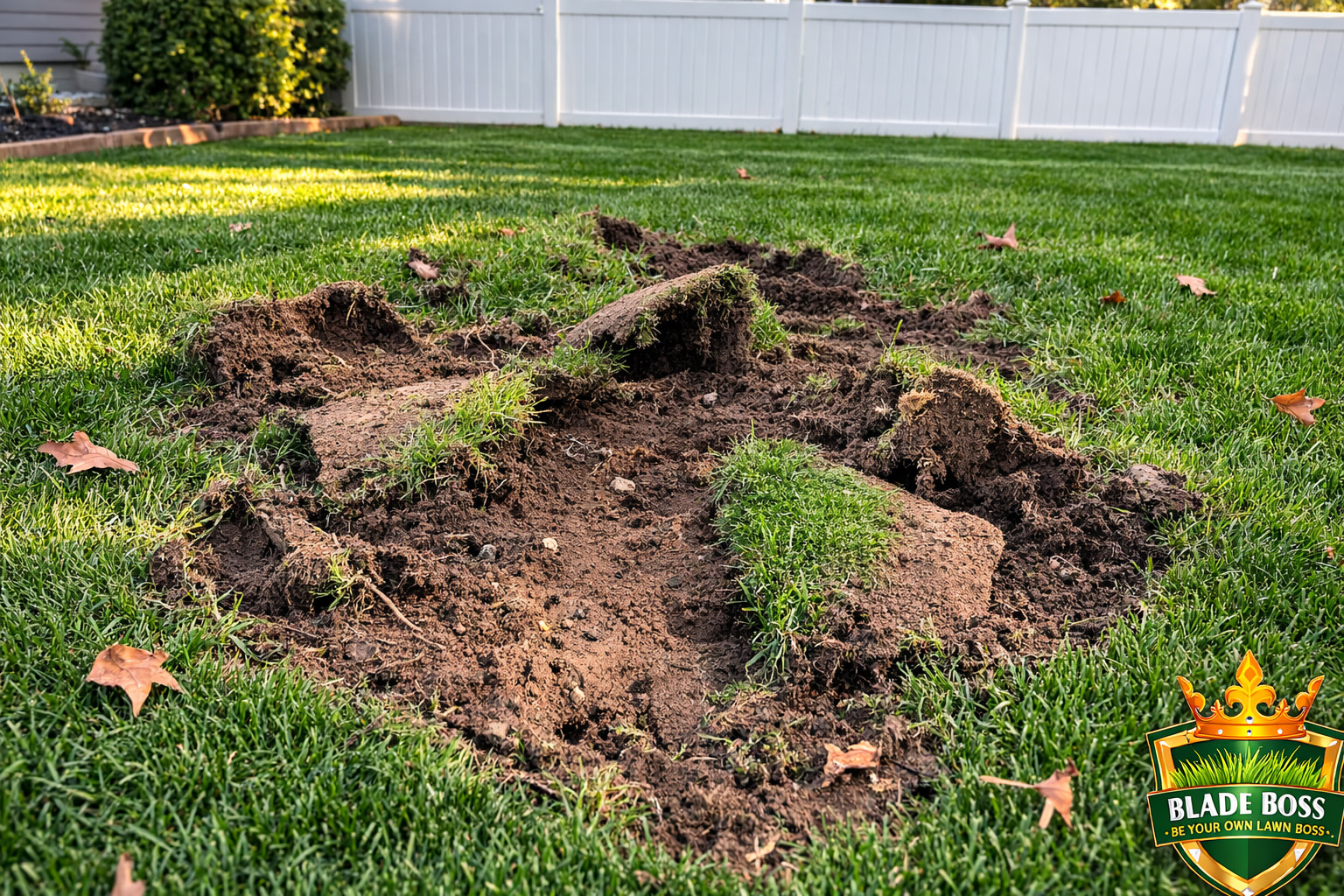
Irregular brown areas that don't green up with irrigation. The grass feels spongy when you walk on it. This is the primary visual symptom, typically appearing in late August through September.
Turf Peels Back Like Carpet
Pull on the brown grass. If it lifts easily with no root resistance, grubs have eaten the roots. Healthy grass resists pulling. This is the most definitive visual test.
Wildlife Digging Up Your Lawn
Skunks, raccoons, crows, and starlings tear up turf to eat grubs. If you're seeing animal damage (torn-up patches, holes, divots), grubs are almost certainly the cause. The predators are doing you a diagnostic favor.
Increased Watering Has No Effect
You're watering correctly but patches keep browning. Without roots, the grass can't uptake water no matter how much you apply. This distinguishes grub damage from drought stress, which responds to irrigation.
The Square-Foot Grub Test
Cut a 1-Foot Square Section
Use a shovel or flat spade to cut three sides of a 12-inch square section of turf at the edge of a brown patch (where healthy meets damaged). Cut 2 to 3 inches deep.
Peel Back the Turf
Fold the turf section back like opening a book. If it peels easily, that's already a sign. Look at the exposed soil in the top 2 to 3 inches.
Count the Grubs
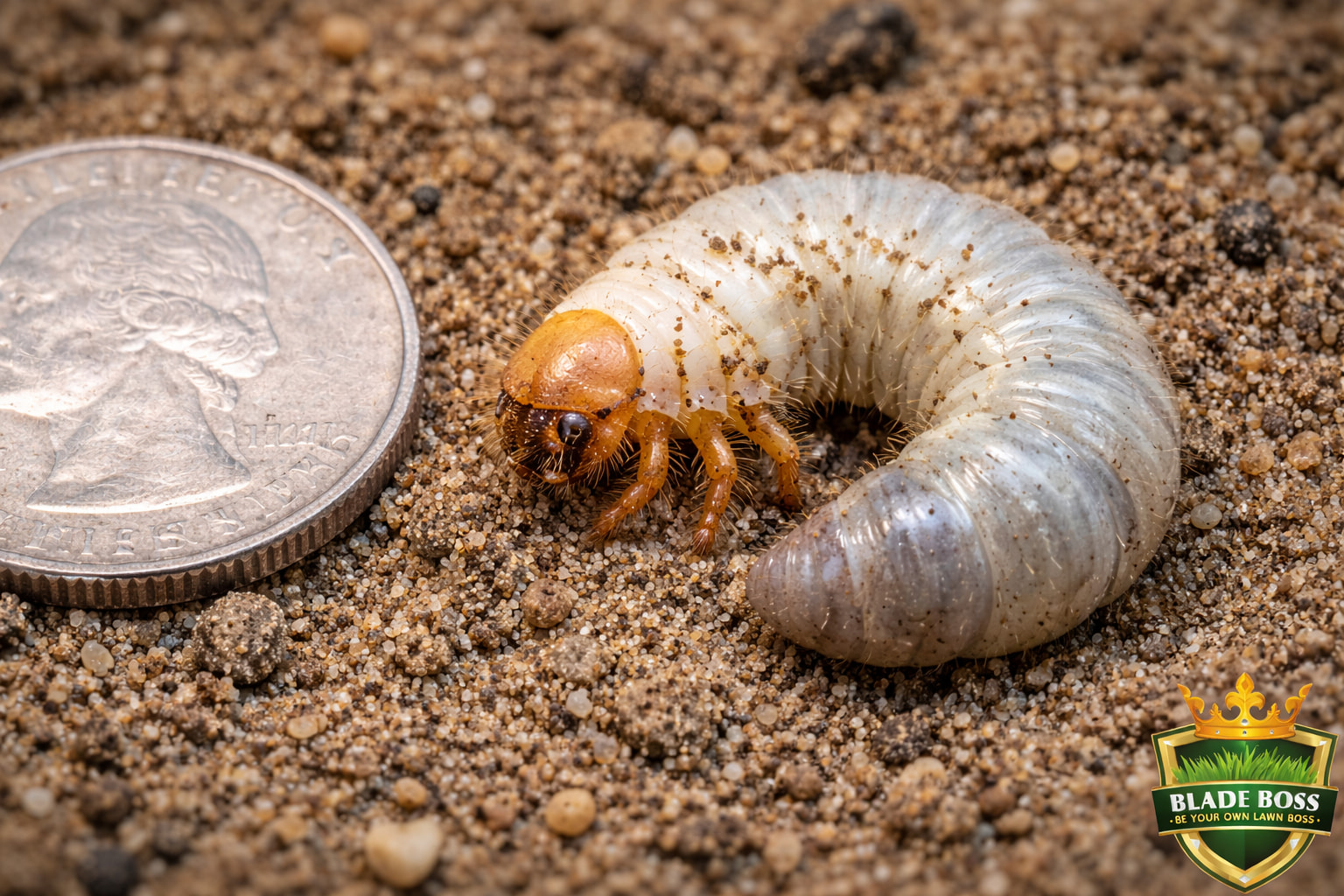
C-shaped white larvae, typically 0.5 to 1 inch long. Count every grub in that 1 square foot area. Do this test in at least 3 to 5 spots around the lawn (both damaged and healthy-looking areas).
Check the Threshold
On Long Island: 8 to 10 grubs per square foot in healthy, irrigated turf is the treatment trigger. In stressed or droughty lawns without irrigation, even 5 to 6 per square foot can cause visible damage. Under 5 in healthy turf? Your lawn can tolerate that population without treatment.
| Species | Threshold (Healthy Turf) | Threshold (Stressed Turf) | Notes |
|---|---|---|---|
| Japanese Beetle | 10+ per sq ft | 6 per sq ft | Rutgers conservative trigger = 6/sq ft |
| Oriental Beetle | 8 to 10 per sq ft | 6 per sq ft | Dominant LI species. Smaller grubs but high populations. |
| European Chafer | 5 to 10 per sq ft | 5 per sq ft | Lower threshold. More damaging per individual. |
| Combined (any mix) | 8 to 10 per sq ft | 5 to 6 per sq ft | Count all species together when sampling. |
| Emergency (any species) | 20+ per sq ft | Any | Almost certainly needs immediate curative treatment. |
One text in late May when GDD50 hits the grub treatment window. One text, no guesswork.
No spam. One seasonal alert per application window. Unsubscribe anytime.
When to Treat: The Two Windows
Grub control has two distinct strategies with completely different products and timing. Using the wrong one at the wrong time is the number one reason grub treatments fail.
Window 1: Preventive (May Through Mid-July)
Preventive products are applied BEFORE grubs are present. They have a long soil residual that stays active through the egg-hatch period. This is the preferred approach because you're killing tiny, vulnerable newly-hatched grubs rather than trying to kill large, established ones later.
| Active Ingredient | Product Example | Application Window | Notes |
|---|---|---|---|
| Chlorantraniliprole | Scotts GrubEx, Acelepryn | May 1st through July 15th | BEST nationally but NYSDEC-RESTRICTED in Nassau/Suffolk Counties. Not legal for sale or use on Long Island. |
| Imidacloprid | Merit, BioAdvanced Season-Long | Late June to early July | Effective but neonicotinoid. Mow flowering weeds before applying to protect bees. |
| Clothianidin | Arena | Late June to early July | Neonicotinoid. Same pollinator precautions as imidacloprid. |
| Thiamethoxam | Meridian | Late June to early July | Neonicotinoid. Professional-grade. Same precautions. |
Chlorantraniliprole (the active ingredient in Scotts GrubEx and Acelepryn) is widely considered the best grub preventive available. It has the widest application window (April through mid-July), the lowest pollinator risk, and works on all LI grub species.
However, NYSDEC prohibits the sale, distribution, and use of chlorantraniliprole in Nassau, Suffolk, Kings, and Queens Counties due to its toxicity to aquatic invertebrates and Long Island's position over a sole-source aquifer. If you purchase it online and apply it, you are technically in violation of state pesticide regulations.
The legal alternative: Imidacloprid (BioAdvanced Season-Long Grub Control, Merit 0.5G). It delivers 75 to 100% grub reduction when applied late June to mid-July and watered in immediately. The window is tighter than GrubEx, but efficacy is actually comparable when timed correctly. The trade-off is a higher pollinator risk, so mow any flowering weeds before application.
Window 2: Curative (August 1st Through September 15th)
Curative products kill grubs that are already in the soil and actively feeding. These are rescue treatments for lawns that didn't get a preventive application and are now showing damage. The window is tight because curative products only work when grubs are small (under 0.5 inches) and feeding near the surface.
| Active Ingredient | Product Example | Application Window | Notes |
|---|---|---|---|
| Trichlorfon | Bayer Dylox, 24-Hour Grub Killer | Aug 1st to Sept 15th | BEST curative option. Fast-acting contact kill. Water in immediately. 7 to 10 day residual. |
| Carbaryl | Sevin | Aug 1st to Sept 15th | Effective but higher environmental impact. Works on JB grubs; slightly less effective on European chafer. |
| Clothianidin | Arena | Aug 1st to Sept 15th | Can work curatively when applied to young grubs. Professional product. |
Michigan State University Extension explicitly warns: do NOT use products containing only lambda-cyhalothrin, bifenthrin, deltamethrin, cyfluthrin, or permethrin for grub control. These pyrethroids bind to organic matter in the thatch layer and never reach the grubs feeding on roots below. They work great for surface insects but are useless underground.
GDD Timing: The Precision Approach
If you're tracking growing degree days, here are the grub-relevant milestones for Long Island:
Your preventive product must be active in the soil by 1,030 GDD50 (approximately late June on Long Island). Imidacloprid applied in late June hits this target with good margin. On Long Island, this is your primary preventive option since chlorantraniliprole (GrubEx) is restricted by NYSDEC in Nassau and Suffolk Counties. Apply imidacloprid no earlier than mid-June (earlier applications degrade before grubs hatch) and no later than mid-July. After 2,500 GDD50, grubs are too large for preventive products and you need curative treatment (trichlorfon).
Track GDD for Your Exact Location
The Blade Boss Weather Hub inside Lawn Map Pro™ monitors GDD50 accumulation in real time for your ZIP code. Set alerts for grub treatment milestones and never miss the preventive window again.
The Long Island Grub Control Calendar
Spring Grub Feeding (Low Priority)
Overwintered grubs return to the surface to feed briefly before pupating. Damage is usually minor and treatment is less effective because grubs are large. Curative deadline: May 15th (trichlorfon). Only treat if you found 10+ per sq ft.
Pupation Period
Grubs stop feeding and transform into adult beetles. No treatment is effective during this stage. This is the calm before the storm.
Adult Beetles Emerge
Japanese beetles emerge at approximately 1,030 GDD50 (late June on LI). Oriental beetles emerge around the same time. Adults feed on ornamental plants and lay eggs in lawn soil throughout July. You'll see the metallic green/copper JB adults on roses and linden trees.
PREVENTIVE WINDOW
Apply chlorantraniliprole (GrubEx) anytime in this window. Apply imidacloprid-based products late June to early July. Water in with 0.5 inches immediately. Mow flowering weeds before neonicotinoid applications to protect pollinators.
Eggs Hatch
Tiny 1st-instar grubs begin feeding on roots. Damage is invisible at this stage. Preventive products that are already in the soil kill grubs as they hatch. This is why timing matters.
CURATIVE WINDOW
Grubs are small (2nd instar) and feeding near the surface. This is when damage becomes visible: brown patches, spongy turf, wildlife digging. Apply trichlorfon (Dylox) and water in immediately. Do the square-foot test first to confirm grub counts exceed threshold.
Late Season (Low Efficacy)
Grubs are reaching 3rd instar (fully grown, ~1 inch). Curative treatments become less effective as grubs grow. After October 15th, grubs start moving deeper into soil for winter. Treatment is largely ineffective.
Overwintering
Grubs are 4 to 8 inches deep below the frost line. No treatment works during this period. Plan your preventive strategy for next June.
Join Long Island homeowners who get data-driven lawn care tips every week. Seasonal reminders, timing alerts, and the stuff your lawn service won't tell you.
How to Repair Grub-Damaged Lawn
Once grubs are controlled, the lawn needs to be repaired. The good news: September aeration and overseeding is the ideal repair strategy and it lines up perfectly with the post-curative treatment window.
Confirm Grubs Are Under Control
Wait 10 to 14 days after curative treatment and do another square-foot test. Grub counts should be dramatically lower. If still above threshold, retreat. Don't overseed until the grubs are dead or they'll eat the new roots too.
Rake Out Dead Turf
Remove the dead, rootless grass from damaged areas. It won't recover. Expose the soil surface for seed contact.
Core Aerate and Overseed
Aerate the entire lawn in September, then broadcast quality seed into the damaged areas. Seeds fall into aeration holes for best germination. Water lightly 2 to 3 times daily until germination.
Fertilize for Recovery
Apply your Round 3rd fall fertilizer (0.75 lbs N per 1,000 sq ft) to fuel root recovery and new seedling growth. The combination of grub control + aeration + overseeding + fall fertilizer is the complete renovation package.
Common Grub Control Mistakes
1. Applying preventive product too late (after mid-August)
Preventive grub products (GrubEx, Merit) need to be in the soil BEFORE grubs hatch in mid-July. Applied in August or later, the active ingredient has already started degrading and the grubs are too large for preventive-class products to kill. If it's August and you see damage, you need a curative product (trichlorfon), not a preventive.
2. Not watering in after application
Every grub product requires immediate watering. Apply 0.5 inches of irrigation right after spreading. The product sits on top of the thatch doing nothing if you don't wash it down into the soil where the grubs live. This is the single most common application failure.
3. Using surface insecticides for underground grubs
Pyrethroid products (bifenthrin, permethrin, lambda-cyhalothrin) are surface-contact insecticides. They bind to thatch and never reach grubs feeding 1 to 3 inches below the soil surface. MSU Extension explicitly warns against using these for grub control. Check the active ingredient, not just the brand name.
4. Treating every year without confirming grubs
Not every lawn needs annual grub treatment. MSU Extension notes that there's an erroneous philosophy that annual treatment is mandatory. If you treated for several years and don't see evidence of grubs in your lawn or your neighbor's lawn, it may be time to stop. Do the square-foot test before spending money on preventive product.
5. Using Japanese beetle traps
University of Kentucky research demonstrated that JB traps attract more beetles than they catch. You're essentially luring beetles FROM your neighbor's yard INTO yours, where the females lay eggs in your soil. Traps were designed for monitoring, not control. Don't use them.
6. Applying curative product after October 15th
By mid-October on Long Island, grubs are moving deeper into the soil (4 to 8 inches) to overwinter below the frost line. Curative products can't reach them at that depth. Treatment after October 15th is wasted product. Wait until the following June and apply a preventive instead.
Organic and Biological Grub Control Options
For homeowners who prefer to avoid synthetic insecticides, there are biological options. They're slower and less consistent than chemical treatments but can be effective as part of a multi-year program.
| Product | How It Works | Effectiveness | Notes |
|---|---|---|---|
| Milky Spore (Paenibacillus popilliae) | Bacterial disease that kills JB grubs. Spores multiply in soil. | Good (JB only) | Takes 1 to 3 years to establish. Only targets Japanese beetle. Does not control oriental beetle. |
| Heterorhabditis nematodes | Parasitic nematodes that enter and kill grubs. | Good (JB), variable (OB) | Apply in late August when soil is moist. Water immediately. Less effective on oriental beetle. Sensitive to heat/UV. |
| Neem oil (soil drench) | Disrupts grub feeding and growth. | Moderate | Requires repeated applications. Works best as supplement, not standalone. |
| Cultural (thick turf + irrigation) | Healthy, deep-rooted turf tolerates higher grub counts. | Ongoing prevention | A well-maintained lawn can tolerate 8 to 10 grubs/sq ft without visible damage. Stressed lawns show damage at 5 to 6. |
Milky Spore is widely marketed for grub control but it only works on Japanese beetle grubs. If your primary grub species is oriental beetle (common on Long Island), Milky Spore will not solve your problem. Before investing in a multi-year Milky Spore program, do the square-foot test in August and try to identify the species. Oriental beetle grubs are slightly smaller (about 0.75 inches fully grown vs 1 inch for JB) and the adult beetles are smaller and straw-brown colored versus the metallic green/copper of Japanese beetles.
Quick Reference: Grub Control Decision Table
| Situation | Action | Product | When |
|---|---|---|---|
| History of grub damage | Preventive treatment | Chlorantraniliprole (GrubEx) | BEST nationally but NYSDEC-RESTRICTED in Nassau/Suffolk Counties. Not legal for sale or use on Long Island. |
| No history, just monitoring | Square-foot test in August | None unless threshold exceeded | August 15th to Sept 1st |
| Active damage (brown patches) | Curative treatment NOW | Trichlorfon (Dylox) | Aug 1st to Sept 15th |
| Skunks/raccoons digging | Curative treatment + repair | Trichlorfon + fall overseed | Immediately, then Sept overseed |
| Prefer organic approach | Milky Spore + nematodes | Both products, multi-year | Milky Spore anytime; nematodes late Aug |
| Missed all windows (Oct+) | Wait until next year | Plan preventive for June | Do nothing until next May/June |
| Grub count under 5/sq ft | No treatment needed | None | Monitor next August |
Build Your Complete Pest and Treatment Calendar
Our month-by-month Long Island lawn care calendar integrates grub control timing with every other task: fertilizer rounds, pre-emergent windows, aeration, and more. Stop guessing, start timing.
Grub control is part of a bigger system. Our crabgrass prevention guide stops the weeds that invade grub-damaged patches. Use the fertilizer calculator to feed recovery, and check your soil pH before reseeding damaged areas. The clover control guide addresses another common invader, and the spring recovery playbook helps repair overwintered grub damage. For zone-specific guidance, Cornell Cooperative Extension Suffolk County is an excellent local resource. Penn State Extension offers additional cool-season grass management resources for the Northeast. See also: dog-friendly lawn care guide.
Chris is a Combat Search and Rescue pilot turned airline pilot who built Blade Boss to bring military-grade precision to backyard lawn care. He treats for grubs every July using imidacloprid on his Ronkonkoma lawn because chlorantraniliprole is banned in Suffolk County.
Every lawn product, every risk level, every wait time for dogs. Plus the year-round dog-safe application calendar. Print it and tape it to your shed.
See what Blade Boss members get and get access to Lawn Map Pro™ for satellite-precision zone mapping, GDD tracking for pest timing, and our complete Long Island lawn care calendar. Every treatment window, every product recommendation, calibrated to your Zone 7B lawn.
See Plans →Frequently Asked Questions
When should I apply grub control on Long Island?
Preventive grub control on Long Island should be applied from late June through mid-July, timed to when adult beetles are laying eggs and before grubs hatch. The recommended product for Long Island homeowners is imidacloprid (BioAdvanced Season-Long Grub Control or Merit 0.5G), applied late June to early July and watered in with 0.5 inches immediately. Chlorantraniliprole (Scotts GrubEx) is the most effective grub preventive nationally, but NYSDEC prohibits its sale and use in Nassau and Suffolk Counties due to aquifer protection regulations. If you missed the preventive window and find grubs in August, curative treatment with trichlorfon (Dylox) is effective from August 1st through September 15th while grubs are still small and feeding near the surface.
How do I know if my Long Island lawn has grubs?
The classic sign is irregular brown patches in late August or September that don't respond to watering. The damaged turf feels spongy and peels back like carpet because the roots have been chewed off. Dig up a 1 square foot section of turf at the edge of a brown patch to a depth of 2 to 3 inches and count the white C-shaped grubs. On Long Island, 8 to 10 grubs per square foot is the treatment threshold for healthy irrigated turf. In stressed or droughty lawns, even 5 to 6 per square foot can cause visible damage. Skunks, raccoons, crows, and starlings digging up your lawn are also strong indicators of grub activity.
What is the most common grub on Long Island?
The oriental beetle (Anomala orientalis) is the dominant white grub species on Long Island lawns, according to Rutgers NJAES FS1009. Most online grub guides focus on Japanese beetles, but oriental beetle grubs are often the primary contributor to grub counts in Long Island turf. Japanese beetle (Popillia japonica), European chafer, and Asiatic garden beetle are also present. Species composition varies by property, and most treatment products work on all common grub species.
Can I use GrubEx on Long Island?
Scotts GrubEx contains chlorantraniliprole, which is one of the most effective preventive grub control active ingredients available nationally. However, NYSDEC prohibits the sale, distribution, and use of chlorantraniliprole in Nassau, Suffolk, Kings, and Queens Counties due to its potential impact on aquatic invertebrates and Long Island's sole-source aquifer. Even if you find it shipped to you online, applying it on Long Island is technically a violation of state pesticide regulations. The recommended legal alternative is imidacloprid (BioAdvanced Season-Long Grub Control or Merit 0.5G), applied late June through mid-July and watered in with 0.5 inches immediately after application. Imidacloprid provides 75 to 100% grub reduction when timed correctly.
Will grub damage repair itself?
Mild grub damage on Long Island lawns can recover on its own if the grass crowns survive and the root system isn't completely destroyed. Once grubs are controlled (either through treatment or natural predation), healthy turf will regrow roots and fill in over 4 to 6 weeks during active growing seasons. Severe damage where turf peels up like carpet typically requires overseeding or sodding. September is the ideal time to repair grub-damaged areas through core aeration and overseeding.

Keep Reading
 Lawn Science
Tall Fescue vs Kentucky Bluegrass: Which Is Best for Long Island?
For Long Island's sandy soil and summer heat, tall fescue wins on drought tolerance and low maintenance. Kentucky...
Mar 12, 2026
14 min
 Lawn Science
Long Island Fungicide Guide: FRAC Groups, Rotation Schedule, and What to Buy
The complete beginner's guide to lawn fungicide on Long Island. Learn FRAC groups, build a 4-product rotation schedule...
Mar 27, 2026
17 min
 DIY How-To
The Truth About Lawn Care Services on Long Island (DIY Comparison)
Long Island lawn services cost $1,200 to $3,000 a year and most treat your lawn identically to every...
Mar 25, 2026
15 min
What is your lawn actually sitting on?
Pull the soil survey, hardiness zone and current growing conditions for your exact address. Eight government sources, about a minute.
No comments yet. Be the first to share your thoughts.
Create a free account to join the conversation.