

GUIDE FERT-02 · REV A
How to Calibrate Your Spreader
The number on your spreader dial is not a rate. It is a guess printed by someone who never met your spreader, your walking speed, or the bag in your garage. Calibration is how you turn that guess into an actual measured rate, and it is the difference between feeding a lawn and burning one. It takes thirty minutes, once, and every application after it is precise.
Pre-Flight Checklist - What You Need
As an Amazon Associate, Blade Boss earns from qualifying purchases. It never costs you a penny more.
Rules of Engagement (ROE's)
The Flight Plan - Step by Step
Understand What the Dial Actually Does
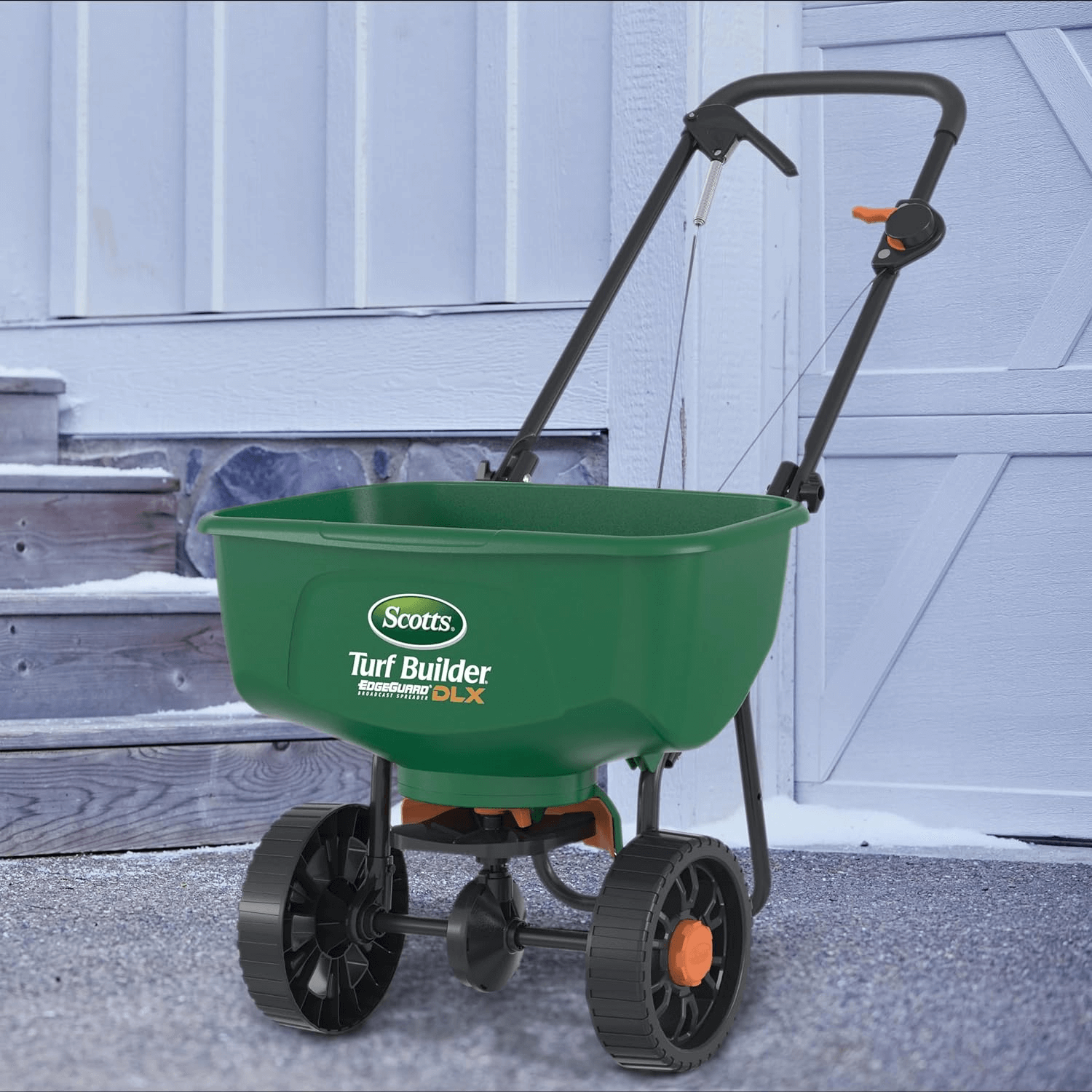
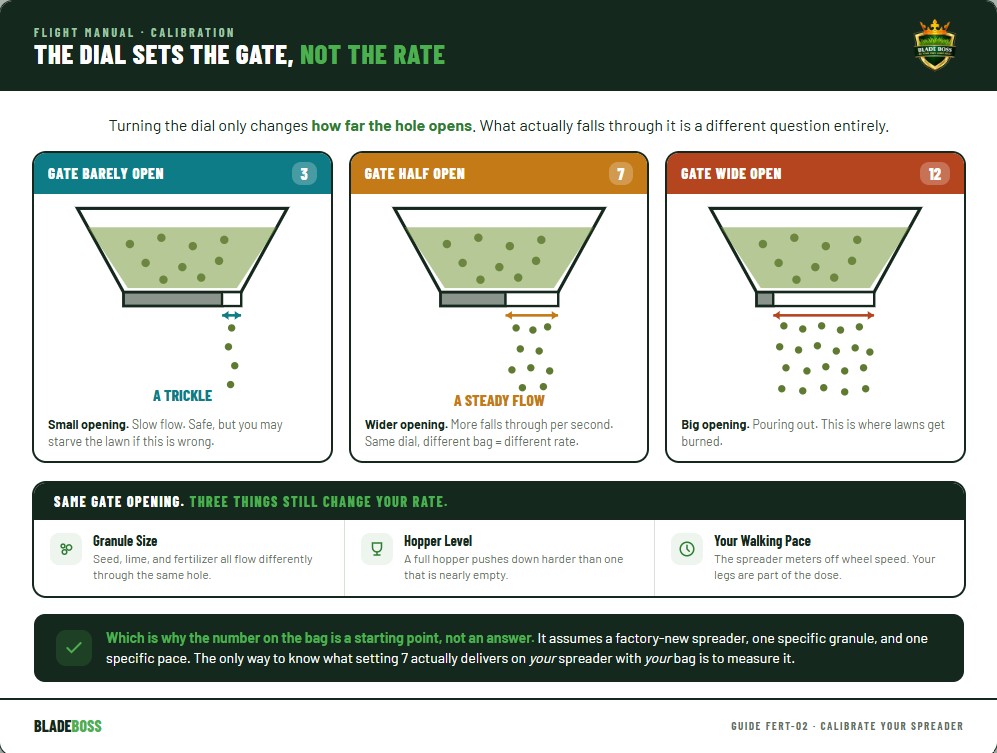
The setting number on your spreader does not control the rate. It controls how far the gate opens. How much product falls through that opening depends on the granule size, the granule density, how full the hopper is, and how fast you are walking. Change any one of those and the same dial number gives you a different rate.
That is why the settings chart on the bag is a starting point, not an answer. It assumes a factory-fresh spreader, a specific walking speed, and that exact product. Your spreader has a season of grit in the gate and you walk however you walk.
Find Your Effective Swath Width
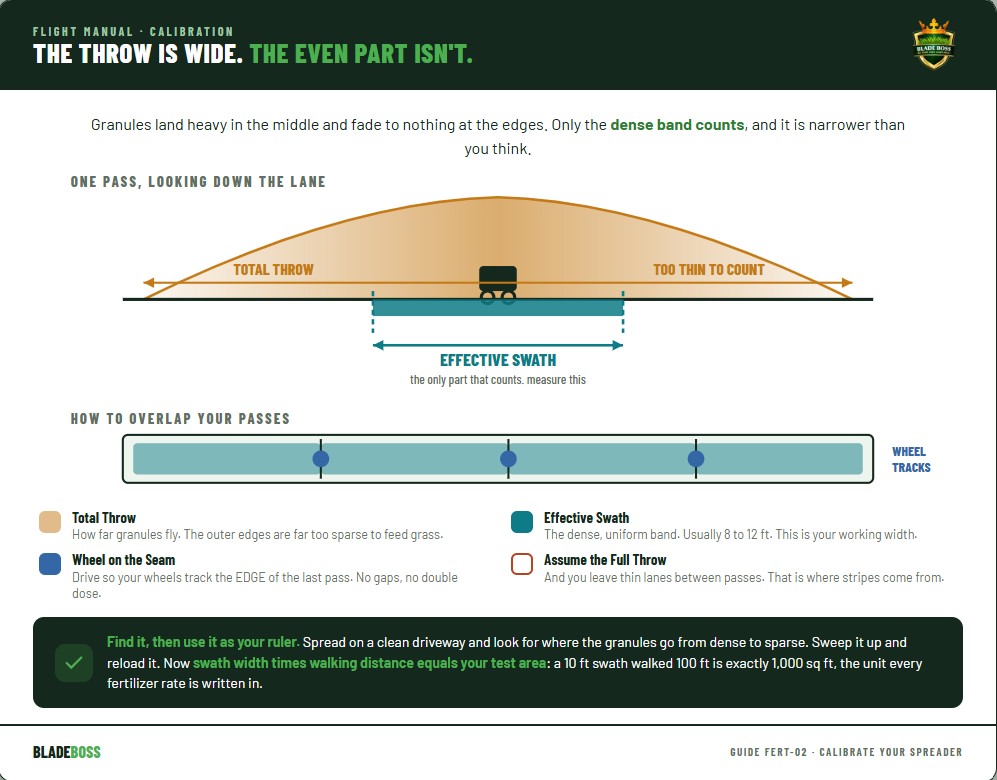
A broadcast spreader throws farther than it covers evenly. The granules land heavy near the middle and taper off to almost nothing at the outer edges. Your effective swath is only the band where coverage is actually uniform, and it is usually a good bit narrower than the total throw.
To find it: spread on a clean driveway and look at where the granules go from dense to sparse. That dense band is your working width. For most homeowner broadcast spreaders it lands somewhere around 8 to 12 feet. Measure yours instead of assuming, then sweep it up and put it back in the hopper.
Lock In Your Walking Pace
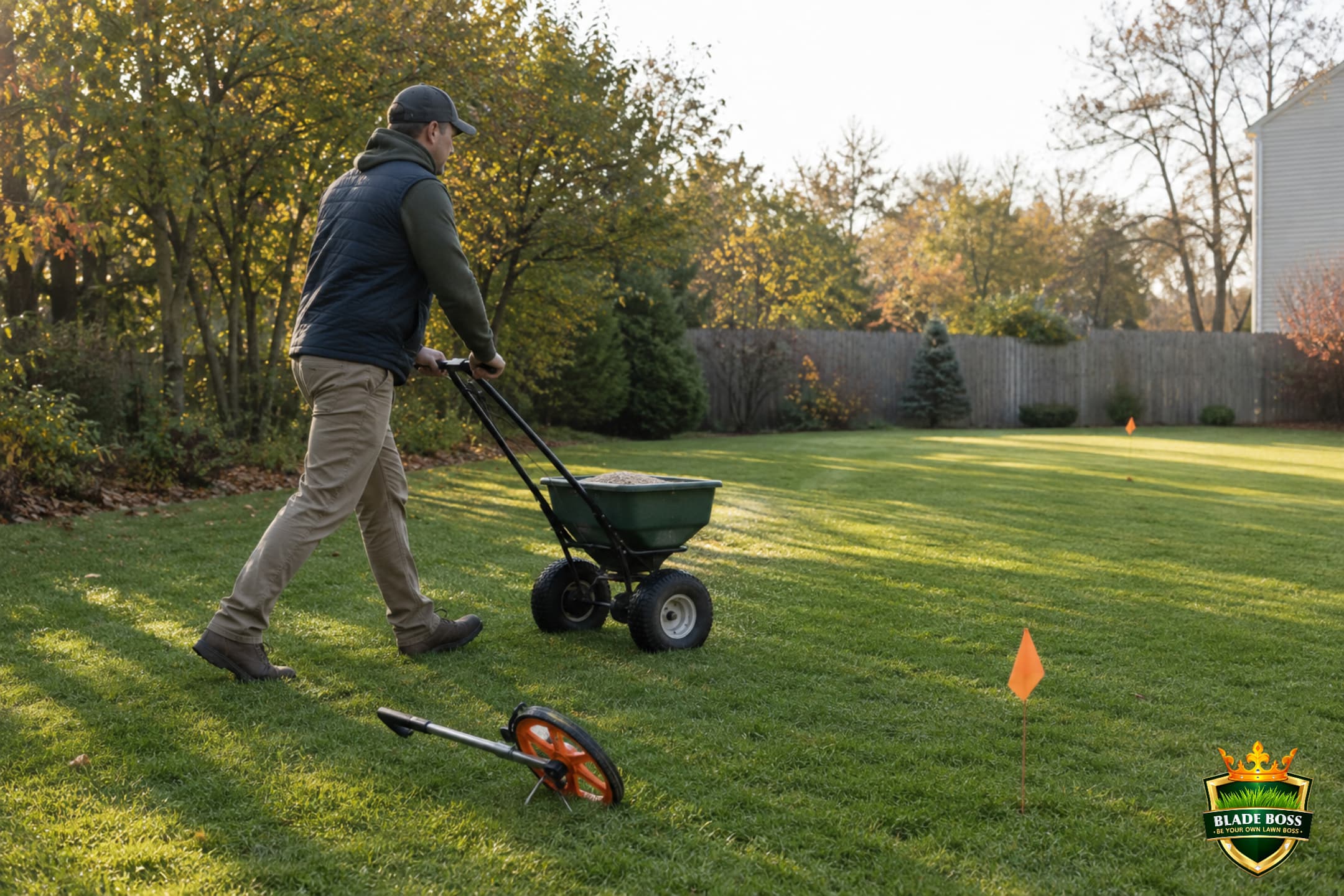
A broadcast spreader meters off wheel rotation, which means your legs are literally part of the dose. Walk slow and you overapply. Walk fast and you starve the lawn. Every settings chart ever printed assumes roughly 3 miles per hour, which is a normal, purposeful walk.
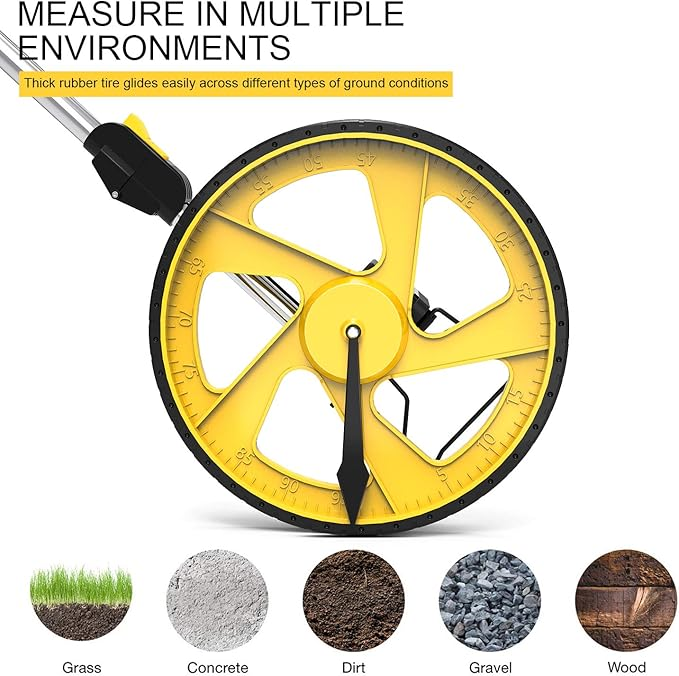
Here is how to calibrate yourself: measure out 100 feet, then walk it with a loaded spreader (gate closed) while someone times you. At 3 mph, 100 feet takes about 22 seconds. Faster than that and you are jogging. Much slower and you are dumping. Walk it three times until 22 seconds feels natural, and then never think about it again.
Weigh Out Exactly One Test Area
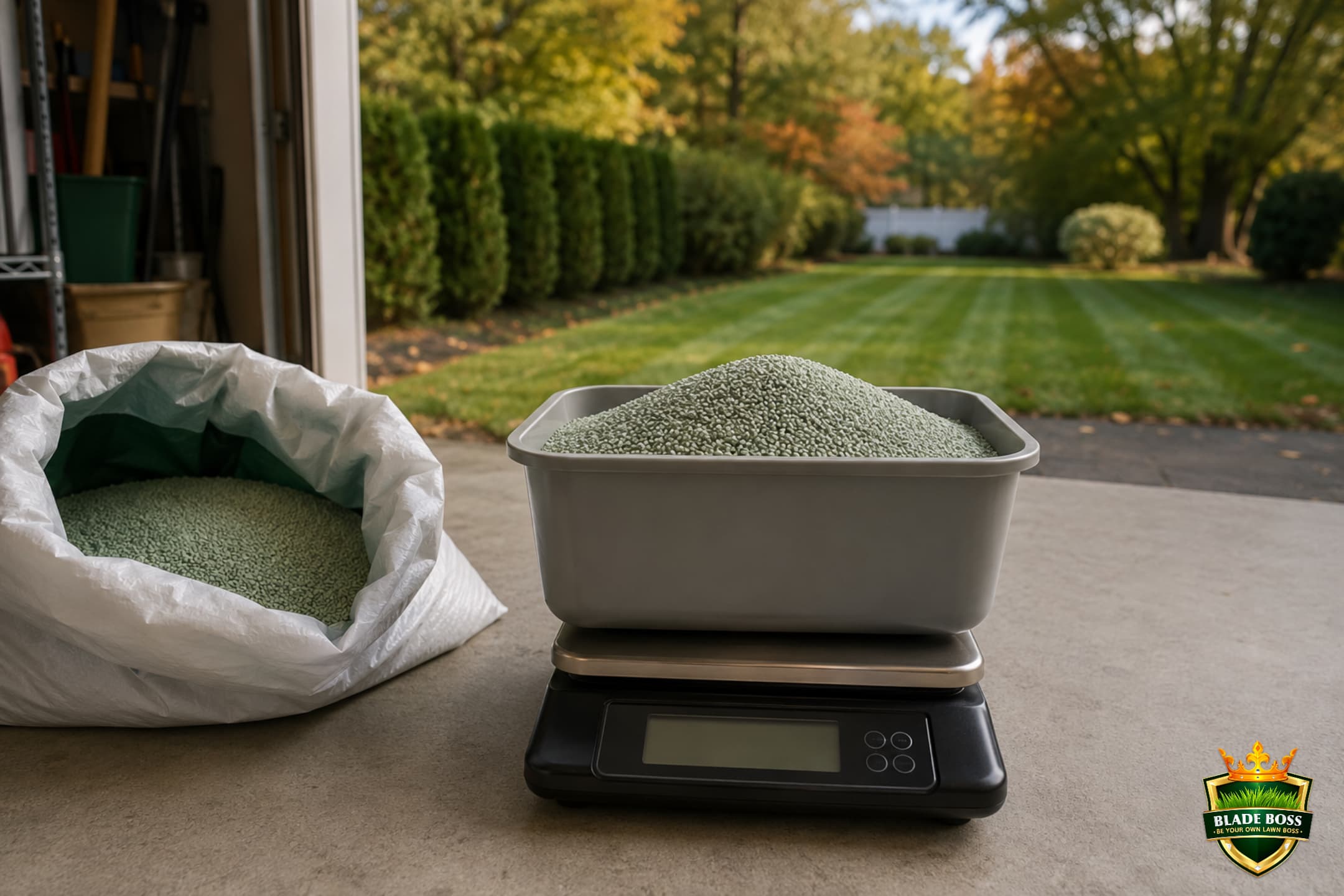
Now you need your target: how many pounds of this product should land on 1,000 square feet? That comes from the nitrogen rate and the NPK on the bag, and it is pure math. Run it in NitroCalc Pro rather than doing it in your head at the store.
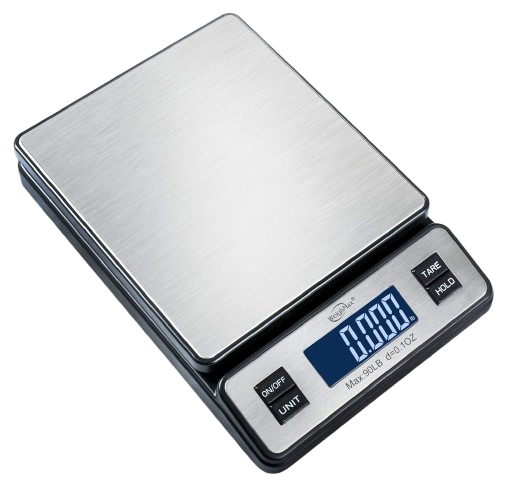
Then weigh that exact amount on a digital scale and load it into an empty, clean hopper. Nothing else. This is why the scale matters: you are about to measure reality against the number the bag promised you, and you cannot do that if you eyeballed the load.
Run the Test Strip
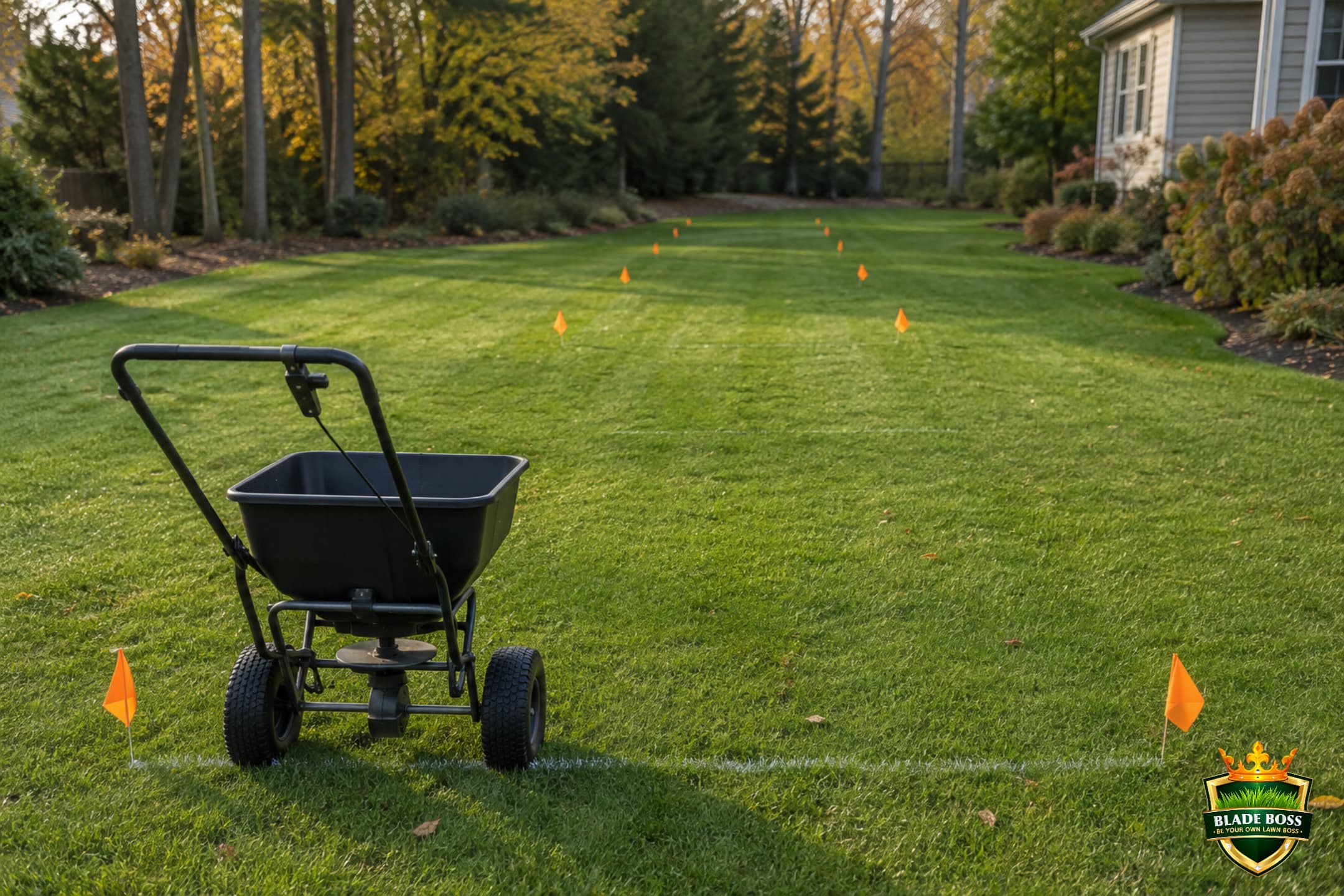
Mark out your test strip on the lawn: your effective swath width by whatever length gives you 1,000 square feet. A 10-foot swath needs 100 feet of walking. Flag both ends so you are not guessing mid-pass.
Set the spreader to the bag's recommended number, but drop it one notch lower as insurance. Start walking before you open the hopper, hold your 3 mph pace down the strip, and close the gate before you stop. Do not stop, do not slow down, do not turn.
Weigh What Came Back and Adjust
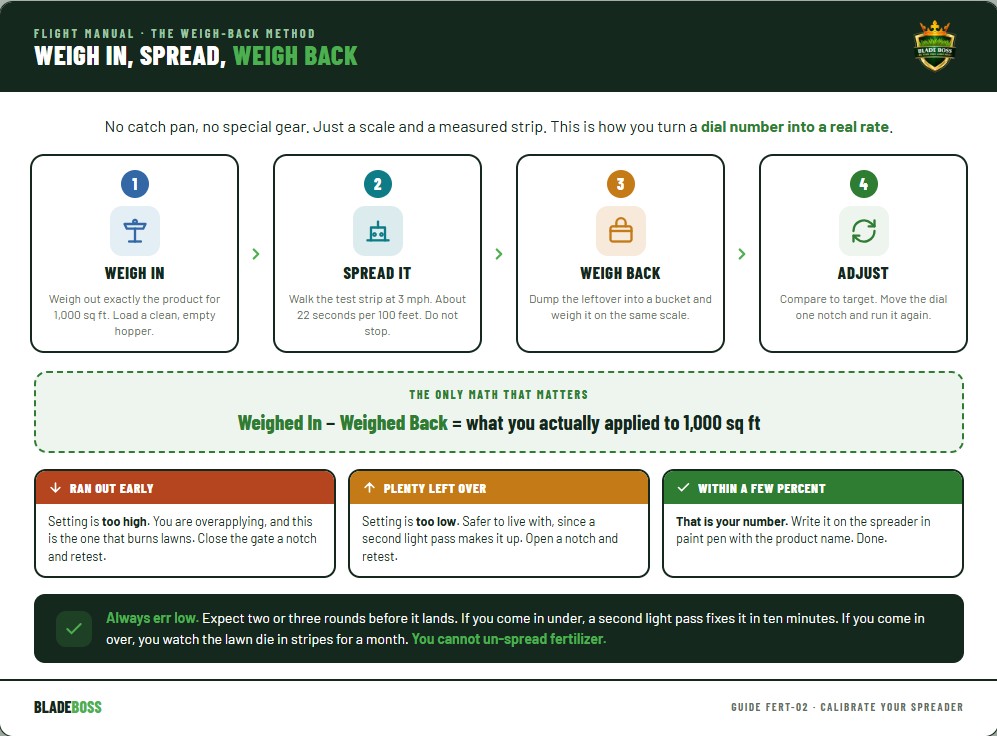
Dump whatever is left in the hopper into a bucket and weigh it. Now do the only math that matters: what you loaded, minus what came back, equals what you actually applied to 1,000 square feet. Compare that to your target.
Ran out before the end of the strip? Your setting is too high. Close the gate a notch and run it again.
Plenty left over? Your setting is too low. Open it a notch and run it again.
Came out within a few percent of target? That is your number. Write it on the spreader with a paint pen, along with the product name. You just turned a guess into a measurement.
Rinse It, or Lose It
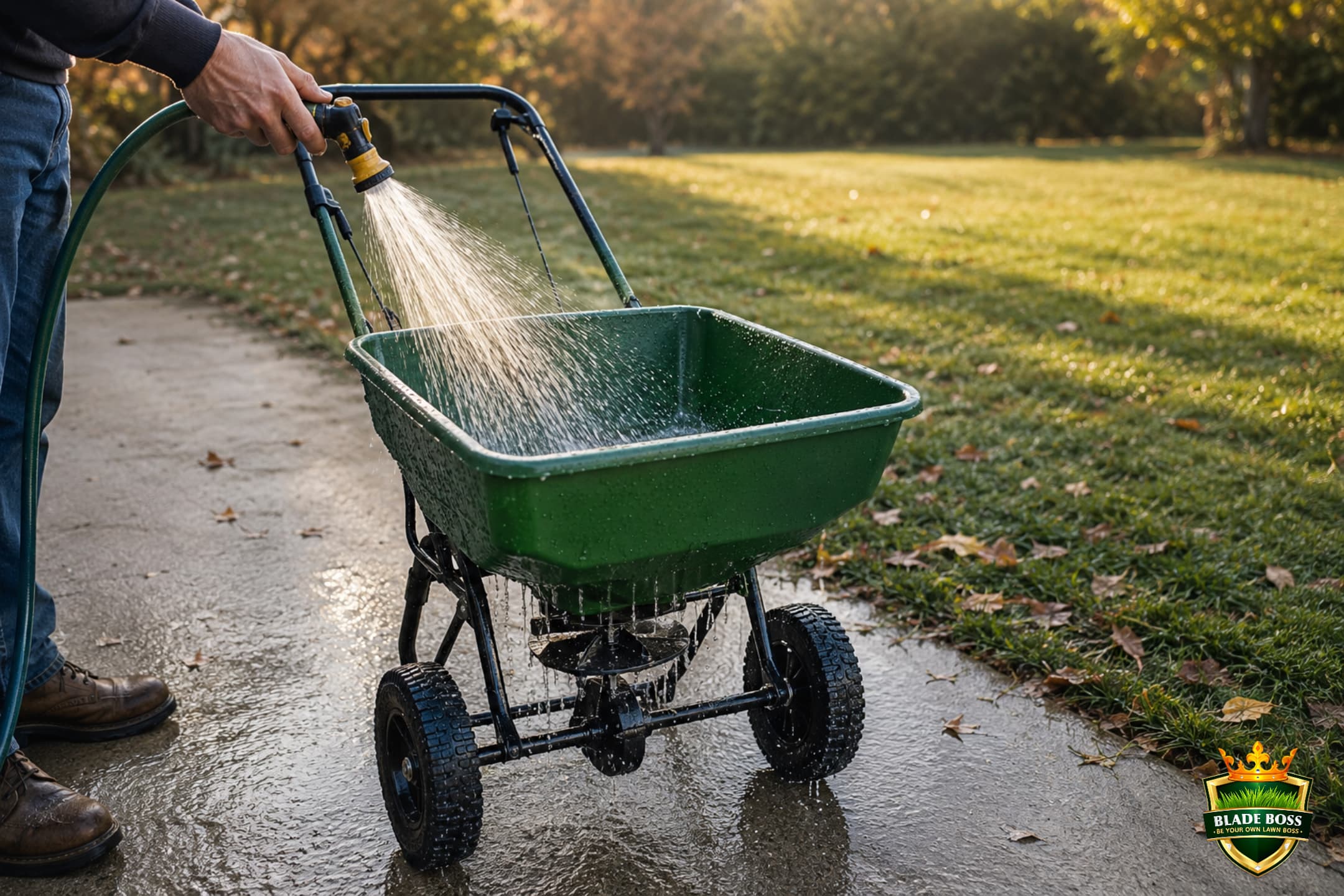
Fertilizer is salt, and salt eats metal. Leave product sitting in the hopper and it draws moisture, cakes into a solid crust, and corrodes the gate and the impeller. A seized gate does not open to the number you calibrated, which means the number you just worked for quietly becomes a lie.
So after every use: empty the hopper completely, rinse the whole spreader with a hose, let it dry, and hit the moving parts with a little lubricant. Two minutes. Do it and your calibration stays true for years. Skip it and you will be re-doing this guide next spring on a spreader that no longer holds a setting.
Get Your Calibration Target in NitroCalc Pro
Calibration is meaningless without a target. Enter your square footage and the NPK numbers off your bag, and NitroCalc Pro tells you exactly how many pounds of that product belong on 1,000 square feet. That is the number you calibrate against, and it changes with every bag you buy.
Open NitroCalc Pro →Abort Criteria - Common Mistakes
Mission Complete. Now Fly the Plan.
Thirty minutes of calibration turns your spreader from a guess into an instrument. Everything downstream depends on it: fertilizer, seed, lime, grub control. But calibration needs a target, and the target changes with every bag you buy. Run your product's NPK through NitroCalc Pro, get the exact pounds per 1,000 square feet, and then go calibrate to it.
Want This as a Printable Field Manual?
Drop your email and the print-ready PDF version lands in your hands. Take it to the lawn, no phone required.
Crew Questions - FAQ
Do I really need to calibrate my spreader?
If you care about not burning your lawn, yes. The setting number on a spreader controls how far the gate opens, not the rate that comes out. The actual rate depends on granule size, granule density, how full the hopper is, and how fast you walk. Until you measure it, every rate you calculate is theoretical.
How fast should I walk with a spreader?
About 3 miles per hour, which is a normal purposeful walk. In practical terms that is roughly 22 seconds to cover 100 feet. Nearly every settings chart printed on a fertilizer bag assumes this pace. Walk slower and you overapply, walk faster and you underapply, because a broadcast spreader meters off wheel rotation.
What is effective swath width?
It is the band of uniform coverage from a broadcast spreader, which is narrower than the total distance the granules fly. Granules land heavy in the center of the throw and taper toward the edges, so only the dense middle band counts as real coverage. Most homeowner broadcast spreaders have an effective swath of roughly 8 to 12 feet, but you should measure yours instead of assuming.
Can I use the same spreader setting for grass seed and fertilizer?
No. Grass seed is light and small, fertilizer granules are heavy and coarse, and lime is different again. The same gate opening lets very different amounts of each product through. Recalibrate every time you change products, and write the correct setting on the spreader for each one.
How do I calibrate a spreader without a special catch pan?
Use the weigh-back method. Measure your effective swath width, mark a test strip that equals 1,000 square feet, weigh out exactly the amount of product that should cover it, load it, spread the strip at your normal pace, then weigh whatever is left. What you loaded minus what came back is what you actually applied. Compare that to your target and adjust the setting.
Why does my lawn have stripes after fertilizing?
Usually one of two calibration errors. Either you overestimated your effective swath width and left lightly covered gaps between passes, or you made a single full-rate pass instead of two half-rate passes at right angles. Both leave alternating rich and lean bands that show up as stripes about two weeks later.