GUIDE GRUB-01 · REV B
How to Identify and Treat Lawn Grubs
Grubs are beetle larvae that eat grass roots from below, and they are the most misdiagnosed cause of a dying lawn. Here is the uncomfortable truth for Long Island: the single best grub product in the country is banned in your county, the second best becomes illegal statewide at the end of 2026, and roughly four out of five lawns never needed treatment in the first place. This guide shows you how to confirm you actually have grubs, why the best chemistry is off-limits here, and the legal program that genuinely works instead.
Pre-Flight Checklist - What You Need

As an Amazon Associate, Blade Boss earns from qualifying purchases. It never costs you a penny more.
Rules of Engagement (ROE's)
First: Do You Actually Have Grubs?
Grubs are the C-shaped, creamy-white larvae of several beetles, and they live in the top few inches of soil where they chew grass roots. The classic sign is turf you can peel back like a loose rug, because the roots that anchored it are gone. But that same brown, dying look comes from drought, disease, chinch bugs, and dog urine, so the only way to be sure is to look.
To scout, cut three sides of a one-square-foot flap of sod about two inches deep, peel it back, and count the grubs in the sod and the soil beneath. A standard golf-hole cup cutter samples about a tenth of a square foot, so one grub in that core is roughly ten per square foot. Grubs are patchy, so sample several spots, and sample after rain or a deep watering, because in dry soil the grubs move deeper and you will undercount.
| Grub Type | Treat Only If You Find More Than |
|---|---|
| Oriental beetle (most common on Long Island) | 8 |
| Japanese beetle | 8 to 10 |
| European chafer | 5 to 8 |
| Northern masked chafer | 8 to 12 |
| Asiatic garden beetle | 18 to 20 |
| May or June beetles | 3 to 4 |
| Species unknown (rule of thumb) | 10 or more |
These are Cornell's numbers, and Cornell adds an important point: a vigorous, well-rooted lawn tolerates far more grubs than a stressed one, so raise the bar for a healthy lawn and lower it for a thin or drought-stressed one. If your count comes in under the threshold, the right move is to do nothing and put your effort into a thick, deep-rooted lawn instead.
Which Grubs You Have Changes Everything
Most grub advice online is written around the Japanese beetle. On Long Island that is misleading. Cornell Cooperative Extension of Suffolk County identifies the Oriental beetle as the most common grub in local home lawns, with Japanese beetle and European chafer also causing significant damage. The often-quoted figure that 70 percent of grubs are Oriental beetle comes from a New Jersey turf survey, not a Long Island count, so treat it as a regional estimate rather than a local measurement. Either way, the Oriental beetle almost certainly dominates here.
Why it matters: Oriental beetle adults are cryptic and active near the soil at dusk, so you get a big grub population without the obvious beetle swarm people associate with Japanese beetle. It also breaks the most popular organic fix. The commercially available beneficial nematode works well on Japanese beetle but poorly on Oriental beetle, so the generic 90 percent organic grub control number you see online does not apply to most Long Island lawns.
Why Long Island Is Different (The Legal Reality)
Long Island sits on a sole-source drinking-water aquifer under sandy, permeable soil, so New York State attaches special prohibitions to the products most likely to leach. These are New York State pesticide registration and labeling conditions tied to Nassau, Suffolk, Kings, and Queens counties, not a town ordinance, and for the strongest grub chemistry they prohibit sale, distribution, and use. That is the key distinction: this is not a restricted-use product you can apply with a license. There is no license that unlocks it, because the ban is on the product itself in these counties.
| When | What Changed | What It Means For You |
|---|---|---|
| Jan 2023 | Imidacloprid and thiamethoxam classified Restricted Use | Homeowners can no longer apply them; homeowner imidacloprid is also banned in the four counties |
| Dec 2024 | Clothianidin and dinotefuran banned on turf statewide | Already off the table across New York |
| Now (2026) | Chlorantraniliprole and homeowner imidacloprid banned in the four counties | The two best preventives are already illegal here |
| Dec 31, 2026 | Ban expands to imidacloprid, thiamethoxam, acetamiprid on turf statewide | Even the professional lane disappears, for everyone |
The Three Lanes: From Best to Legal
Here is every real option, sorted honestly. We are not going to hide the best chemistry from you, but we are going to be straight about what you can actually and legally use on a Long Island lawn.
| Lane | Best Option | Legal on Long Island? | How Well It Works |
|---|---|---|---|
| Red | Chlorantraniliprole (GrubEx, Acelepryn) | No, banned outright | 96 to 100 percent, the best there is |
| Amber | Imidacloprid (Merit, professional only) | Pros only, and only until Dec 31, 2026 | 80 to 95 percent |
| Green | Scout, cultural control, trichlorfon rescue | Yes, fully legal today and after 2026 | 75 to 100 percent curative, timed right |
That leaves the green lane, and the good news is that it is more effective than it first sounds, it is fully legal today and after 2026, and it is exactly what Cornell has recommended all along. It is the program below.
The Flight Plan - Step by Step
Mow High All Season (Free, Legal, and Nobody Mentions It)
This is the most overlooked grub control there is. In replicated Kentucky field experiments, Potter and colleagues found that mowing high reduced total white grub biomass by up to 55 percent, because taller grass and deeper roots make the turf a worse place for beetles to lay and for grubs to thrive. Keep your mower at 3 inches or higher all season. It costs nothing, needs no license, and it is working against grubs before you ever pick up a product.
Manage Your Watering Around Beetle Flight
Beetles are drawn to moist soil to lay eggs, and the eggs and young grubs need moisture to survive. During peak adult flight, roughly late June through July, let the lawn run on the dry side if it can tolerate it, since the same Kentucky research found irrigated plots developed significantly higher grub densities than nonirrigated ones. Then flip it: once grubs are feeding in late summer, resume normal deep watering so the lawn can grow new roots and tolerate the feeding. This is not a contradiction, it is timing, and it meaningfully lowers your grub pressure.
Scout: Late July to Mid August
This is the decision point. Cut several one-square-foot samples, count the grubs, and identify the species by the pattern of hairs on the rear (the raster) if you can. Compare your worst counts to the Cornell threshold table above. On Long Island, late July through mid August is the prime window, both because it is when you can find the young grubs and because it sets up the curative option if you need it. Remember: about four in five lawns come in under threshold and need nothing.
If Over Threshold and Japanese Beetle Dominant: Nematodes
Beneficial nematodes (Heterorhabditis bacteriophora) are a legal biological option, applied in early to mid August at about 23 million infective juveniles per 1,000 square feet. Water with about half an inch before and a quarter inch after, apply in the evening or on an overcast day with soil at least around 65 degrees, keep spray pressure low, and use fresh, refrigerated product away from sunlight.
If Over Threshold: Trichlorfon, the Legal Curative
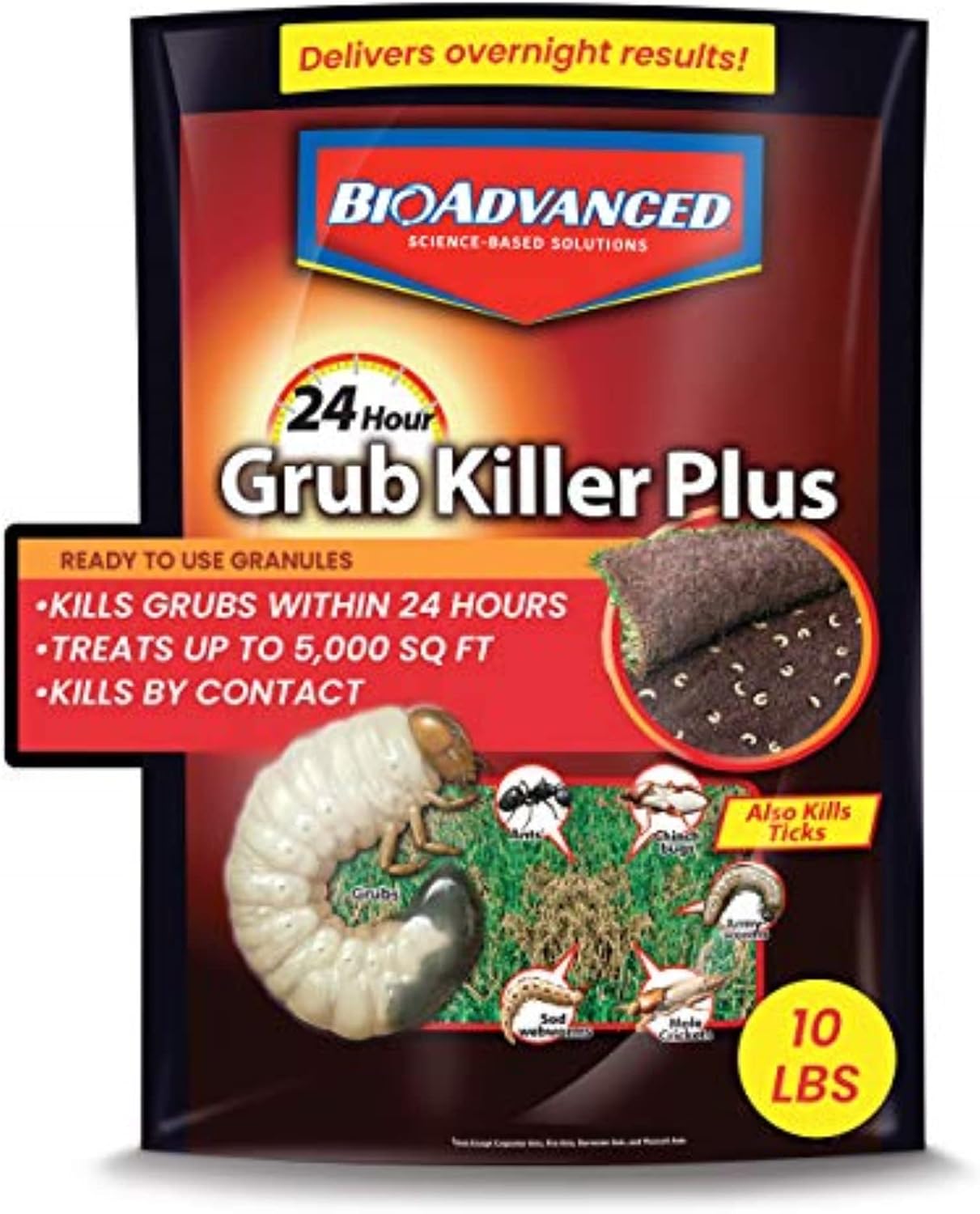
Trichlorfon is the one effective grub chemical that is legal for a Long Island homeowner, because it is not a neonicotinoid and is not on any New York prohibition list. The homeowner product is BioAdvanced 24-Hour Grub Killer Plus (9.3 percent trichlorfon, EPA Reg. No. 92564-40), applied at 2 pounds per 1,000 square feet in August to early September on grubs that are still young to medium sized. Expect 75 to 100 percent on accessible grubs, dropping under 50 percent once grubs are full-sized, so do not wait too long.
Watering it into the soil the same day is mandatory on the label, not optional. Use a spreader (the label prohibits hand-held or chest-mounted spreaders), never exceed 3 applications per year with at least 7 days between them, and resample one to two weeks later and only re-treat if you are still over threshold.
Post Your Markers if Treating More Than 100 Square Feet
Under New York's Neighbor Notification Law as adopted in Nassau and Suffolk, if you apply pesticide to more than 100 square feet of residential lawn you must post clearly visible perimeter markers on the day of application telling people not to enter or remove them for at least 24 hours. Most homeowners have never heard of this. Confirm your county's current details before you treat, since local implementation can differ.
Abort Criteria - Common Mistakes
Mission Complete. Now Fly the Plan.
Here is the whole thing in one breath: most lawns do not need grub treatment, so scout before you spend; the strongest products are banned here for a real reason; and the legal green program (mow high, manage water, scout in August, trichlorfon only if you are over threshold) is what actually protects a Long Island lawn now and after 2026. Time your scouting and your treatment window with the Weather Hub, and if you are not even sure grubs are your problem, back up to the pest ID guide first.
Want This as a Printable Field Manual?
Drop your email and the print-ready PDF version lands in your hands. Take it to the lawn, no phone required.
Crew Questions - FAQ
Is GrubEx legal on Long Island?
No. GrubEx is chlorantraniliprole, and its New York State label prohibits the sale, distribution, and use of the product in Nassau, Suffolk, Kings, and Queens counties. This is not a restricted-use situation where a license unlocks it; the product itself is banned in these four counties. The reason is environmental: chlorantraniliprole is toxic to aquatic invertebrates and can leach through Long Island's sandy soil into the sole-source drinking-water aquifer beneath it. Retailers here cannot legally sell it to you, and you cannot legally apply it, even though it is the single most effective grub preventive available. For a legal option, the guide points you to the green program built around scouting, cultural control, and trichlorfon as a curative rescue.
What can I actually use for grubs in Suffolk County?
The one effective grub chemical that is legal for a homeowner in Suffolk County is trichlorfon, sold as BioAdvanced 24-Hour Grub Killer Plus (9.3 percent, EPA Reg. No. 92564-40). It is a curative, meaning you use it when grubs are already present and you have confirmed you are over the treatment threshold by scouting, ideally in August to early September while the grubs are still young to medium sized. Apply it at 2 pounds per 1,000 square feet and water it into the soil the same day, which is required on the label. Beyond that one product, your best legal tools are cultural: mowing high all season, which research shows can cut grub numbers by up to 55 percent, managing your watering around beetle flight, and using beneficial nematodes if your lawn is dominated by Japanese beetle. The neonicotinoid preventives that most people reach for, including all homeowner imidacloprid and chlorantraniliprole products, are banned in Suffolk County.
How many grubs per square foot before I should treat?
It depends on the grub species and the health of your lawn, per Cornell's thresholds. For the Oriental beetle that dominates Long Island lawns, the threshold is about 8 grubs per square foot; for Japanese beetle it is 8 to 10; for European chafer it is a lower 5 to 8, because it is harder to control. If you cannot identify the species, a good rule of thumb is that under 5 per square foot needs no treatment, 6 to 9 is a judgment call based on how healthy and irrigated your lawn is, and 10 or more is increasingly likely to cause visible damage, especially in a stressed lawn. Cornell stresses that a vigorous, deep-rooted lawn tolerates far more grubs than a thin or drought-stressed one, so a healthy lawn can carry a higher count without treatment. Always confirm by cutting a one-square-foot sample and counting, and sample several spots because grubs are patchy.
When should I apply grub control on Long Island?
Scout in late July through mid August, and treat only if you are over threshold, ideally from August into early September while the grubs are still small enough to kill. That is the window for the legal curative, trichlorfon. Do not treat in spring or in October: Cornell calls spring treatment a waste of time and money because the damage already happened and the big overwintered grubs resist control, and October is really too late because the grubs have moved deep and stopped feeding. The old advice to apply a preventive in June and July is now largely moot here, because the effective preventives are either banned in the four counties or are professional-only products being phased out statewide at the end of 2026. That is exactly why this guide shifts you toward scouting plus a well-timed August curative rather than a calendar-based summer preventive.
Does milky spore actually work on grubs?
No, and this is one of the most persistently sold products that does not deliver. Milky spore is a bacterium marketed as a natural, long-term grub control, but replicated university trials tell a different story: a multi-year study on two Kentucky golf courses found that neither commercial formulation increased milky disease in the grubs nor reduced Japanese beetle populations, and it failed even at a concentrated dose in a small enclosure. On top of that, milky spore only affects Japanese beetle grubs, so it is useless against the Oriental beetle that is the most common grub in Long Island lawns. It also needs an existing susceptible grub population to build up, which is a circular problem. Save your money; Cornell rates it as supplemental at best. If you want a biological option, beneficial nematodes are far better supported, though even those work well only on Japanese beetle.