

GUIDE IRR-04 · REV A
How to Calculate Your Lawn's Watering Needs and Run Times
Your controller came with run times someone guessed at a factory. They have no idea what grass you grow, what your soil is, or how hard the July sun hits your yard. This guide replaces the guess with a number, the same water math every pro uses, and AquaSync Pro does all of it for you from your address.
Pre-Flight Checklist - What You Need
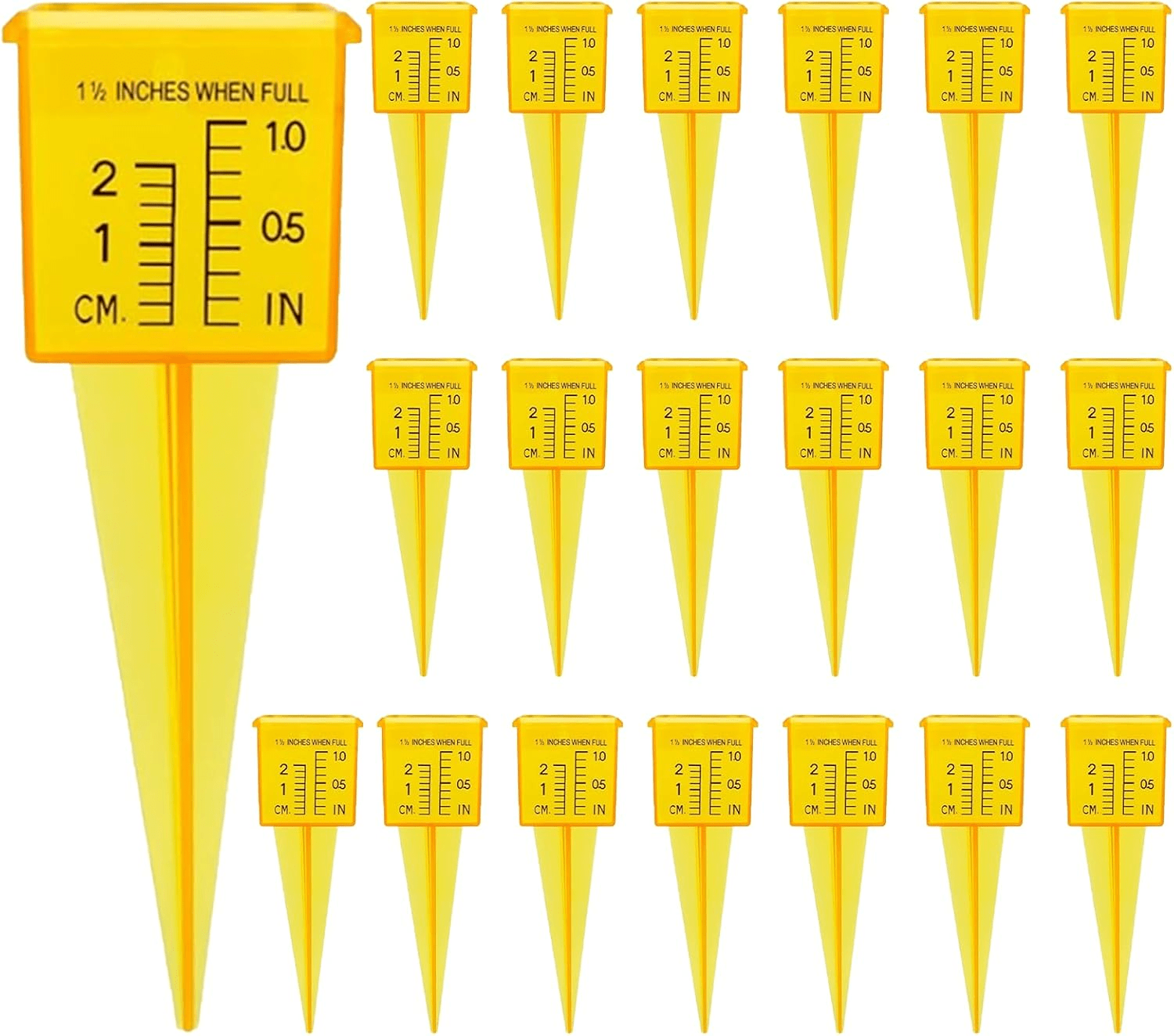
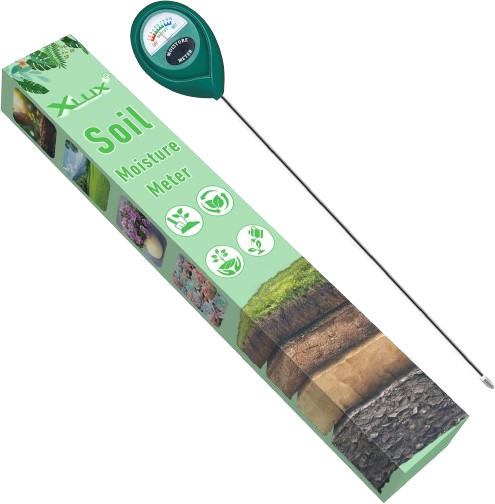
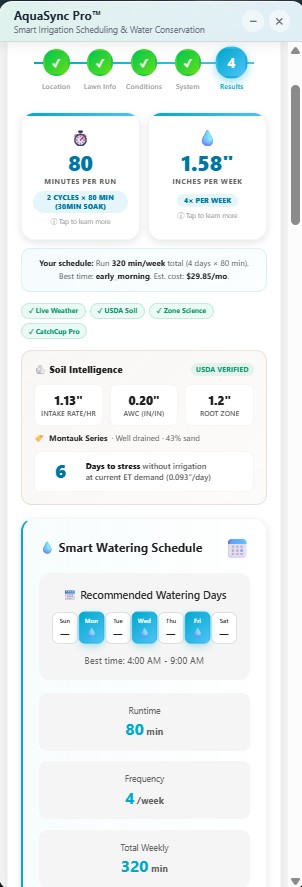
As an Amazon Associate, Blade Boss earns from qualifying purchases. It never costs you a penny more.
Rules of Engagement (ROE's)
The Flight Plan - Step by Step
What ET Actually Is (In Plain English)
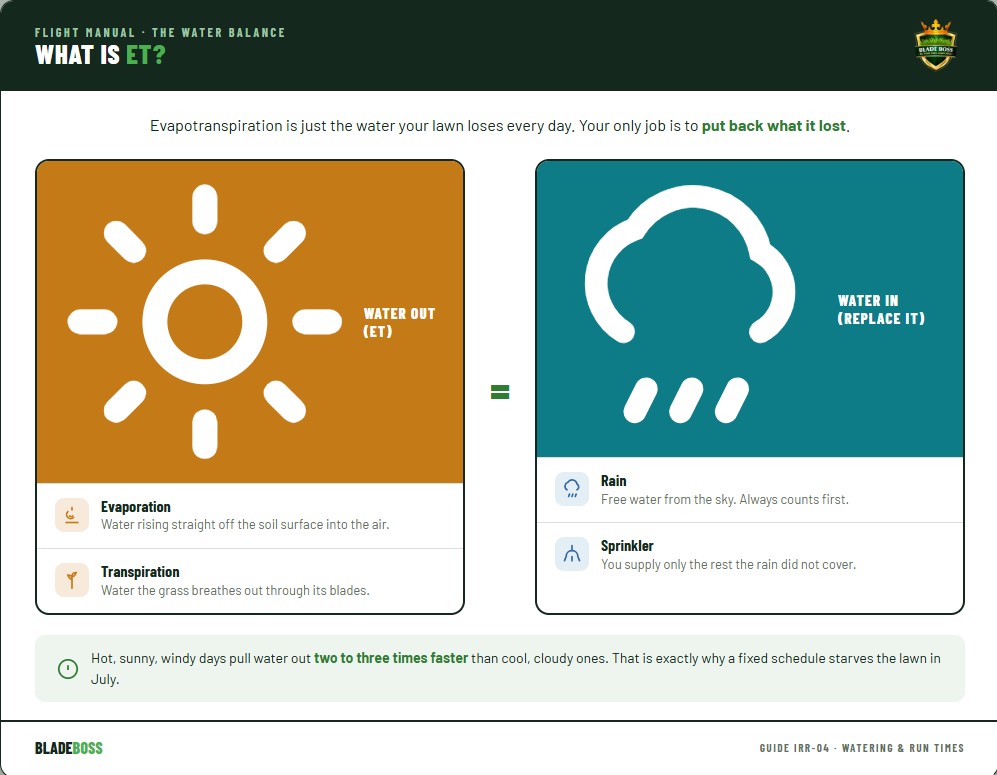
ET stands for evapotranspiration. Forget the word. It just means the water your lawn loses every day, two ways at once: water that evaporates off the soil, and water the grass breathes out through its blades. Add them up and that is how much your lawn drank that day.
Hot, sunny, windy, dry days have high ET. Cool, cloudy, calm days have low ET. Your entire job is simple: put back what the lawn lost. Nothing more.
Find Your Grass's Weekly Number
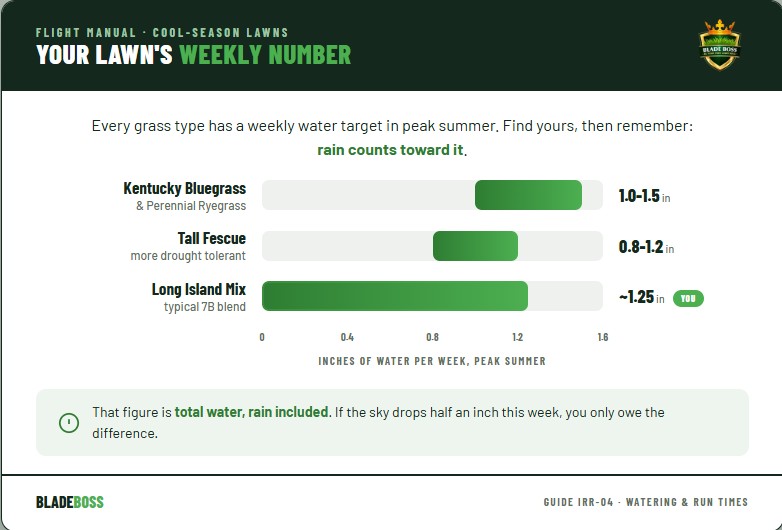
Every grass type has a weekly water target in the heat of summer. Long Island lawns are cool-season, so find yours:
- Kentucky bluegrass and perennial ryegrass: 1.0 to 1.5 inches per week.
- Tall fescue: 0.8 to 1.2 inches per week (it is more drought tolerant).
- A typical Long Island mix lands around 1.25 inches per week at peak summer.
That is total water, rain included. So if the sky drops half an inch this week, you only owe the rest. Hold that thought, it is the next step.
Subtract the Rain
This is the step almost everyone skips, and it is literally free water. Take your weekly need, subtract what fell from the sky, and the leftover is all you actually have to irrigate. Pros call it the net irrigation requirement. You can call it the bill after the rain discount.
Example: your lawn wants 1.25 inches this week. A Tuesday storm dropped 0.5 inches. You owe 0.75 inches, not 1.25. Skip this step and you overwater by 40% every rainy week.
One nuance worth knowing: not all rain counts the same. A slow, soaking half-inch banks almost fully, but a three-quarter-inch downpour in twenty minutes mostly runs to the curb, so do not credit all of it. Your soil also holds only so much at once. Anything past what the root zone can store drains straight through, it does not save up for next week. AquaSync Pro handles both, crediting real rainfall and capping it at what your soil can actually hold.
Why You Water to 80%, Not 100%
Here is the counterintuitive part. You do not water to 100% of what the lawn lost. You water to about 80%.
Running the lawn slightly lean forces the roots to chase water downward, which builds a deeper, tougher root system that survives heat and drought far better than a pampered, shallow lawn. It also trims your water bill by roughly 20% with no loss in quality. This is called deficit irrigation, and it is the single biggest difference between a lawn that limps through August and one that cruises through it.
Let AquaSync Pro Do the Math
Steps two through four are exactly what AquaSync Pro automates. Enter your address and pick your zone, grass type, and soil. It pulls live ET for your location, subtracts rainfall, applies the 80% deficit target, and hands you the precise weekly water figure and a run time for every zone. No weather data, no spreadsheets, no guessing.
Open AquaSync Pro →Turn Inches Into Minutes
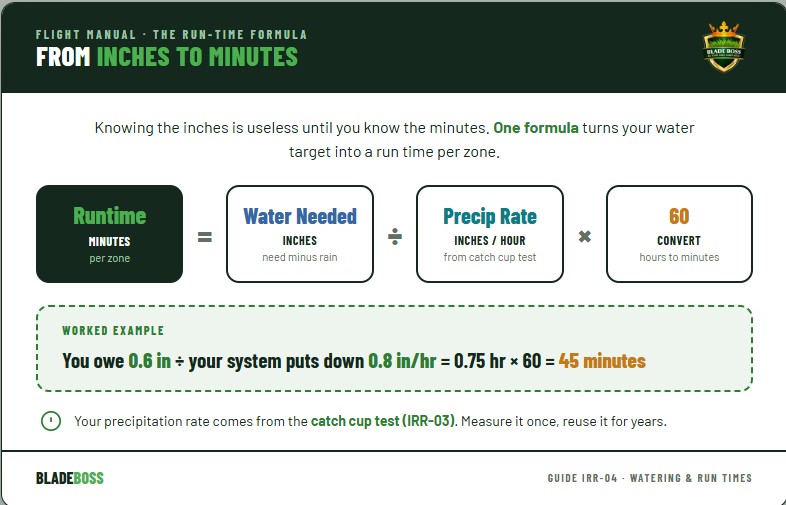
Knowing you owe the lawn an inch of water is useless until you know how long to run the sprinklers to deliver it. That is where your catch cup test pays off. Remember your precipitation rate from IRR-03, the inches per hour your system actually puts down? Here is the entire formula:
Example: you owe 0.6 inches this cycle, and your catch cup test measured a precipitation rate of 0.8 inches per hour. 0.6 ÷ 0.8 = 0.75 hours, times 60 = 45 minutes. That zone runs 45 minutes. Do this once with your own numbers and you will never trust a factory setting again.
Cycle and Soak So It Does Not Run Off
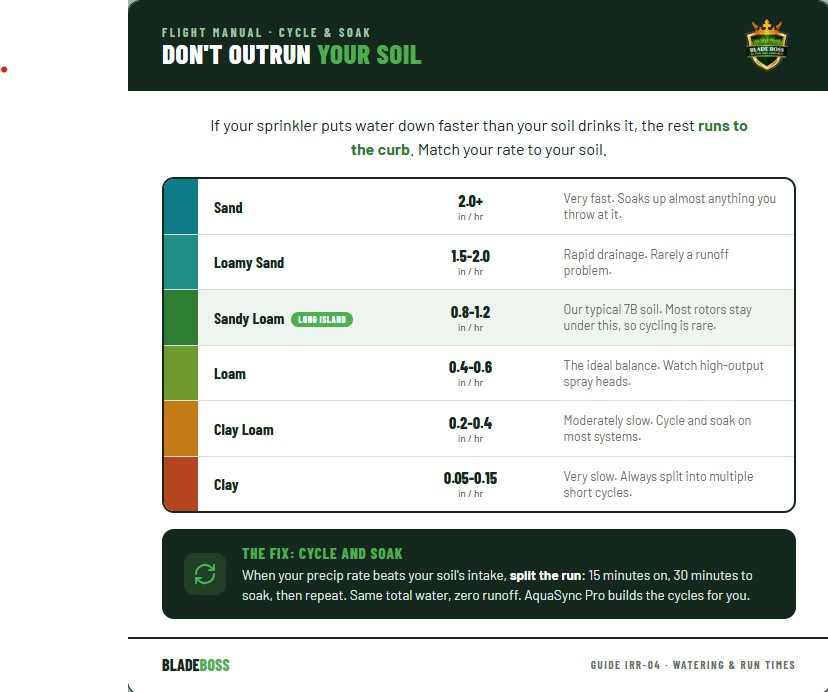
One catch: if your sprinklers put water down faster than your soil can drink it, the extra runs off to the curb and you wasted it. Match your precipitation rate against how fast your soil absorbs water:
- Sand: 2.0+ inches per hour. Soaks up almost anything.
- Sandy loam (typical Long Island): 0.8 to 1.2 inches per hour.
- Loam: 0.4 to 0.6 inches per hour.
- Clay loam: 0.2 to 0.4 inches per hour.
- Clay: 0.05 to 0.15 inches per hour. Very slow.
If your precip rate is higher than your soil's intake rate, split the run into two or three shorter cycles with a soak break between them. Run 15 minutes, let it sink for 30, run again. Same total water, zero runoff. AquaSync Pro flags this and builds the cycles for you.
Abort Criteria - Common Mistakes
Mission Complete. Now Fly the Plan.
Stop guessing and start measuring. Open AquaSync Pro, enter your address and zone, and get the exact weekly water figure and per-zone run times for your Long Island lawn: ET-adjusted, rain-subtracted, and dialed to your soil.
Want This as a Printable Field Manual?
Drop your email and the print-ready PDF version lands in your hands. Take it to the lawn, no phone required.
Crew Questions - FAQ
What is ET and why does it matter for watering?
ET, or evapotranspiration, is the water your lawn loses each day to evaporation from the soil and transpiration through the grass blades. It rises on hot, sunny, windy days and falls on cool, cloudy ones. Watering to replace your ET means you put back exactly what the lawn used, instead of guessing with a fixed schedule.
How much water does a Long Island lawn need per week?
Cool-season lawns like Kentucky bluegrass and ryegrass need about 1.0 to 1.5 inches per week at peak summer, including rainfall. Tall fescue needs a little less, 0.8 to 1.2 inches. A typical Long Island mix sits around 1.25 inches per week in July and August, and much less in spring and fall.
How do I turn inches of water into sprinkler minutes?
Use Runtime equals Water Needed divided by Precipitation Rate, times 60. Your precipitation rate comes from a catch cup test (IRR-03). If you owe 0.6 inches and your system puts down 0.8 inches per hour, that is 0.6 divided by 0.8, times 60, which is 45 minutes for that zone.
Why water to 80% instead of 100%?
Watering to about 80% of full ET, called deficit irrigation, forces roots to grow deeper in search of water, which builds a tougher lawn that handles heat and drought better. It also saves roughly 20% on water with no drop in quality.
What is cycle and soak?
When your sprinklers put water down faster than your soil can absorb it, the excess runs off. Cycle and soak splits one long run into two or three shorter ones with soak breaks between them, so the same total water sinks in instead of running to the curb. It matters most on clay and on slopes.
Should I water my lawn every day?
No. Daily watering grows shallow, weak roots. Water deep and infrequent, two or three times a week, so moisture reaches the full root zone and the surface dries between waterings. Daily watering is one of the most common and most damaging lawn habits there is.