

GUIDE PREP-03 · REV A
How to Topdress and Level Your Lawn
Topdressing is spreading a thin layer of soil, sand, or compost across your lawn. Done right, it levels bumps, smooths dips, and slowly rebuilds the soil underneath. Done wrong, it buries and suffocates the grass you were trying to help. The entire skill is in one word: thin. This is how to do it in the right order, at the right depth, without smothering a single blade.
Pre-Flight Checklist - What You Need
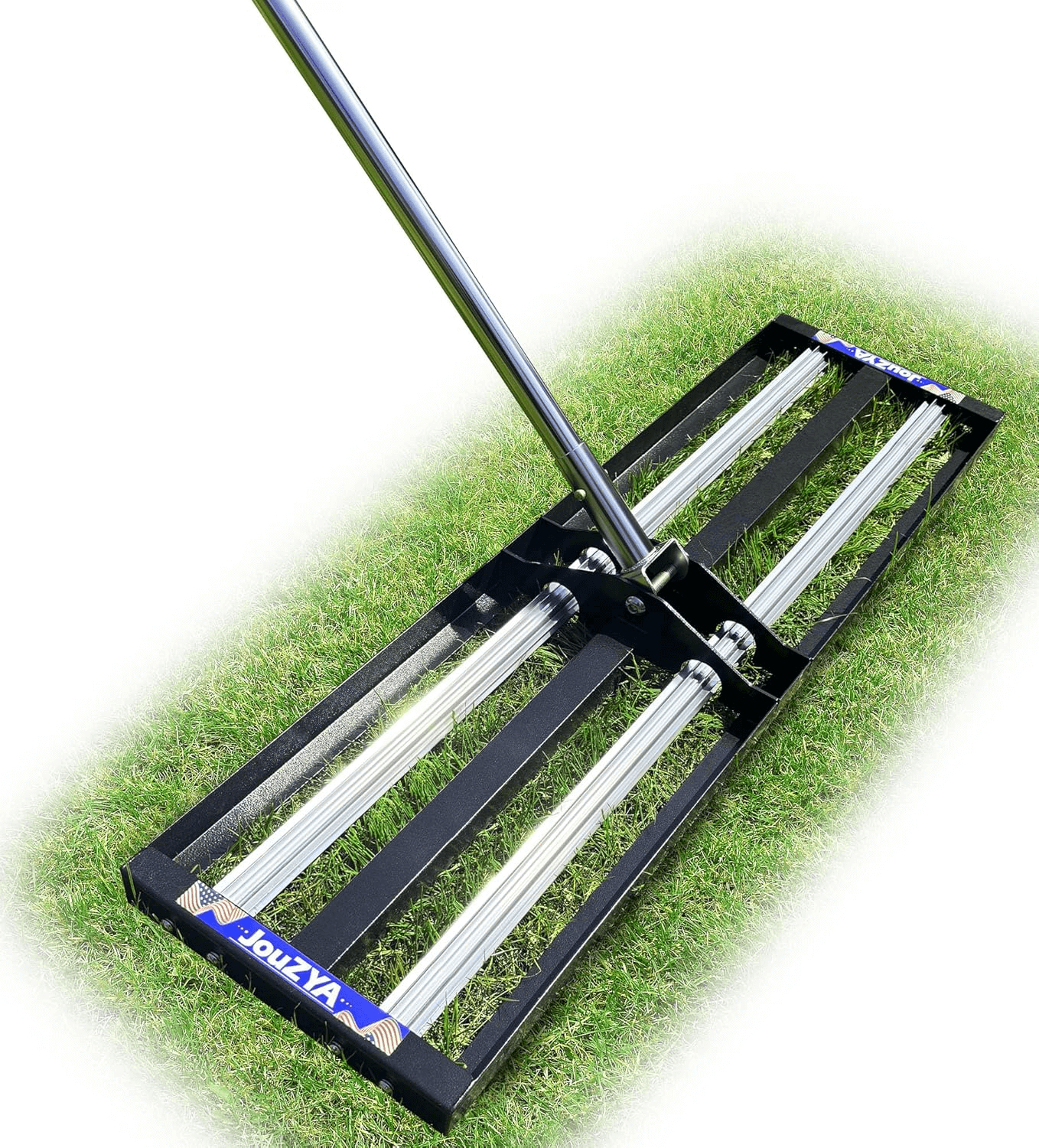
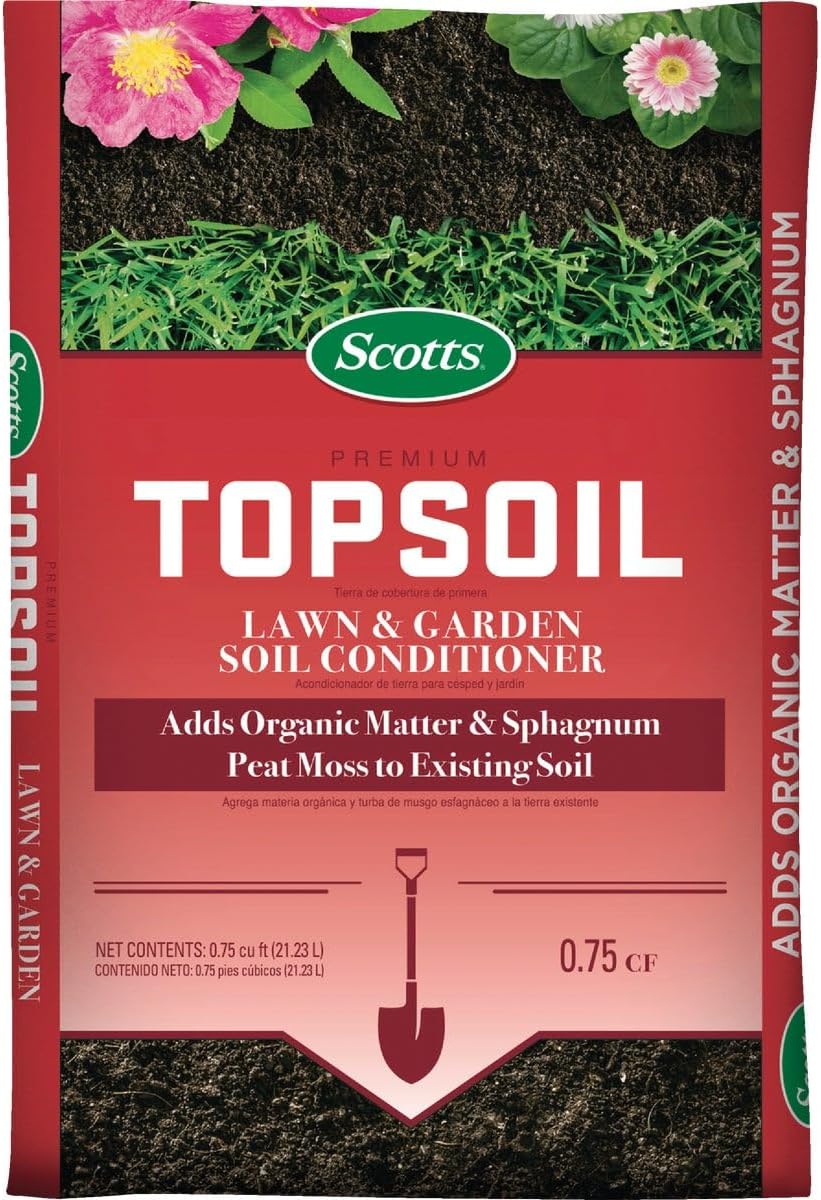
As an Amazon Associate, Blade Boss earns from qualifying purchases. It never costs you a penny more.
Rules of Engagement (ROE's)
The Flight Plan - Step by Step
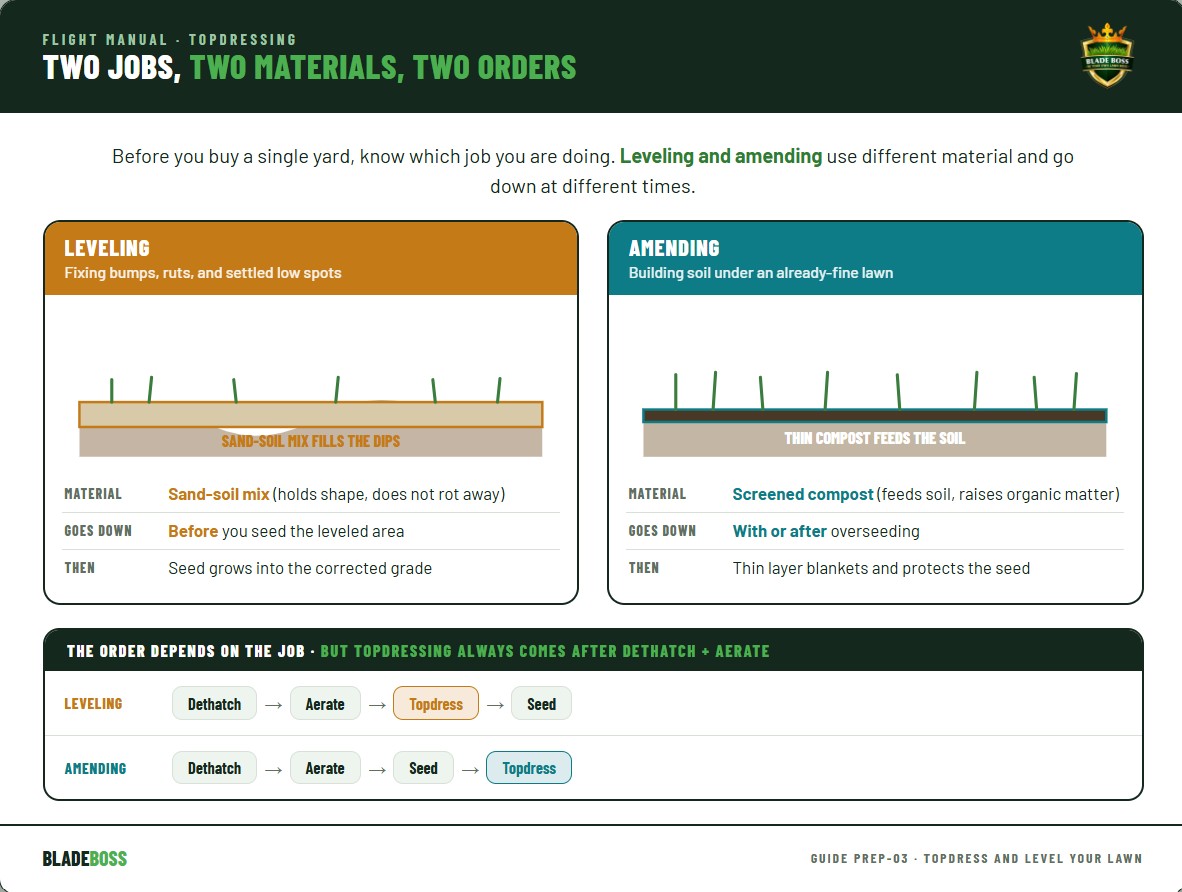
Decide: Are You Leveling or Amending?
These are two different jobs with two different materials and two different spots in the sequence. Leveling fixes a physically uneven surface: bumps, ruts, settled low spots, the trench where they buried a pipe. Amending improves the soil under an otherwise fine lawn by adding organic matter.
Prep the Lawn First (Order Matters)
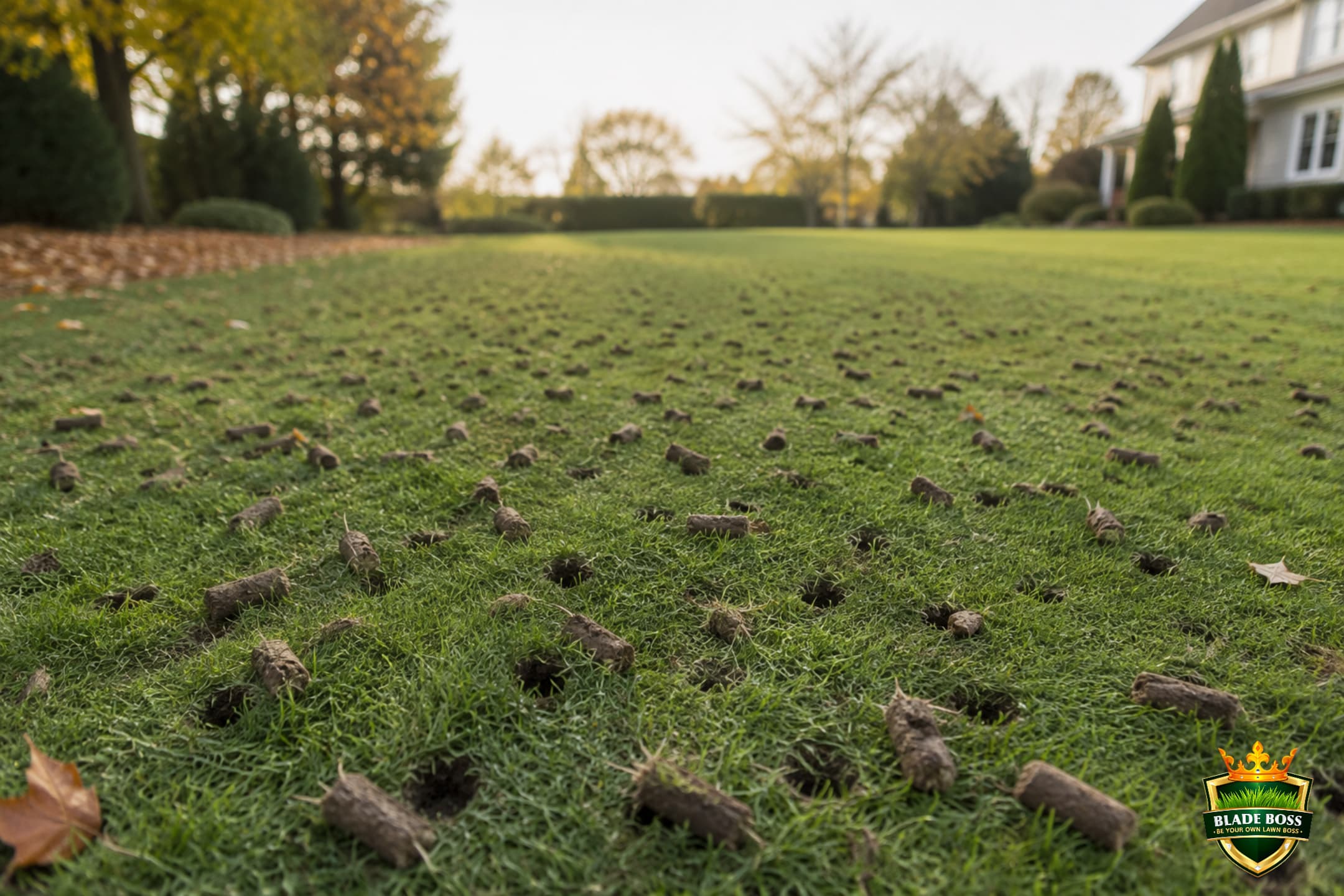
Topdressing is not a standalone job, it is the step that rides on top of cultivation. The correct fall renovation sequence is mow low, dethatch, aerate, then topdress. Dethatching clears the surface so material reaches soil instead of sitting on thatch, and aerating opens holes for the topdressing to fall into and make contact with the root zone.
So before any soil goes down: mow a notch lower than usual and bag the clippings, dethatch if the thatch layer is over half an inch, and core aerate. Leave the cores on the surface, because your rake will break them down and they become part of the topdressing.
Calculate How Much You Actually Need
This is where people wildly over or under buy. Topdressing is sold in cubic yards, and the volume you need depends on your square footage times the depth. The math is not hard, but it is easy to get an order of magnitude wrong and end up with three tons of soil in your driveway or not nearly enough to finish.
As a reference point: covering 1,000 square feet at a quarter-inch depth takes about 0.75 cubic yards of material. A half inch doubles that. Run your real numbers before you order or haul anything.
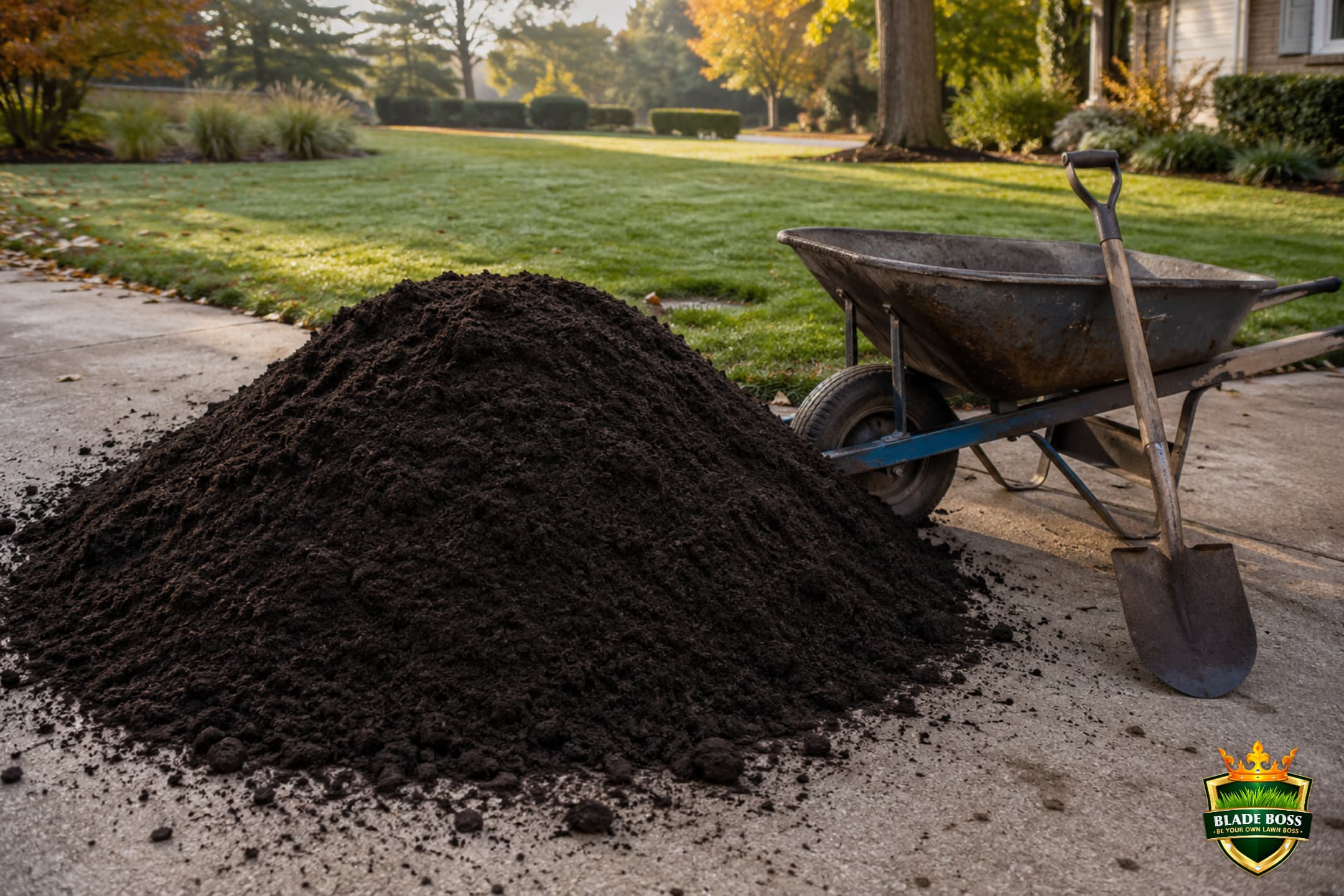
Spread It in Small Piles
Do not try to spread from one giant heap. Shovel or dump small mounds across the lawn in a grid, a wheelbarrow-load every several feet, so you are working the material out from many starting points instead of dragging one pile across the whole yard. This is how you keep the layer even and thin instead of deep in one corner and bare in another.
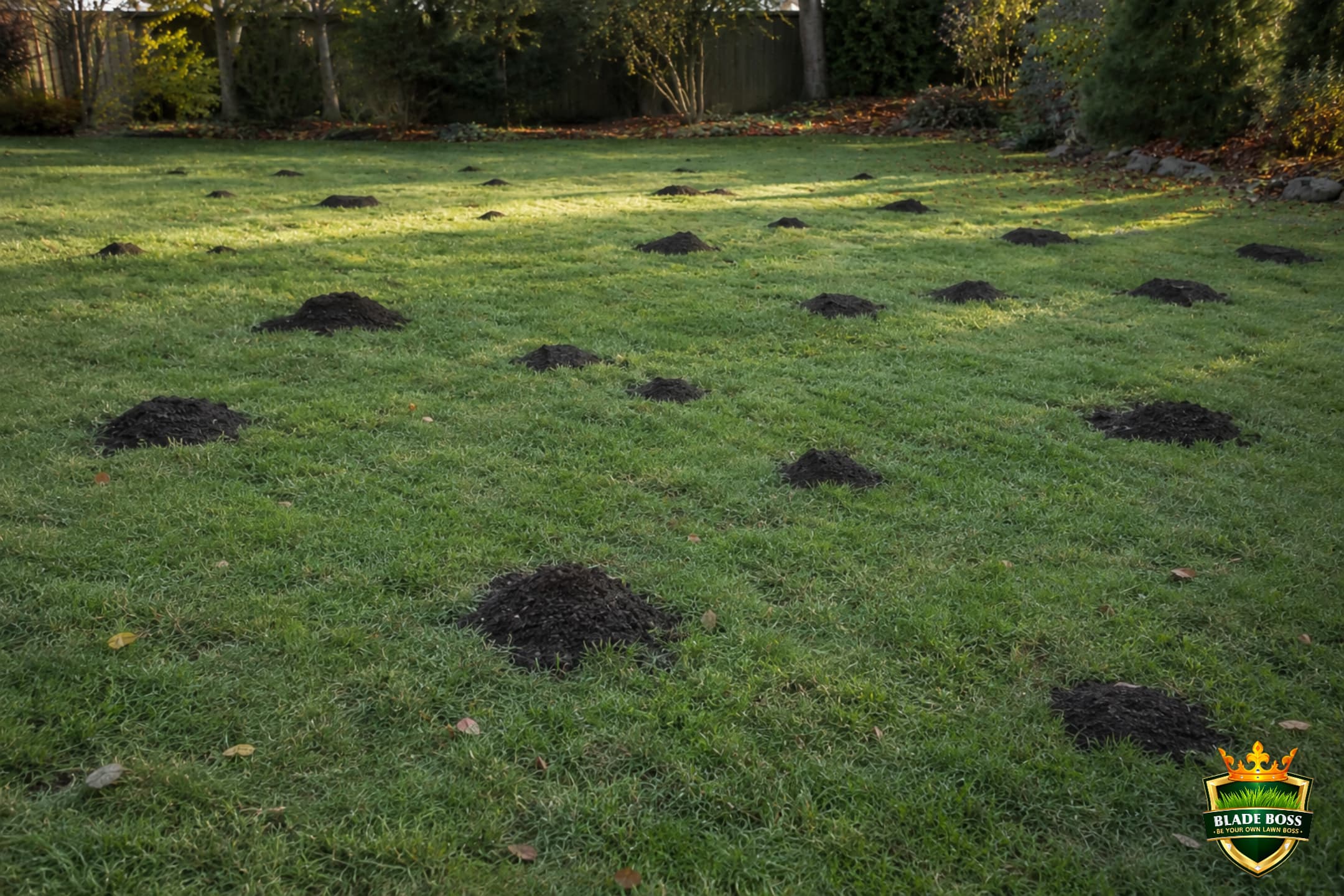
Rake It In Until the Grass Shows Through
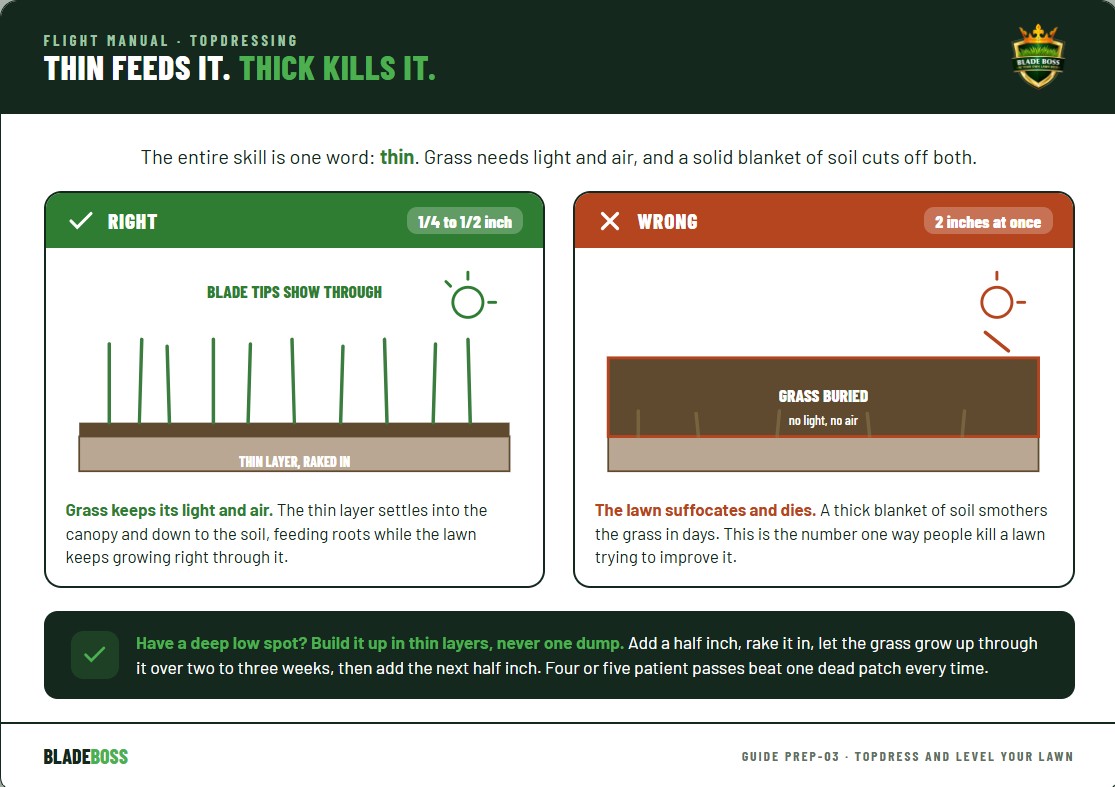
This is the step that makes or breaks the whole job. Using a leveling rake (a wide flat lute, not a leaf rake), work the material back and forth to spread it out and push it down into the canopy and the aeration holes. Keep going until the grass blades poke back up through the soil.
Seed the Timing Right, Then Water In
Now the order pays off. If you are leveling, this is the moment to overseed the leveled areas, so the new seed makes contact with the fresh soil surface and grows into the corrected grade. If you are amending a healthy lawn, you likely seeded just before topdressing, and the thin compost layer is now acting as a protective blanket over that seed.
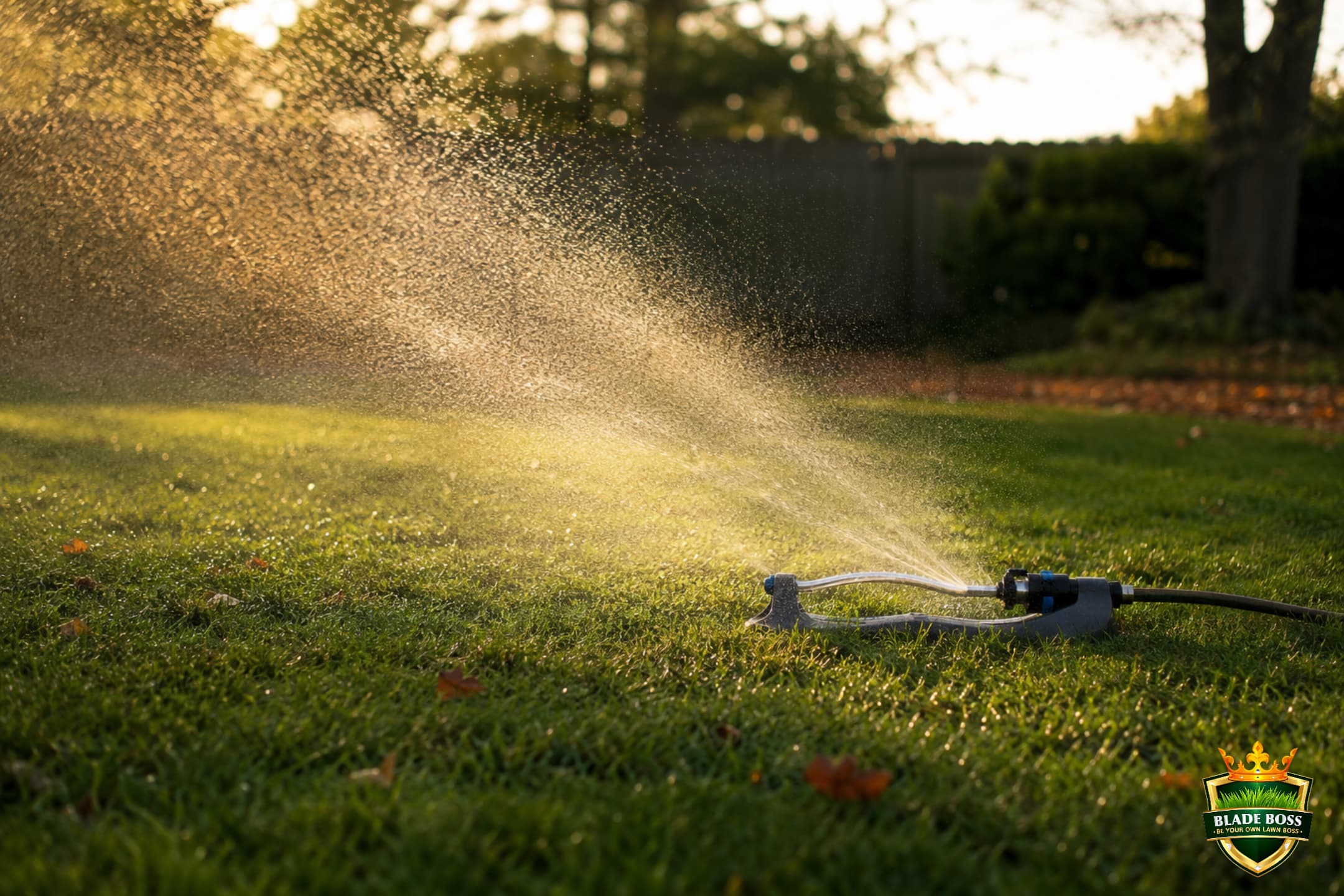
Either way, finish by watering lightly to settle the topdressing down into the canopy and against the soil, and to start any new seed. Keep it consistently moist while seed germinates. Do not blast it with a hard spray that washes your fresh level job into ripples.
Get Your Exact Soil Volume in TopCalc Pro
Guessing at cubic yards is how you end up with a mountain of soil you cannot use or a half-finished lawn. Enter your square footage and target depth, and TopCalc Pro tells you exactly how many cubic yards or bags of topsoil, sand, or compost to buy. It handles the depth math so you order once and order right.
Open TopCalc Pro →Abort Criteria - Common Mistakes
Mission Complete. Now Fly the Plan.
Topdressing is one of the highest-payoff things you can do for a lawn and one of the easiest to get catastrophically wrong, and the whole difference is depth. Stay thin, rake until the grass shows through, and build deep fills in patient layers. Before you order a single yard, run your square footage and target depth through TopCalc Pro so you buy exactly what you need. Then overseed to lock in the result.
Want This as a Printable Field Manual?
Drop your email and the print-ready PDF version lands in your hands. Take it to the lawn, no phone required.
Crew Questions - FAQ
Do you topdress before or after overseeding?
It depends on your goal. If you are leveling an uneven surface, the soil goes down first and you overseed the corrected grade afterward, so the seed contacts the fresh level surface. If you are amending a healthy lawn with compost, you typically overseed first and then apply a thin quarter-inch compost layer over the seed as a protective blanket. In both cases, topdressing comes after dethatching and aerating.
How thick can you topdress a lawn?
A quarter to a half inch per pass, maximum, and you must rake it in so the grass blade tips still show through. Any thicker and you smother the lawn by cutting off its light and air. To fix a deep low spot that needs an inch or two of fill, apply it in multiple thin passes spaced two to three weeks apart, letting the grass grow up through each layer before adding the next.
What is the best material to topdress a lawn with?
It depends on the job. For leveling bumps and dips, use a sand-soil mix that holds its shape. For amending and improving the soil, use screened compost, which feeds soil biology and raises organic matter. On sandy Long Island soil, compost is ideal because it adds the water and nutrient holding capacity that sand lacks. Avoid pure sand over clay-heavy soil, where it can set up like concrete.
When is the best time to topdress a lawn?
Late summer through fall, during active cool-season growth, and right after core aeration. The grass needs to be growing vigorously so it can push up through the new layer, and aeration holes give the topdressing somewhere to settle and contact the root zone. Avoid topdressing a dormant, dry, or heat-stressed lawn, which cannot recover through the material.
How much topdressing do I need for my lawn?
Covering 1,000 square feet at a quarter-inch depth takes roughly 0.75 cubic yards of material, and a half inch takes about 1.5 cubic yards. Since it is sold in cubic yards and the depth math is easy to get wrong by a wide margin, run your exact square footage and target depth through TopCalc Pro before you order so you buy the right amount once.
Will topdressing kill my grass?
Only if you apply too much. A thin quarter-inch layer raked into the canopy helps the lawn, but a thick blanket of soil left sitting on top of the blades cuts off light and air and suffocates the turf. The rule that keeps grass alive is simple: never more than half an inch per pass, always rake it in, and make sure the grass tips are still visible when you finish.