GUIDE DIAG-02 · REV A
What Type of Grass Do I Have? How to Identify Your Lawn
Almost every decision you make about your lawn depends on one thing you probably do not know: what grass you are actually growing. Mowing height, how much water it needs, which seed matches, which diseases it gets, how much you feed it, all of it changes by type. The good news is you do not need a lab. On a cool-season Long Island lawn there are really only four grasses to sort between, and a few close looks at a single blade will tell you which ones you have. This is how to read them.
Rules of Engagement (ROE's)
The Flight Plan - Step by Step
Read the Blade Up Close
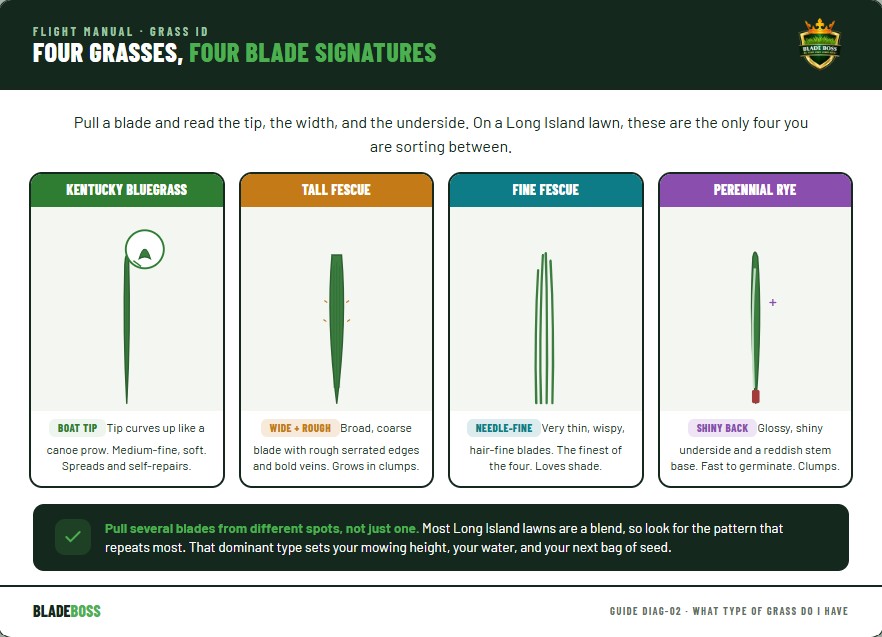
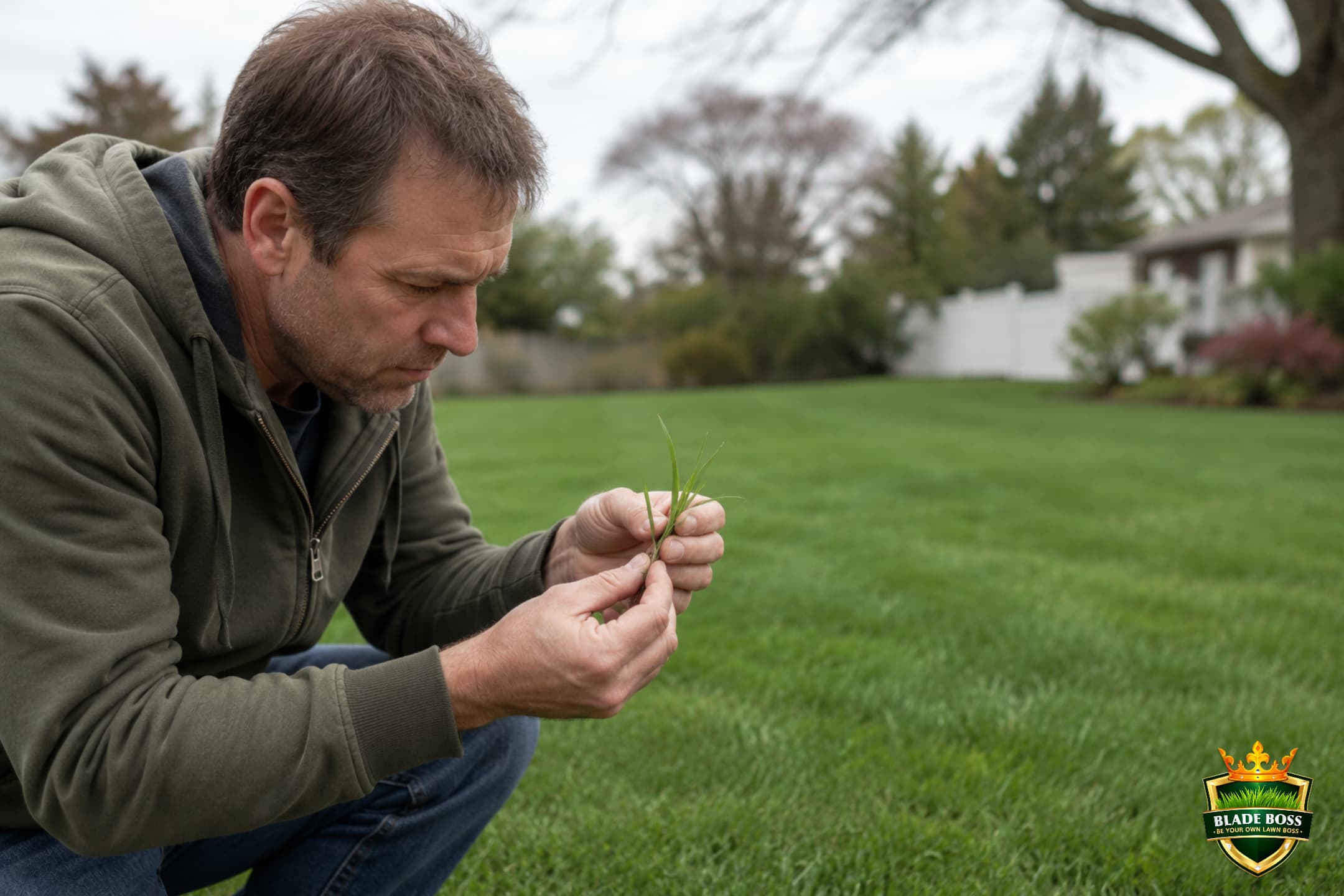
Pull a healthy blade and look closely at three things: the shape of the tip, the width and roughness, and the underside when you flip it. Each grass leaves a different signature here.
- Kentucky bluegrass: boat-shaped tip, curved up like a canoe prow. Medium-fine, soft. The boat tip is the giveaway.
- Tall fescue: wide, coarse blade with rough, serrated edges you can feel, and prominent veins.
- Fine fescue: very thin, needle-like blades, the finest of the four.
- Perennial ryegrass: medium blade with a glossy, shiny underside, often a reddish stem base.
Watch How It Grows
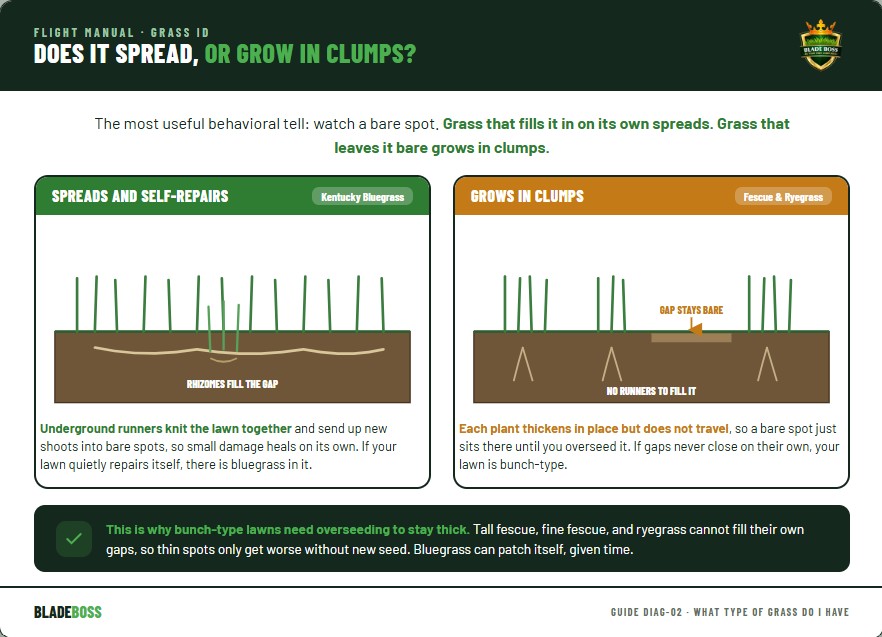
The single most useful behavioral tell is whether the grass spreads on its own or grows in clumps. This splits the four types cleanly and it changes how you repair the lawn, so it is worth confirming even when the blade already gave you an answer.
Kentucky bluegrass spreads by underground runners (rhizomes), so it knits together into dense sod and slowly fills in bare spots on its own. Tall fescue, fine fescue, and perennial ryegrass are bunch-type, growing in clumps that get thicker but do not travel, so a bare spot in a bunch-type lawn stays bare until you overseed it. If your lawn heals its own small damage, there is bluegrass in the mix. If gaps just sit there, you are mostly bunch-type.
Confirm With Your Conditions
How the grass behaves in your yard is a strong second opinion, because each type earns its keep in different conditions. Match what you see to what thrives:
- Thrives in real shade under trees: fine fescue. It is the only cool-season type that genuinely tolerates shade.
- Stays green and deep-rooted through summer drought: tall fescue. Its deep roots are why it is the Long Island workhorse.
- Fills in its own bare spots over a season: Kentucky bluegrass, doing its spreading thing.
- Came up fast, within a week or two of seeding: perennial ryegrass (the fastest to germinate) or a turf-type tall fescue.
Put It Together (It Is Probably a Mix)
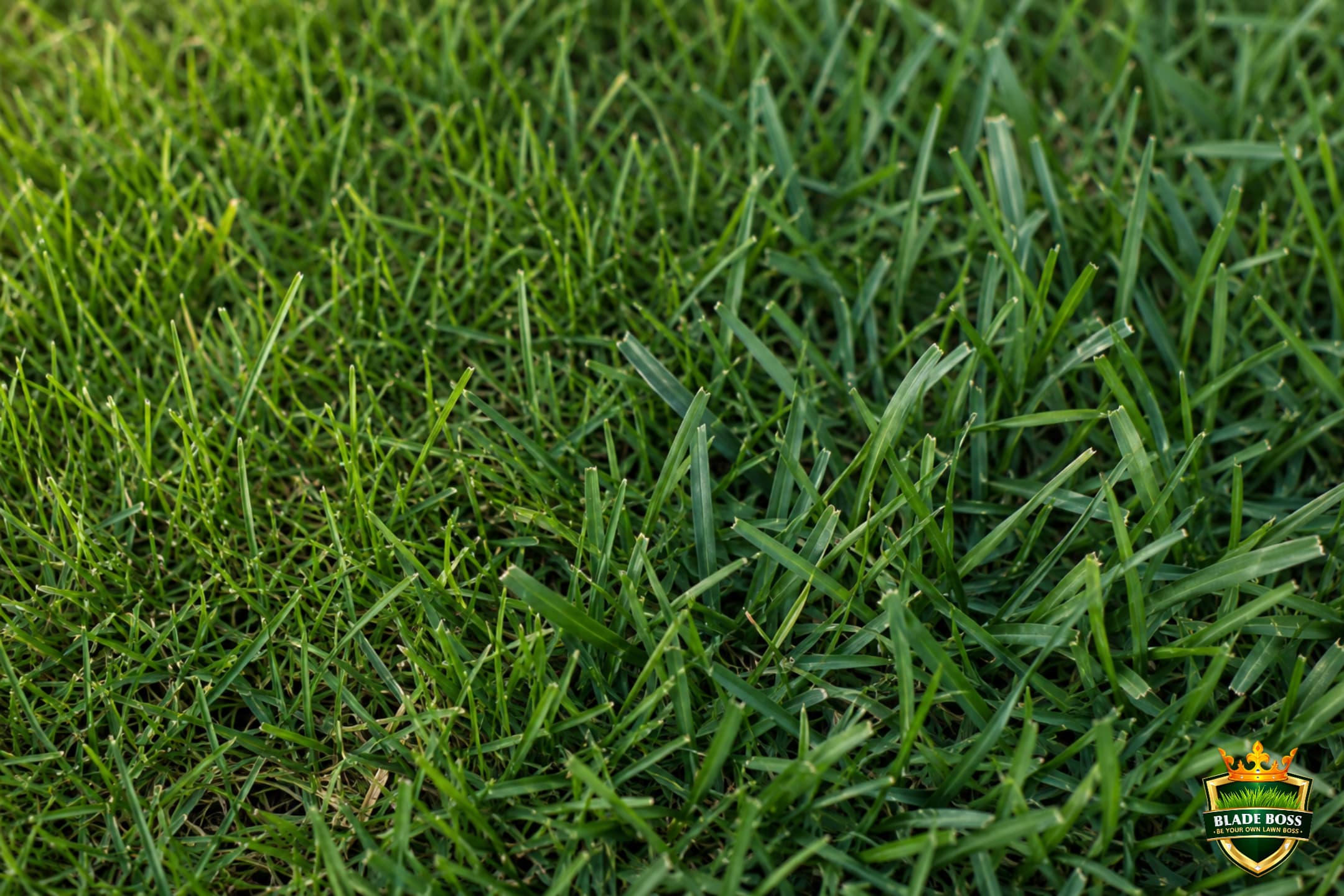
Here is the honest part: most established Long Island lawns are not one grass, they are a blend, often sold that way on purpose (a sun-and-shade mix, or a bluegrass-rye-fescue contractor blend). So do not chase a single perfect answer. Identify the dominant type, the one you see most as you walk the lawn, and note any obvious second player, like fine fescue holding the shady strip along the fence.
Once you know your dominant type, you can actually make decisions instead of guessing: you will set the correct mowing height, buy seed that matches instead of fighting your conditions, water to the type's real needs, and know which diseases to watch for. That one fifteen-minute answer quietly improves every other job on the lawn.
Know Your Type? Match Your Seed in SeedGenius Pro
The whole payoff of identifying your grass is buying seed that actually fits it and your conditions, instead of grabbing a bag that fights your lawn. Tell SeedGenius Pro your grass type, your sun and shade, and your goals, and it matches you to the right seed and the right rate, so an overseed thickens what you have instead of introducing a fifth grass that clashes. Identify here, then match there.
Open SeedGenius Pro →The Grass Identification Reference
Members get the printable four-grass identification chart with every blade and growth signature side by side, the quick-ID decision path, and the what-it-changes table so your type sets your mowing height, water, and seed automatically.
Open this with a free account →Abort Criteria - Common Mistakes
Mission Complete. Now Fly the Plan.
Fifteen minutes of reading blades tells you the one thing every other lawn decision depends on. Find your dominant type, then let it set your mowing height, your water, and your disease watch, and use SeedGenius Pro to match your next seed to what you actually have. Deciding what to plant instead of what you have? Our Long Island grass-type breakdowns cover which cool-season grasses win here and the classic tall fescue versus Kentucky bluegrass call.
Crew Questions - FAQ
What type of grass do I have?
On a cool-season Long Island lawn it is almost certainly one or a blend of four grasses: Kentucky bluegrass, tall fescue, fine fescue, and perennial ryegrass. Identify it by pulling several healthy blades and checking four things: the leaf tip (a boat shape curved like a canoe prow means Kentucky bluegrass), the blade width and edges (wide and rough is tall fescue, needle-thin is fine fescue), the underside (glossy and shiny is perennial ryegrass), and how it grows (spreading and self-repairing is bluegrass, clumping is the others).
How do I identify Kentucky bluegrass?
Two tells. First, the leaf tip is boat-shaped, curving up to a point like the prow of a canoe, which no other common lawn grass has. Second, it spreads by underground runners called rhizomes, so it forms dense sod and slowly fills in its own bare spots over a season. If your lawn quietly heals small damaged areas on its own and the blades have that boat tip, you have Kentucky bluegrass in the mix.
What is the most common grass on Long Island?
Turf-type tall fescue is the workhorse of Long Island lawns because of its deep roots and strong heat, drought, and wear tolerance, which suit our summers and sandy soils. It is frequently blended with Kentucky bluegrass and perennial ryegrass in contractor and retail mixes, so many local lawns are a tall-fescue-dominant blend rather than a single grass. You can identify tall fescue by its wide, coarse blade with rough, serrated edges and prominent veins.
Can my lawn have more than one type of grass?
Almost certainly, yes. Most established cool-season lawns are a deliberate blend, sold as sun-and-shade mixes or bluegrass-rye-fescue contractor blends, because different grasses cover different weaknesses. So rather than hunting for one answer, identify the dominant type you see most across the lawn and note any obvious secondary, such as fine fescue holding a shady strip. The dominant type is enough to set your mowing height, watering, and seed choice correctly.
How do I tell tall fescue from crabgrass?
Timing and habit. Tall fescue is a perennial that grows upright and uniform and is present year-round, with a wide coarse blade. Crabgrass is a summer annual that grows low and spreads flat in a star pattern, thrives in the heat, and then dies completely at the first hard frost. The simplest test: if the patch vanishes in late fall, it was crabgrass, not tall fescue.
Why does it matter what grass type I have?
Because nearly every lawn decision changes by type. Mowing height differs (tall fescue wants 3 to 4 inches, bluegrass and rye run lower), as do water needs, shade tolerance, and which diseases each is prone to. Most importantly, it tells you what seed to buy: overseeding a shady lawn with sun-loving Kentucky bluegrass wastes money, while matching fine fescue to that shade succeeds. Knowing your type turns guesswork into the right call every time.